
TDRec: Mastering Recommendations by Balancing Trust and Distrust
5034_TDRec Enhancing Social Recommendation Using Both Trust and Distrust Information.
The paper introduces TDRec, a novel recommendation framework that integrates Trust and Distrust (TD) relations into Matrix Factorization (MF). By leveraging both positive and negative social ties with a specialized objective function, it achieves State-of-the-Art (SOTA) performance in rating prediction.
TL;DR
TDRec is a social recommendation framework that breaks the tradition of only looking at who users like. By mathematically modeling both Trust and Distrust (TD) through a dual-factor Matrix Factorization approach, it achieves superior accuracy in predicting user ratings, outperforming traditional social-aware models by significant margins (up to 8% in MAE).
The Missing Piece: The Value of Distrust
Most recommendation engines operate on the assumption that "friends share tastes." While true, this ignores a powerful social signal: Distrust. If User A distrusts User B, their preferences are likely divergent. Existing SOTA methods like SoRec or SocialMF primarily focus on the "Trust" manifold. TDRec argues that ignoring the "Distrust" signal leaves half of the social context on the table, leading to blurred user latent vectors.
Methodology: Dual Latent Factors
The core innovation of TDRec lies in how it redefines the user representation. Instead of a single vector, it splits the user influence into two components:
- Trust Factor (): Captures the positive alignment with trusted peers.
- Distrust Factor (): Captures how a user diverges from those they distrust.
The final predicted rating is a weighted combination of these influences:
The Global Objective
The model doesn't just predict ratings; it regularizes the latent space so that the distance between users in the latent space respects the social graph topology.
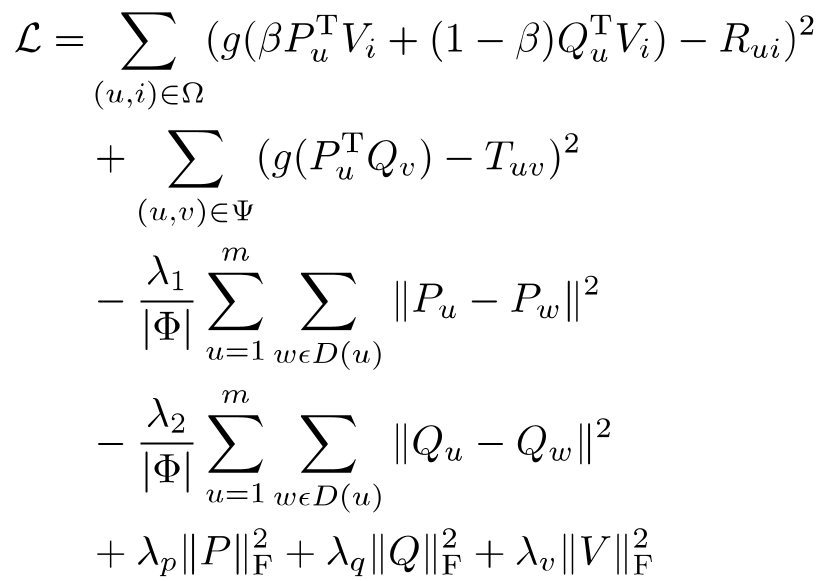 Figure 1: The comprehensive loss function of TDRec, combining rating error, social tie constraints, and regularization.
Experimental Performance
TDRec was tested against several heavyweight baselines, including SoRec, SocialMF, and MF+TD (Matrix Factorization with Triplets).
Quantitative Edge
Across different latent dimensions (), TDRec secured the #1 Rank in both Mean Absolute Error (MAE) and Root Mean Square Error (RMSE).
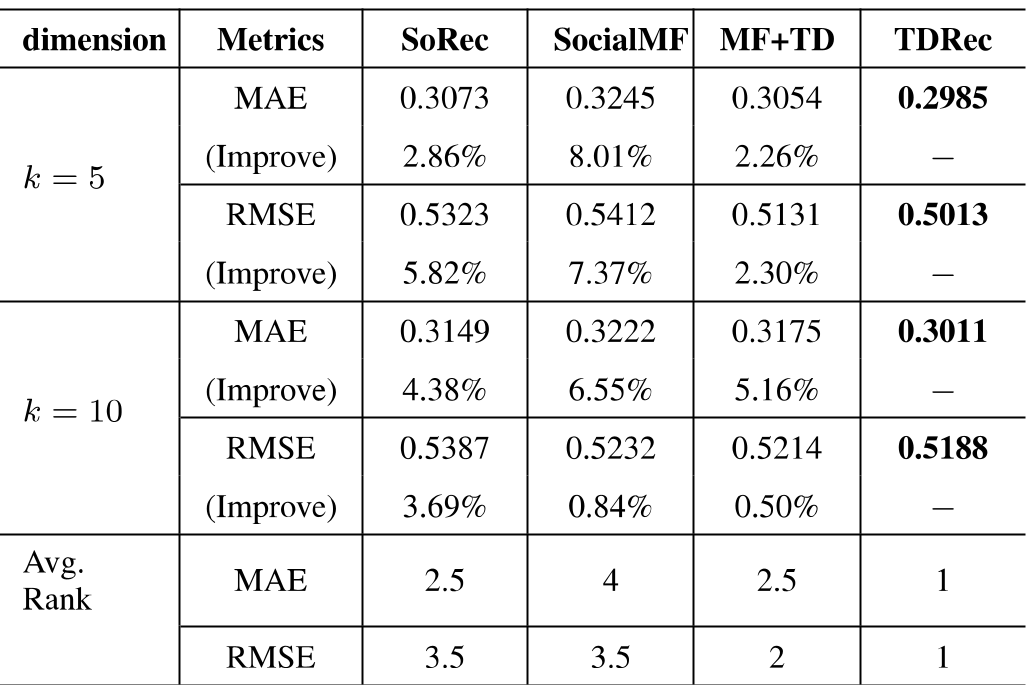 Figure 2: Comparative results showing TDRec's consistent improvement over traditional methods.
Key highlights from the results:
- Dimension : MAE improvement of 8.01% over SocialMF.
- Consistency: Regardless of the sparsity of the data, the dual-factor approach provided a more resilient bottleneck for learning user preferences.
Critical Insight & Conclusion
The success of TDRec (Takeaway) demonstrates that negative social ties are not just "noise" to be filtered—they are structural constraints that help define the boundaries of a user's latent profile. By explicitly modeling (Distrust), the model effectively "pushes" the user factor away from irrelevant or contradictory taste-clusters, resulting in a cleaner, more accurate mapping to the item space ().
Future Outlook: While TDRec uses a traditional MF approach, the logical next step is extending this "Trust-Distrust" duality into Graph Convolutional Networks (GCNs), where message passing can be signed to account for antagonistic relationships in larger social ecosystems.