
Beyond Prediction: Actionable Domain-Driven Data Mining for High-ROI Marketing
5095_Domain driven data mining to improve promotional campaign ROI and select marketing channels.
This paper introduces an actionable knowledge discovery methodology tailored for one-to-one marketing in the building materials retail sector. By integrating Ridge Regression scoring with a ROI-driven optimization framework, the authors successfully improved promotional campaign outcomes for VM Matériaux, identifying 115 new high-value customers.
TL;DR
While many data science projects end with a "probability score," this paper presents a complete end-to-end framework that converts raw data into specific marketing actions. By combining Ridge Regression for customer scoring with a Domain-Driven ROI model, the authors transformed a wholesaler's promotional strategy, resulting in a 5% turnover increase and €1.2M in new revenue.
Academic Positioning: This work is a premier example of Domain-Driven Data Mining (D3M), moving the needle from academic "pattern discovery" to industrial "actionable knowledge."
The "Actionability" Gap
The core pain point identified is that standard data mining often operates in a vacuum. A model might tell you a customer has an 80% chance of buying, but it doesn't tell you:
- The Cost of the Ask: If it costs €250 to send a salesperson (Visit) to a customer expected to spend only €100, the "high probability" is a trap.
- Channel Sensitivity: Some customers respond to SMS; others require a face-to-face visit to be convinced.
- Domain Constraints: Real-world logistics and salesperson bandwidth limit how many "top" customers can actually be reached.
Methodology: The Dual-Scoring Engine
The heart of the paper is a four-step pipeline that marries statistical rigor with business logic.
1. The Strategy of Ridge Regression
The authors utilize Ridge Regression for two distinct targets:
- Binary Target: Identifying the tendency to purchase.
- Continuous Target: Predicting the net margin (monetary value) a customer provides.
Why Ridge? It handles correlated predictors (multicollinearity) better than standard OLS, providing more stable "weights" that experts can interpret to understand which variables (like past turnover or specific salesperson influence) actually drive sales.
2. The ROI and Channel Optimization Model
Instead of just contacting the "top 10%" of buyers, the authors calculate a Customer Profit for each individual using various channel classes :
- : Probability of purchase.
- : Expected net margin.
- : Certainty and Convincement factors (Domain Knowledge).
- : Variable cost of the channel (e.g., Mail vs. Phone).
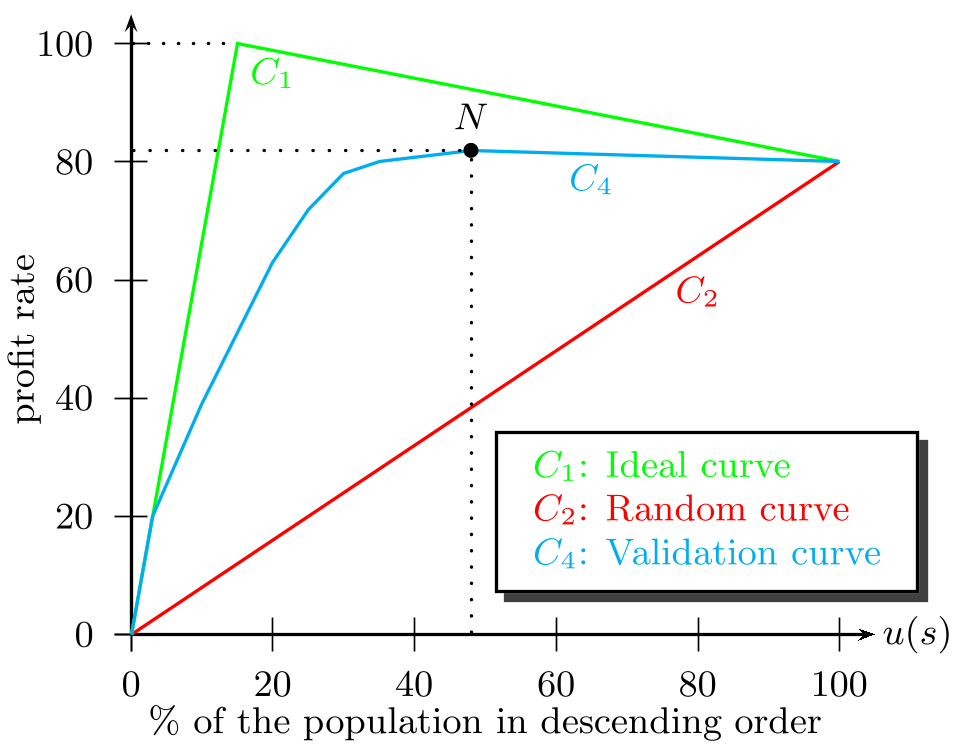 Figure 1: Lift curves demonstrating the model's accuracy (KI) and robustness (KR) compared to random/ideal baselines.
Real-World Application: VM Matériaux
The methodology was tested on an application dataset of 16,500 professional customers.
Feature Engineering (Constraints)
The experts integrated 173 variables across:
- Internal Data: Loyalty, credit limits, and store location.
- External Data: Company size and professional category.
- Aggregates: Six-month turnover trends and product-family margins.
Interpretability and Insight
The model revealed that 35.1% of salespersons actually had a negative influence on campaign participation. This "Loop-closed mining" allowed the company to rebalance salesperson portfolios—an organizational change driven directly by data.
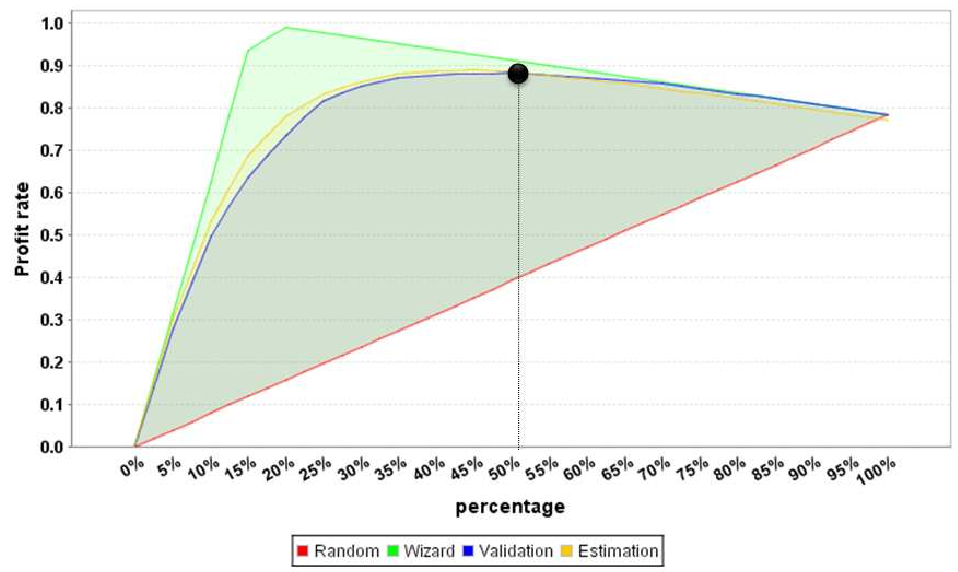 Figure 2: Analysis of salesperson influence, showing how domain entities impact the target variable.
Experimental Results
The "Naive Profit Curve" was used to find the optimal cut-off point. It suggested contacting 50.3% of the population, which would capture 88.1% of the potential profit.
| Metric | Outcome |
|---|---|
| Buyer Response Rate | Increased from 18% to 22% |
| Overall Turnover | +5% |
| New Customers | 115 participants |
| Additional Revenue | €1,200,000 |
Critical Insight & Conclusion
The success of this work isn't just in the Ridge Regression; it’s in the Actionable Knowledge framework. By involving decision-makers in defining "Certainty" (will the message reach them?) and "Convincement" (will they care?), the data miners transformed a black-box model into a surgical tool for ROI.
Limitation: The current model uses a simplified "max" function for channel interactions, ignoring the potential synergistic effects of seeing an ad (Fax) and then receiving a visit. Future work on attribution modeling would further refine these results.
Takeaway: Data mining is a business process, not just a computational one. ROI-driven selection is the bridge that turns "interesting patterns" into "profitable actions."