
Stochastic ED: Leveraging Markovian Intelligience to Optimize Wind-Heavy Power Grids
5155_Stochastic Optimization-Based Economic Dispatch and Interruptible Load Management With Increased Wind Penetration.
This paper proposes a stochastic optimization framework for Economic Dispatch (ED) and interruptible load management to handle high wind power penetration. It utilizes a novel Markov chain-based distributional forecast model that accounts for diurnal nonstationarity and seasonality, achieving SOTA performance in reducing system operating costs.
TL;DR
As wind penetration increases, the grid faces a paradox: more free energy creates higher "insurance" costs (reserves). This paper introduces a Stochastic Economic Dispatch (ED) framework that uses Markov Chain-based distributional forecasts and Interruptible Load Management to slash these costs. By predicting the probability distribution of wind instead of a single point, the model balances grid reliability with economic efficiency, outperforming traditional robust and deterministic methods.
Background: The Uncertainty Paradox
In modern power systems, wind generation is notoriously "nondispatchable." While load forecasts typically have a 1-3% error, wind forecasts can suffer from 15-20% inaccuracy.
The industry's current reaction is often binary:
- Over-conservative (Robust Optimization): Scheduling based on the "worst-case," which wastes money on unnecessary reserves.
- Over-optimistic (Deterministic/Persistence): Assuming wind will stay the same, leading to expensive emergency interventions when wind drops.
The authors' insight? Temporal correlation matters. Wind doesn't jump randomly; its next state is highly dependent on its current state and the specific time of day/season.
Methodology: The Core Innovations
1. The Markovian Distributional Forecast
Instead of a single "best guess," the authors generate a probability distribution of where wind generation will be in the next 10 minutes.
- Nonstationarity: They don't use the same model for the whole year. They build unique Markov chains for every 3-hour epoch and every month to account for diurnal and seasonal patterns.
- State Space Design: Using the Level Crossing Rate (LCR), they intelligently divide the wind generation range into states, ensuring the "average duration" in each state is physically meaningful.
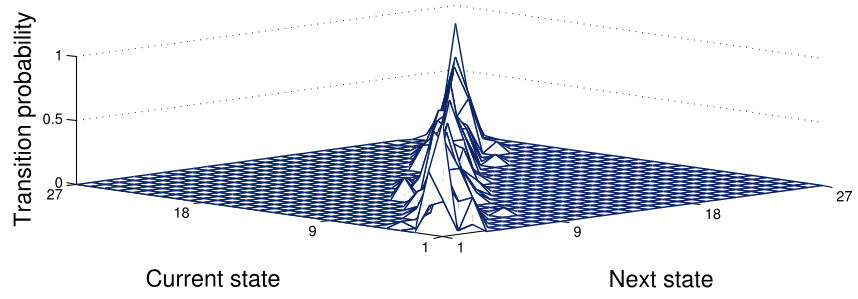 Figure: The sparse nature of the transition matrix shows that wind usually moves to neighboring states, allowing the stochastic optimizer to focus only on a few likely scenarios.
2. Joint Stochastic Optimization
The Economic Dispatch problem (P1) is formulated to minimize:
A key technical feature here is the use of Interruptible Load. Instead of always firing up expensive spinning reserves when wind drops, the system can "interrupt" specific industrial customers (based on pre-set contracts), which acts as a cheaper, high-speed reserve.
Experimental Validation
Using real-world wind data and the IEEE Reliability Test System-1996, the authors compared their model against four baselines.
Performance Gains
The results prove that the Markov-based Stochastic ED (P1) is the most efficient. As wind penetration grows, the advantage of P1 becomes even more pronounced.
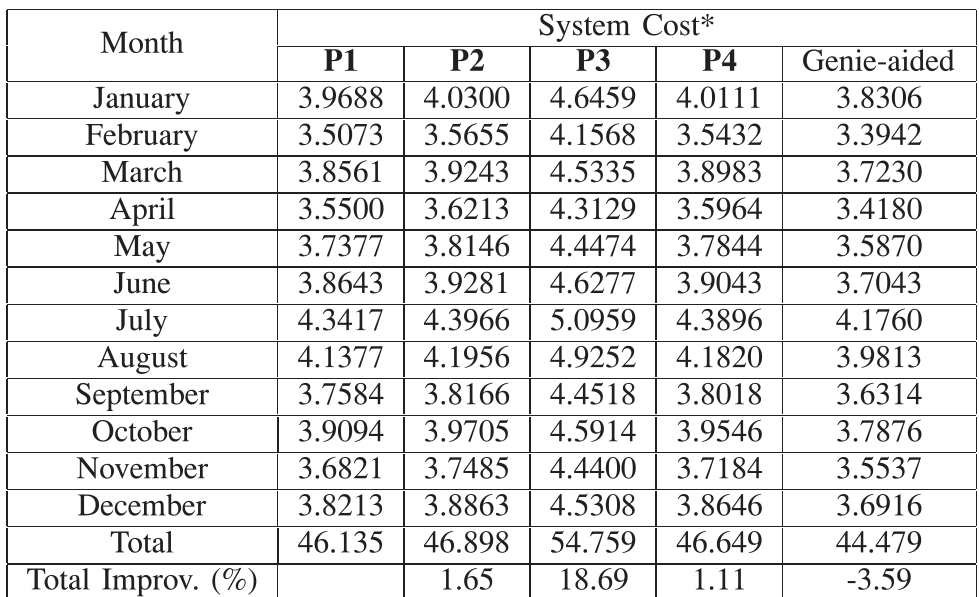 Table: At high wind penetration, P1 achieves an 18.69% improvement over persistence models. Crucially, it is significantly cheaper than Robust ED (P2), which is too conservative.
The "Worst-Case" Myth
The paper highlights a critical finding: Robust Optimization (P2) focuses so much on the worst-case scenario that it constantly over-schedules conventional coal/gas units, leading to higher baseline costs. The Stochastic model (P1) uses the full probability distribution to find a "sweet spot" that minimizes expected costs while maintaining reliability.
Critical Analysis & Takeaways
- Accuracy over Conservatism: Accurate distributional forecasting is a "force multiplier." It allows operators to move away from rigid worst-case planning toward flexible, risk-aware scheduling.
- Demand-Side Flexibility: The study proves that interruptible loads are not just for emergencies; they are essential tool for day-to-day renewable integration.
- Limitations: The model currently assumes fixed interruptible load contracts. Future iterations should explore Real-Time Pricing (RTP) to see if dynamic demand response can further optimize the grid's "self-healing" capabilities.
Conclusion
This work provides a rigorous bridge between statistical data analytics and power system operations. By transforming historical wind data into actionable Markovian insights, the authors offer a blueprint for a more resilient, low-carbon grid.