
TOSS: Harmonizing Online Social Circles and Offline Mobility for Massive Traffic Offloading
520_Mobile traffic offloading by exploiting social net
The paper proposes TOSS (Traffic Offloading assisted by SNSs), a novel framework that integrates Online Social Networks (SNS) and Offline Mobile Social Networks (MSN) to offload cellular traffic. By leveraging Device-to-Device (D2D) sharing and predicting user access delays, TOSS achieves a SOTA-level traffic reduction of 63.8% to 86.5%.
TL;DR
The TOSS framework addresses the mobile data explosion by treating users not just as signal receivers, but as social entities. By combining Online Spreading Impact (who influences whom on SNS) with Offline Mobility (who meets whom in person), TOSS achieves a staggering 63.8% to 86.5% reduction in cellular traffic using opportunistic D2D sharing.
The Motivation: Why Your Social Life Matters to the Network
Traditional mobile network offloading sees the world as a set of physical coordinates. However, the authors argue that content consumption is driven by "word-of-mouth" propagation. Existing methods have two fatal flaws:
- Blind Seeding: They pick "seeds" based on mobility alone, ignoring who actually has the influence to trigger reshares.
- Ignoring Patience: They assume everyone wants content now, whereas human lifestyles dictate different Access Delays (some check their phones every 5 minutes, others every 5 hours).
Methodology: The TOSS Architecture
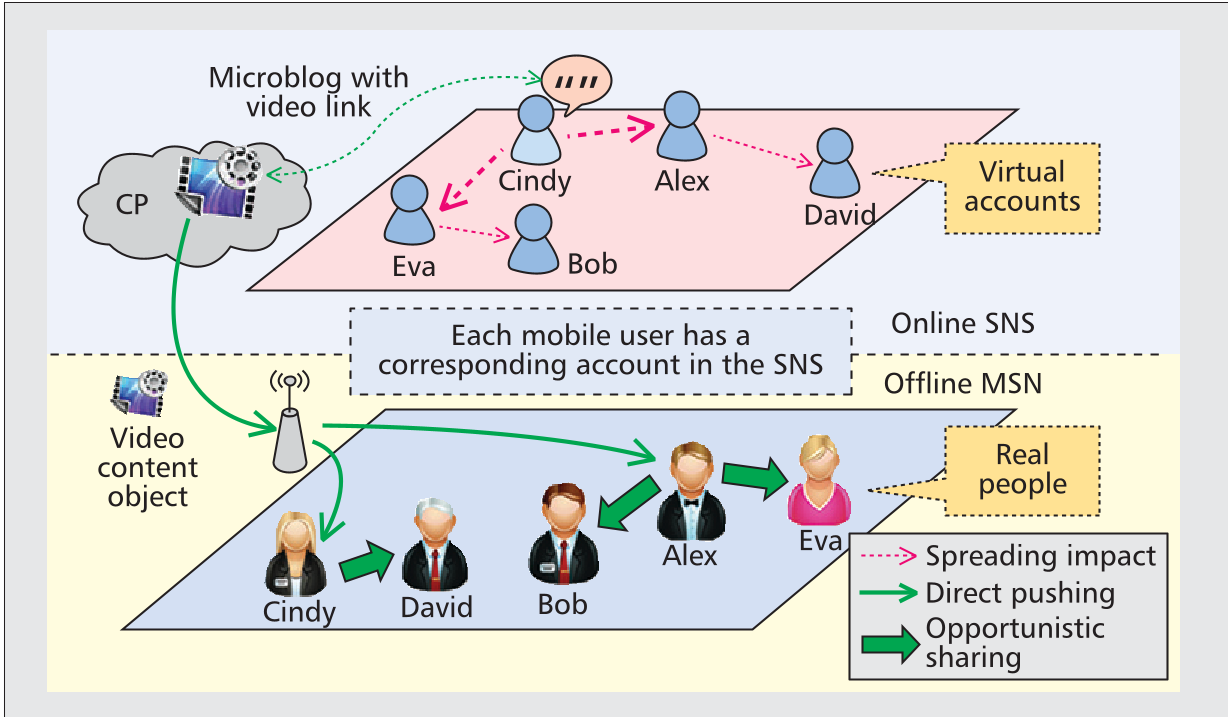
TOSS bridges the gap between the virtual and the physical through three key metrics:
- Mobility Impact (): Calculated from inter-contact rates () derived from real-world traces (like MIT and Infocom). It measures a user's potential to "infect" others via local links like WiFi Direct.
- Spreading Impact (): Uses probabilistic models to quantify how likely a user is to influence their followers to reshare content.
- Access Delay Sensitivity: This is the "secret sauce." Using a Weibull Distribution, the authors model the probability that a user will access content at a specific time. If D2D sharing can get the file to the device before the user's predicted access time, the cellular network stays silent.
The Seeding Strategy
Instead of random pushing, TOSS uses a Heuristic Hill-Climbing Algorithm () to select the optimal set of seeds. It balances the "influence" of a user online with their "reachability" offline.
Experiments: Real-World Trace Validation
The authors tested TOSS against four distinct mobility environments:
- MIT & Infocom: High-density, high-contact environments.
- Beijing & SUVnet: Large-scale, vehicle-based mobility with lower contact frequency.
Key Results
- Massive Reduction: Average traffic offloading reached up to 86.5% in high-contact scenarios.
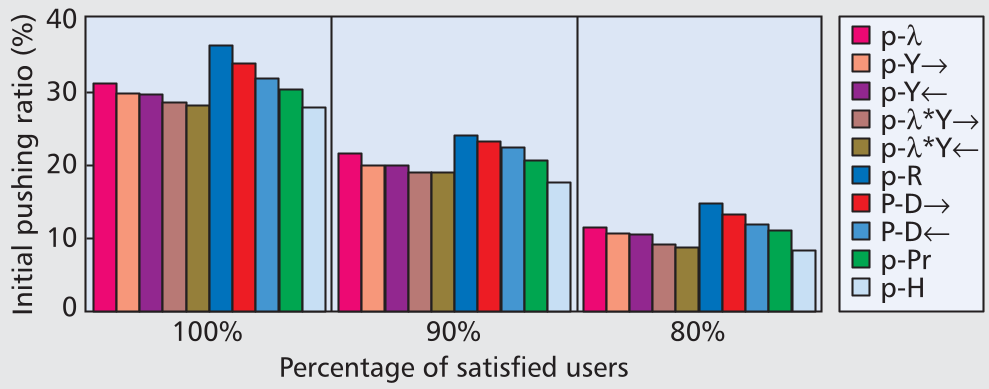
- Efficiency: To satisfy 90% of users, TOSS only needs to "push" content to about 10-15% of the total user base via cellular links. The rest is handled for "free" by the users themselves.
Critical Analysis & Professional Insight
The brilliance of TOSS lies in its Inductive Bias: it assumes that virtual social bonds are strong indicators of physical proximity and shared interests (Homophily).
However, two challenges remain:
- Privacy: Mapping a user's virtual SNS identity to their physical MAC address requires deep integration between Mobile Network Operators (MNOs) and SNS providers (like Meta or Twitter), raising significant privacy concerns.
- Incentives: Why should a user's phone use its battery to share a video with a stranger? Future work must integrate Blockchain or Token-based incentive mechanisms to reward the "seeds."
Conclusion
TOSS represents a shift from "Pipe-Centric" to "Content-Centric" and "Social-Aware" networking. By exploiting the inherent delays in human behavior and the power of social networks, it provides a blueprint for sustainable mobile data growth in the 5G/6G era.