
SybilGuard: Taming the Sybil Multitude through Social Topology
5204_SybilGuard defending against sybil attacks via social networks.
This paper introduces SybilGuard, a decentralized protocol designed to limit Sybil attacks in P2P systems by leveraging social network topologies. By utilizing verifiable random walks (random routes), it bounds the number of accepted fake identities based on the number of trust relationships (attack edges) between honest and malicious users.
TL;DR
SybilGuard is a seminal decentralized protocol that uses social network "trust graphs" to prevent malicious users from subverting distributed systems with infinite fake identities. By utilizing a unique "random route" mechanism, it ensures that the number of fake nodes an attacker can successfully insert is strictly bounded by the number of real-world "friends" they have among honest users.
The Core Challenge: The Sybil Vulnerability
In any decentralized system—be it a P2P file-sharing network or a Byzantine-tolerant ledger—the fundamental assumption is that a majority of participating nodes are honest. The Sybil Attack shatters this assumption. An adversary can cheaply spawn thousands of virtual nodes, "out-voting" honest participants in collaborative tasks like routing, spam filtering, or consensus.
Traditional defenses are fundamentally flawed:
- IP-address binding: Failed by botnets and IP harvesting.
- Resource Puzzles (Proof-of-Work): Overpowered by adversaries with superior hardware.
- Centralized Verification: Introduces a single point of failure and privacy bottlenecks.
The SybilGuard Insight: Trust as a Bottleneck
SybilGuard's genius lies in its observation of Social Graph Topology. In a network where edges represent real-world human trust:
- Honest Region: Well-connected and "fast-mixing," meaning random walks traverse the region efficiently.
- Sybil Region: Malicious users can create infinite nodes, but they have a disproportionately small number of "attack edges" (trust links) connecting them to the honest region.
This creates a "structural bottleneck." To "pass" as a valid node, a Sybil identity must route its way through these limited attack edges to intersect with the routes of honest nodes.
Methodology: Random Routes and Convergence
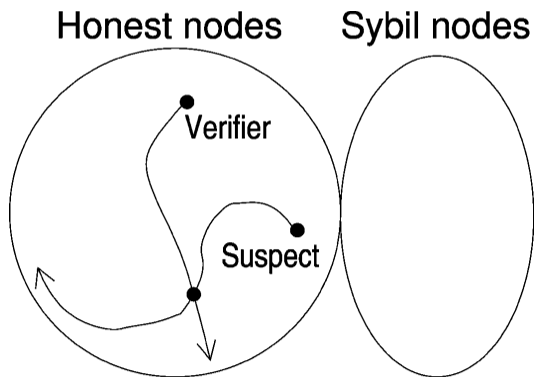
Unlike standard random walks that flip a coin at each hop, SybilGuard uses Random Routes. Each node pre-computes a fixed permutation (a routing table) that maps an incoming edge to a unique outgoing edge.
Why Random Routes?
- Convergence: If two routes ever share an edge in the same direction, they merge completely.
- Back-traceability: A route can be traced backward uniquely.
- Equivalence Groups: Because of the merge property, all Sybil routes passing through a single attack edge will converge at a specific intersection node. The verifier then groups these into a single "Sybil Group," capping the total number of accepted Sybil nodes at (attack edges route length).
Experimental Results
The authors validated SybilGuard using a million-node synthetic small-world graph.
- Scalability: For a node network, a route length () of 2,000 hops is sufficient.
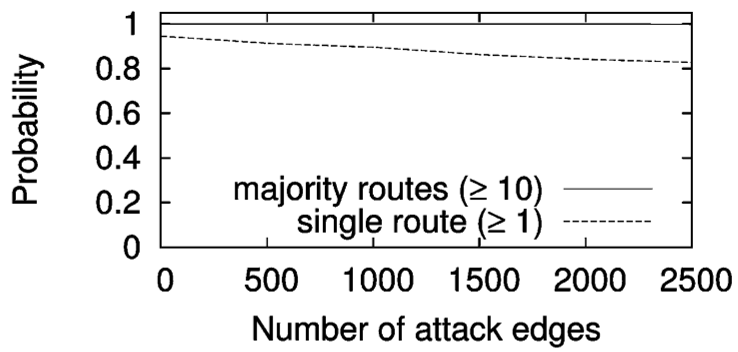
- Robustness: Even with 2,500 attack edges, 99.8% of honest nodes successfully verify each other, while the malicious influence remains strictly bounded.
- Decentralized Estimation: The protocol includes a clever sampling method where nodes perform short 3-hop walks to estimate the required route length for their specific neighborhood.
Critical Analysis & Conclusion
Takeaway
SybilGuard provides a rare provable guarantee in decentralized security: the adversary's power is no longer proportional to their CPU power or bandwidth, but strictly to their "social engineering" capability.
Limitations
- Dynamics: While the paper handles node churn, the overhead of re-propagating registry tables when human-trust links change can be significant.
- Averaging: Nodes geographically "close" to attack edges are more likely to be compromised or have their routes subverted.
- Fast Mixing Requirement: If the social graph is "sparse" or has many "community islands," honest nodes might accidentally reject one another.
Future Outlook
SybilGuard laid the foundation for subsequent protocols like SybilLimit, which further reduced the bound of accepted Sybil nodes. Its legacy persists in modern decentralized identity (DID) frameworks and "web of trust" designs used in contemporary blockchain ecosystems.