
Smart Fall-Down Detection: Beyond Simple Acceleration Thresholds
5213_A new smart fall-down detector for senior healthcare system using inertial microsensors.
This paper presents a smart wearable fall-down detector for senior healthcare that integrates a tri-axial accelerometer and gyroscope with Wi-Fi connectivity. It utilizes a microcontroller-based supervised learning algorithm to distinguish between actual falls and high-acceleration safe motions (e.g., sitting or jumping), achieving linear separability in the feature space.
TL;DR
Researchers have developed a specialized wearable device that uses combined inertial sensors (accelerometer + gyroscope) and supervised machine learning to protect the elderly. Unlike smartphone apps that are prone to noise, this dedicated system learns the user's specific habits to minimize false alarms and uses Wi-Fi to alert caregivers the moment a fall occurs.
The "False Alarm" Bottleneck in Senior Care
Falls are a leading cause of accidental injury among seniors, but the technology to detect them has long been plagued by two issues: availability and accuracy.
- Availability: Seniors often forget their smartphones.
- Accuracy: A sudden drop onto a sofa or a quick jump can trigger the same "G-force" alert as a dangerous fall.
The authors argue that the "why" and "how" of a motion are just as important as the speed. A fall isn't just a spike in acceleration; it is a fundamental shift in orientation that persists after the impact.
Methodology: Fusing Physics with Machine Learning
The system doesn't just look at raw sensor data; it performs sensor fusion. By combining a tri-axial accelerometer and a tri-axial gyroscope, the device tracks the body's position in 3D space.
1. The Hardware Loop
The prototype uses an Atmel microcontroller integrated with a Wi-Fi module, acting as a mini-server. This allows the device to be clipped to a belt and remain independent of a phone.
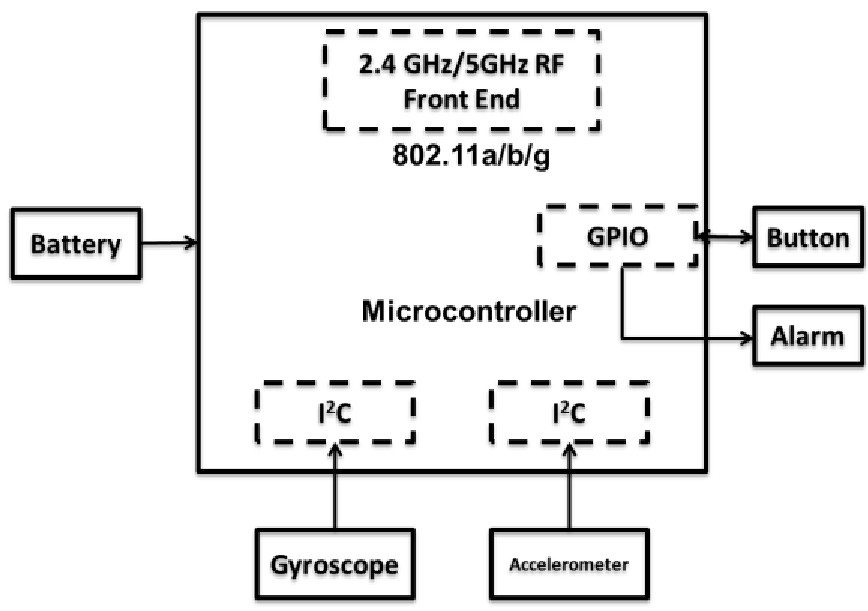 Figure 1: The system diagram highlighting the I2C sensor integration and Wi-Fi communication loop.
2. The Learning Algorithm
The core innovation is the Supervised Learning Flow. If the device detects a suspicious motion, it sounds a local IC alarm. If the senior is fine, they press a button to "clear" it. The system then analyzes that specific motion, extracts its features, and labels it as "Safe." After five such instances, the system builds a personalized profile that ignores these specific types of movements in the future.
Deciphering the "Signature" of a Fall
The study highlights how different motions "look" to the sensors. While walking or running creates rhythmic "triangle waves," a fall creates a sharp "slope" indicating an orientation change accompanied by high-frequency vibration (the hit).
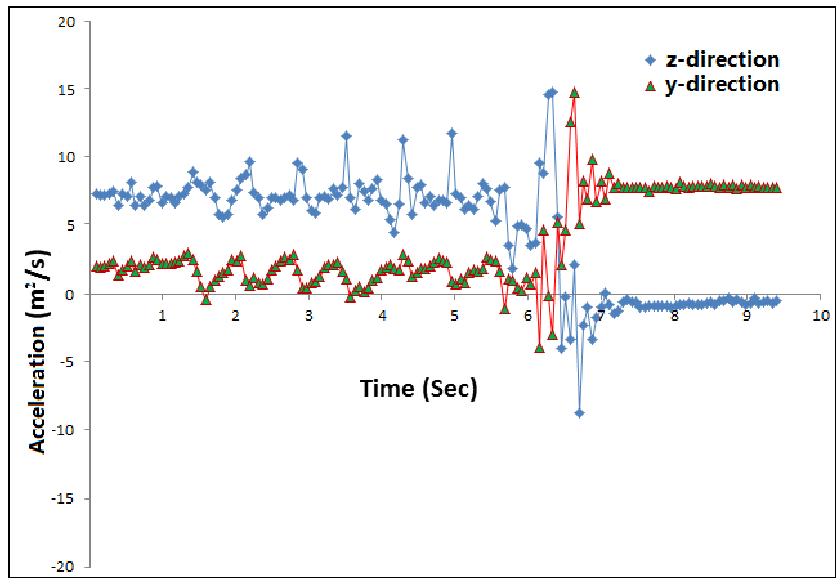 Figure 2: Signal patterns showing the distinct "slope" of an orientation change during a fall while walking.
To quantify this, the authors defined two mathematical variables:
- (Acceleration): Measuring the intensity of the impact.
- (Orientation): Measuring the change in body angle before and after the event.
Results & Linear Separability
The most significant finding is that when plotted on a 2D graph (Acceleration vs. Rotation), falls and safe motions (like sitting down or jumping) fall into two distinct groups. This linear separability means that a simple, low-power algorithm can effectively distinguish life-threatening falls from everyday activities without needing massive computational resources.
Critical Insight & Future Outlook
This work excels by moving the intelligence to the "Edge." By incorporating a manual feedback loop (the button), it addresses the Inductive Bias problem—where a general model fails to account for an individual's unique movement patterns.
Limitations: The current prototype is breadboard-based and relies on Wi-Fi, which limits range to the home environment. Transitioning to BLE (Bluetooth Low Energy) or LTE-M would be necessary for outdoor mobility. Furthermore, the 10-second window for feature extraction is robust but introduces a slight delay in alarm transmission.
Conclusion: As our population ages, "Smart Healthcare" must become invisible yet vigilant. This research takes a pragmatic step by proving that high-accuracy fall detection doesn't require complex deep learning; it requires the right physical features and a personalized touch.