
SD-FCCM: Balancing Economic Boom and Green Mandates in Poly-Silicon Production
5218_Simulation and Optimization of One Low-Carbon Poly-Silicon Industry Production Chains Using SD-FCCM in World Natural and Cultural Heritage Areas A Cas
This paper introduces the SD-FCCM (System Dynamics - Fuzzy Chance-Constrained Model), a hybrid framework designed to optimize the poly-silicon industrial chain in Leshan, China. By coupling dynamic simulation with fuzzy multi-objective programming, it achieves a strategic balance between maximizing economic output and minimizing carbon intensity in a high-energy manufacturing sector.
TL;DR
The poly-silicon industry sits at the heart of the global transition to solar energy, yet its production is notoriously "dirty" and energy-intensive. This paper proposes a sophisticated SD-FCCM framework that uses System Dynamics to simulate industrial feedback loops and Fuzzy Chance-Constrained Modeling to optimize production ratios under uncertainty. Applied to Leshan, China, the model demonstrates that industrial chain extension—specifically recycling toxic waste like —can nearly double economic output while cutting carbon intensity by over 50%.
Problem & Motivation: The Green Paradox
Poly-silicon is the lifeblood of solar PV cells, but its birth is a trial by fire. The production process involves massive coal-dependent electricity consumption and the generation of , a suffocating, poisonous liquid.
The authors identify a critical "Limits to Growth" tension:
- Positive Feedback: Investment drives production, which generates economic benefit, driving further investment.
- Negative Feedback: Increased production leads to pollution and energy spikes, triggering restrictive environmental policies that stifle the industry.
Current research often ignores the temporal dynamics (how the chain evolves over a decade) and the uncertainty of energy data. The goal here is to find the "sweet spot" where the economy thrives without violating the environmental sanctity of heritage areas like Leshan.
Methodology: Coupling Simulation with Optimization
The core innovation lies in the SD-FMOP (System Dynamics - Fuzzy Multi-Objective Programming) architecture.
1. System Dynamics (SD) Component
The SD model maps the flow from silicon mining to final products (solar lamps, IC devices). It uses differential equations to describe how stocks of materials change over time based on "Rate" parameters.
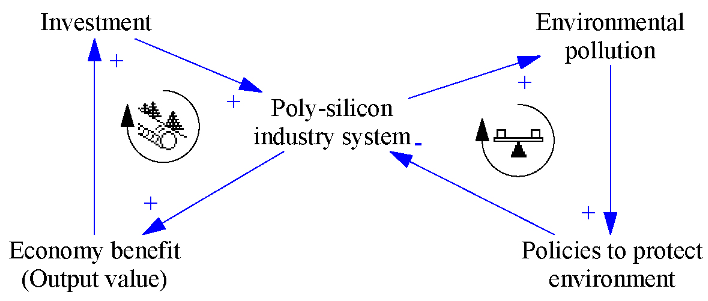 Figure: The feedback relationship between economic stimulus and environmental constraints.
2. Fuzzy Multi-Objective optimization
Since energy consumption coefficients () fluctuate due to tech shifts, they are treated as Triangular Fuzzy Numbers. The model pursues two conflicting goals:
- Max : Total Output Value.
- Min : Total Energy Consumption.
The authors use a Geometric Mean method to weigh expert opinions, eventually arriving at a balanced weight ( for economy, for environment).
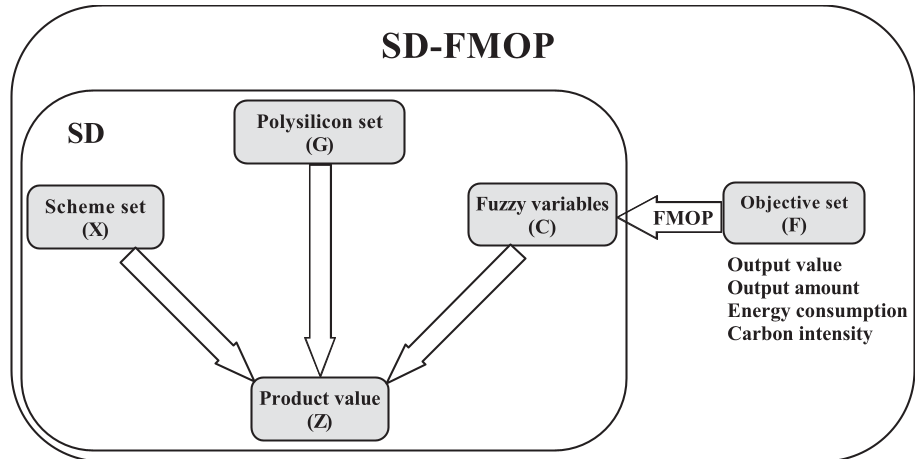 Figure: The structural flow of the SD-FMOP modeling process.
Experiments & Results: The "Leshan" Case Study
The model was tested using data from Leshan, a city balancing a 40-year industrial history with its status as a World Heritage site.
Key Findings:
- Carbon Intensity: In the optimized "Program 3," carbon intensity drops from 4.74 to 2.15. The current (non-optimized) trajectory would only reach 3.0.
- The Power of Recycling: By increasing the recycling ratio of to ~85%, the industry transforms a liability into assets like white carbon black and ethyl silicate.
- Product Shift: The simulation suggests that IC electronic devices are currently too energy-hungry for the region. In contrast, solar cells and white carbon black are "priority advantages" that should see production increases.
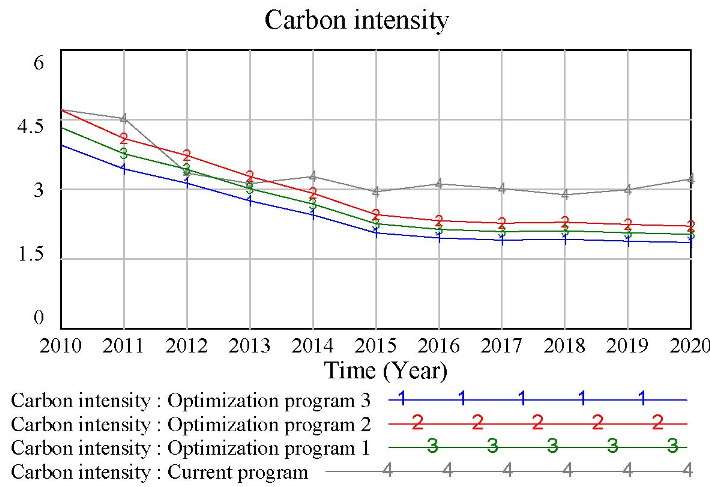 Figure: Comparison of Carbon Intensity between optimization schemes and the current baseline.
Critical Insight & Conclusion
The study proves that "Low-Carbon" doesn't mean "Low-Growth." The breakthrough comes from Chain Extension. By viewing toxic by-products not as waste to be treated, but as raw materials for secondary industrial chains, the industry can decouple economic growth from environmental degradation.
Limitations: The model currently ignores the recycling of waste heat and the low market share of fiber products, which could further optimize the "Energy" objective if included in future iterations.
Final Takeaway: For decision-makers in heavy industry, the SD-FCCM framework provides a "mathematical lens" to see through the fog of data uncertainty, allowing for policies that are both scientifically backed and environmentally responsible.