
C3PO: Redefining Social Interaction through Spontaneous and Ephemeral Networks
525_C3PO A Spontaneous and Ephemeral Social Networking Framework for a Collaborative Creation and Publishing of Multimedia Contents.
This paper introduces C3PO, a framework for Spontaneous and Ephemeral Social Networks (SESNs). It enables mobile users to collaboratively create and publish multimedia content during localized events (e.g., marathons) using a decentralized, peer-to-peer architecture that operates without relying on permanent Internet connectivity.
TL;DR
The C3PO framework introduces Spontaneous and Ephemeral Social Networks (SESNs)—a decentralized approach to social networking designed for specific events (like marathons or festivals). Unlike Facebook or Twitter, C3PO works without a central server by leveraging the mobile devices of attendees to create a "pop-up" network for collaborative micro-journalism, ensuring data privacy and local relevance.
Background & Motivation: The Limits of Centralized Social Media
Current Online Social Networks (OSNs) are built on a "permanent" model. They assume you want to talk to people you already know, through servers owned by corporations, using an internet connection that must always be active.
The authors point out three critical failures in this model for live events:
- Ownership & Privacy: Users lose control of their data to OSN operators.
- Connectivity Barriers: Large events often saturate cellular networks, rendering OSNs useless.
- Collaborative Gap: There are no tools for strangers at an event to "co-edit" a collective story of the experience in real-time.
C3PO tackles these by shifting the focus from the Social Graph (who you know) to the Event Space (where you are and what is happening).
Methodology: The Anatomy of a Spontaneous Network
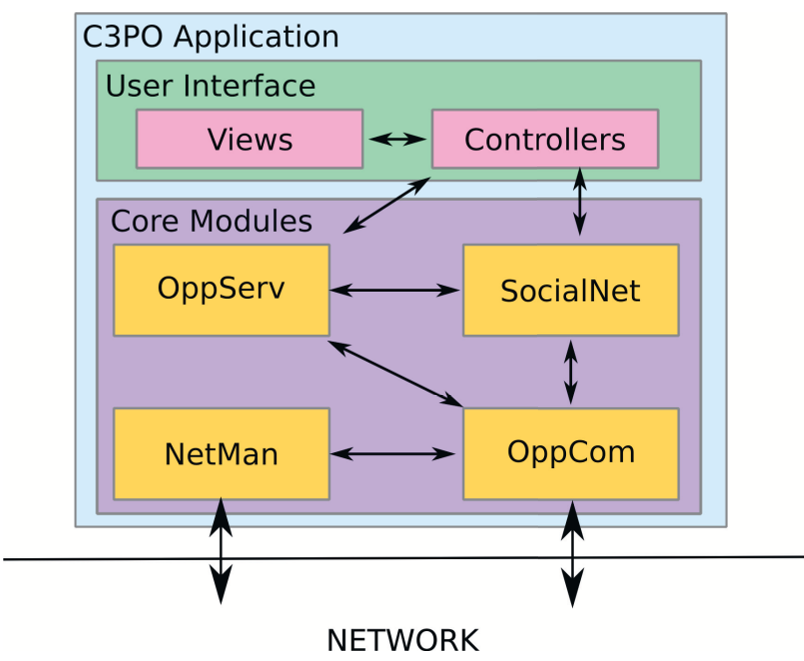
The C3PO framework is built on a modular 4-tier architecture designed to handle the "chaos" of mobile environments:
- NetMan & OppCom: These layers handle device discovery and the "Store, Carry, and Forward" mechanism. If User A is near User B, they swap data. If User B later moves near User C, the data travels across the crowd like a virus—no cell tower required.
- OppServ: A service discovery layer. Need an "automatic bib number recognition" service for your marathon photos? OppServ finds a nearby device with the CPU power to run it.
- SocialNet: The specific logic for "likes," comments, and multimedia reports.
The Content Lifecycle
Content in C3PO is designed to be ephemeral yet valuable. It uses a push principle similar to Twitter, but since users don't have "followers" in a spontaneous group, the system uses Content Recommendation to filter the noise.
- Activity Traces: How long did people look at this post?
- Popularity: How many times was it forwarded?
- Tags: Digital "likes" that boost a post's visibility to new people entering the network.
Real-World Application: The Marathon Scenario
Imagine a marathon where runners, spectators, and journalists are all nodes in the SESN:
- Runners: Automatically broadcast their position and receive audio updates about their competitors.
- Spectators: Capture photos, use "bib recognition" services provided by the organizer, and earn "tips" (virtual currency) for high-quality posts.
- Journalists: Access the "crowd-sourced" feed to find unique angles for their professional reports.
The "ephemeral" nature means the network exists only for the race. Once the marathon ends, the network dissolves, and the most "liked" content is uploaded to a permanent archive on the organizer's website.
Key Insights & Experimental Findings
The research highlights that the success of a SESN relies heavily on the Incentive Mechanism. Users aren't naturally inclined to share data if it drains their battery. C3PO proposes:
- Extrinsic Rewards: Virtual "purses" that can be traded for physical goodies (e.g., sponsor merchandise).
- Intrinsic Motivation: Recognition through "top story" rankings.
The architecture addresses Information Quality through three dimensions: Relevance (is it about the event?), Timeliness (is it happening now?), and Quantity (avoiding information overload).
Critical Analysis & Conclusion
C3PO represents a significant step toward Participatory Micro-Journalism. By removing the middleman (centralized servers), it empowers local communities to tell their own stories.
Limitations:
- Battery Consumption: Continuous Wi-Fi/Bluetooth scanning and P2P data transfer are energy-intensive.
- Critical Mass: The network requires a certain density of users to ensure "opportunistic" connections don't time out.
Future Work: The authors plan to move beyond the Android-based proof-of-concept to real-world pilot tests at sport events, focusing on refining the recommendation algorithms to handle thousands of concurrent users.
Takeaway: SESNs are the future of localized digital interaction, proving that the most relevant social network isn't the one you're always on, but the one that exists exactly when and where you are.