
Not All Trips are Equal: Decoding City Visitors through LBSN Data
5328_Not All Trips are Equal Analyzing Foursquare Check-ins of Trips and City Visitors.
This paper presents a comprehensive analysis of user mobility using Foursquare check-in data to differentiate between long-term and short-term visitors in cities like Singapore and Jakarta. By categorizing trips based on duration using Gaussian Mixture Modeling (GMM), the authors demonstrate distinct behavioral patterns and develop a visitor-type-aware venue prediction model using Kernel Density Estimation (KDE).
TL;DR
This research moves beyond treating all city visitors as a single "tourist" category. By analyzing Foursquare data from Singapore and Jakarta, the authors distinguish between long-term and short-term visitors based on trip duration. They reveal that short-term visitors are "intensity-driven," focusing on hotspots, while long-term visitors mirror local behavior. Crucially, they prove that visitor-type-aware models can double the accuracy of venue predictions for short-term travelers.
Problem & Motivation: The Hidden Heterogeneity of Visitors
Why do some tourists spend three days at a theme park while others spend three weeks exploring suburban cafes? Historically, city planners used expensive surveys to understand these patterns, but surveys lack the "where" and "when" precision of digital footprints.
The authors argue that current Location-Based Social Networks (LBSN) research often ignores the temporal context of the trip. A middle-ground exists between the "Local" and the "Casual Tourist." By understanding the duration of a trip, we can better predict where a user will go next.
Methodology: Categorizing Trips and Visitors
The researchers developed a robust way to estimate trip duration using "crossing times"—the midpoint between a check-in at home and the first check-in in the target city.
- Trip Extraction: Segments of check-ins outside the user's home city.
- GMM Clustering: Using Gaussian Mixture Modeling to find the natural "break point" between long and short stays (e.g., ~9.9 days for Singapore).
- KDE Modeling: A Kernel Density Estimation model was built using three components:
- Personal History: Where has this user been?
- Social Influence: Where have their friends been?
- Type Background: Where do other visitors of the same type go?
 Figure 1: Conceptual framework for analyzing check-ins based on trip duration.
Key Insights: How Visitor Types Differ
The empirical analysis yielded three major clinical observations:
1. The "Locals-Lite" Phenonmenon
Long-term visitors behave more like locals. Their Jensen-Shannon divergence scores for venue categories (Food, Shop, Nightlife) were significantly closer to residents than to short-term visitors.
2. Check-in Intensity
Short-term visitors have a much higher "check-in density." They squeeze more activities into a smaller window, leading to smaller time gaps between consecutive check-ins, likely driven by a "utility maximization" mindset.
3. Popularity Bias
Short-term visitors gravitate toward high-popularity venues (casinos, airports, monuments). Long-term visitors, having more time, venture "off the beaten path," evidenced by their lower CCDF curves in popularity metrics.
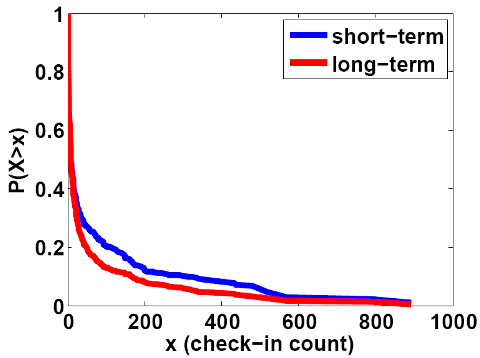 Figure 2: Short-term visitors (blue) show a higher probability of visiting extremely popular venues compared to long-term visitors (red).
Experimental Results: The Power of Stratification
The core of the paper’s contribution lies in its Venue Prediction Experiment. By comparing a "Type-Aware" setting (Model A) vs. a "Type-Blind" setting (Model B), the results were striking:
- For Short-Term Visitors: Knowing the visitor type and using a type-specific background component increased MAP by 56% in Singapore.
- For Long-Term Visitors: The gain was negligible. Why? Because long-term visitors provide enough personal history for the KDE model to learn their preferences without needing the "visitor type" crutch.
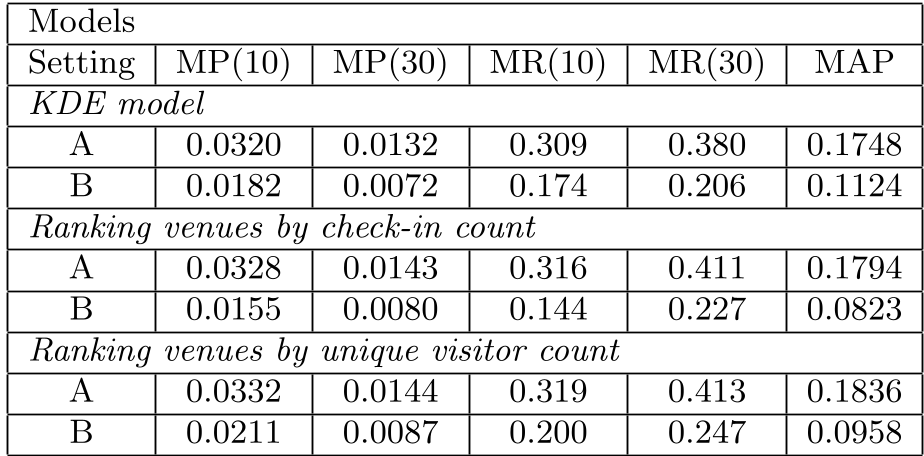 Table: Comparison of prediction accuracy (MAP, Recall, Precision) across different settings.
Critical Analysis & Future Outlook
The study highlights that context is king. Simple popularity-based ranking actually outperformed sophisticated KDE models for short-term visitors because these users have "cold-start" histories—too few check-ins to build a personalized profile.
Limitations: The data is rooted in Foursquare (Twitter-crawled), which may carry a selection bias toward "tech-savvy" or "extroverted" travelers.
Future Work: The authors suggest moving toward Dynamic Prediction. Imagine a system that estimates your "remaining trip time" in real-time and shifts recommendations from "must-see icons" (start of trip) to "souvenir shops/airports" (end of trip) as your departure approaches.