
mlALCR: Decoding the "Silent Influencers" Across Multilayer Social Networks
5386_Identifying Users With Alternate Behaviors of Lurking and Active Participation in Multilayer Social Networks.
The paper introduces mlALCR (Multilayer Alternate Lurker-Contributor Ranking), the first ranking framework designed to identify users who exhibit opposite behaviors—active participation (contributor) and silent consumption (lurker)—across different layers of a multilayer social network. Evaluated on four real-world datasets, the method successfully captures the cross-layer behavioral transitions that single-layer models overlook.
TL;DR
Most social network analysis assumes you are either a leader or a follower. mlALCR (Multilayer Alternate Lurker-Contributor Ranking) shatters this binary by proving that the most interesting users are those who switch roles: they might be "lurkers" (silent consumers) on a technical site like StackOverflow while acting as "contributors" (active producers) on Twitter. This paper provides the first mathematical framework to rank these "cross-layer" chameleons.
The Motivation: Why "Lurkers" Matter
In any Online Social Network (OSN), the population follows a power law: a tiny fraction produces content, and the vast majority—the lurkers—simply consume it.
Traditional research treats lurking as a "lesser" behavior. However, the authors argue that lurking is a strategic information acquisition phase. In a multilayer world, a user might "lurk" on GitHub to learn a new skill and then "contribute" that knowledge on Twitter. Current SOTA (State-of-The-Art) methods like PageRank or even Multiplex PageRank fail to catch this because they look for consistency across layers. If you are a lurker everywhere, you rank high as a lurker; if you are a contributor everywhere, you rank as an influencer. But what if you are both?
Methodology: The Logic of Alternation
The core innovation of mlALCR is its mutually reinforcing duality. It doesn't calculate roles in isolation. Instead, it defines a user’s importance based on two principles:
- Cross-layer Lurker Behavior: Your score as a lurker in Layer A increases if you are a strong contributor in Layer B.
- Cross-layer Contributor Behavior: Your score as a contributor in Layer A increases if you are a prominent lurker in Layer B.
This is implemented through a system of dependent equations solved via power iteration. The algorithm looks for the Inductive Bias of information flow—where consumption in one context fuels production in another.
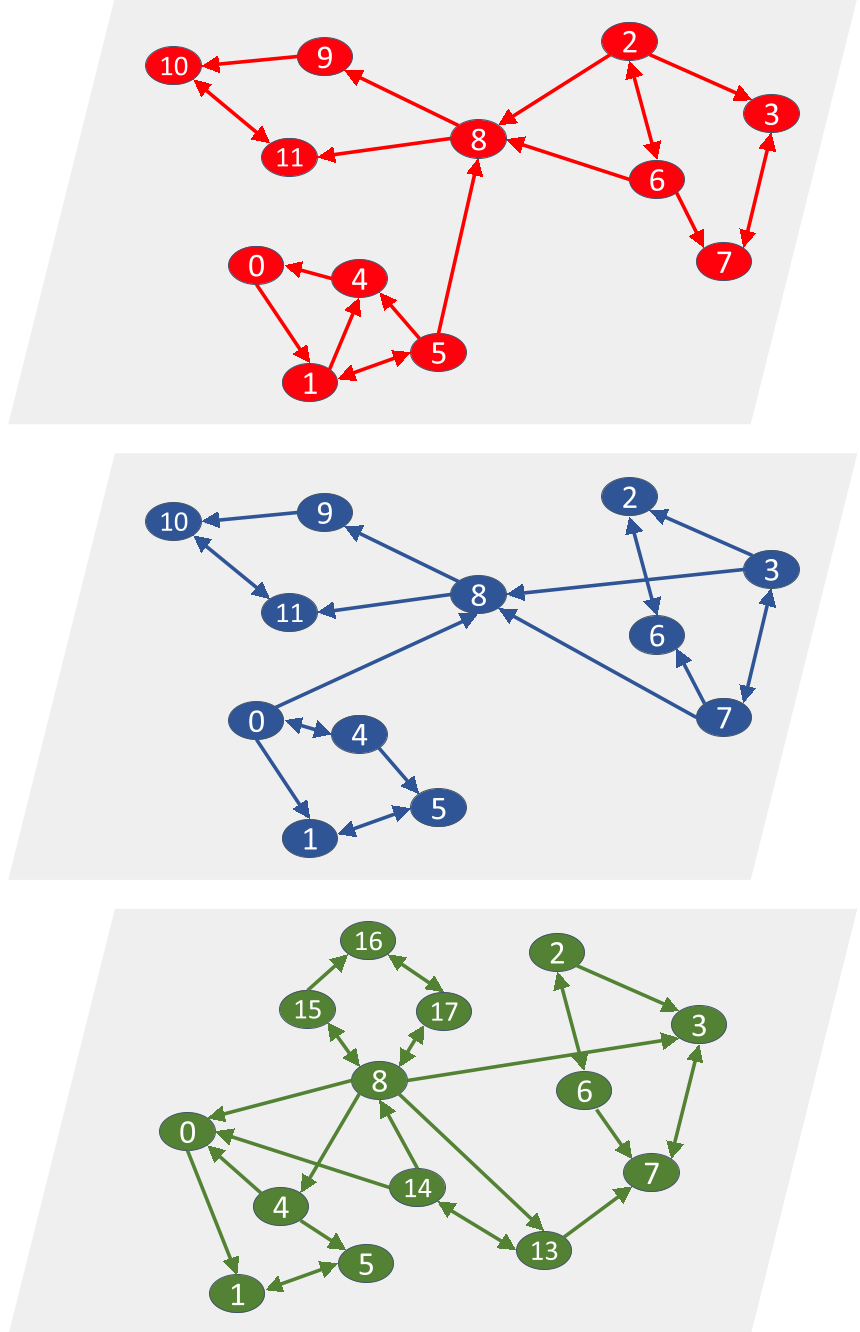 Figure 1: An example multilayer network showing how nodes (users) exhibit different in/out-degree ratios across layers, suggesting alternating roles.
Experimental Results: Proving the Duality
The authors tested mlALCR on four massive datasets, including GH-SO-TW (GitHub, StackOverflow, Twitter) and HiggsTW.
Key Findings:
- Unique Rankings: There is almost zero correlation between the rankings of mlALCR and traditional models. This means mlALCR is finding a "hidden" class of users that other algorithms completely miss.
- Cross-Layer Variability: Users in the "tail" of the distribution show massive rank swings (e.g., top 1% contributor on one layer, bottom 10% on another).
- Attachment Styles: The study found that the relationship between lurkers and contributors follows a Log-Normal distribution rather than a standard Power Law, suggesting a more complex social tie mechanism than "the rich get richer."
 Table: Comparative performance across various datasets showing the consistency of mlALCR in different social contexts.
Critical Insights & Conclusion
This work transitions user behavior analysis from a static "snapshot" to a dynamic "systemic" view.
Main Takeaway: For marketing and security, these "alternate" users are vital. A "lurker" on a sensitive forum who is a "contributor" on a public platform is a high-risk vector for information leakage. Conversely, for product adoption, these users are the "bridges" who bring expertise from professional layers (like GitHub) to social layers (like Twitter).
Limitations & Future Work
While the topological approach is robust, it ignores the content of the messages. The next frontier for this research involves integrating Natural Language Processing (NLP) to see if the topic of what a user lurks on matches the topic of what they eventually contribute.