
A Step Towards Sociable Robots: Adaptive Monitoring and Social Commitment
5515_A step towards a sociable robot guide which monitors and adapts to the person's activities.
This paper introduces a social navigation framework for mobile robot guides that adapts to human intentions using a Joint Intention model. It utilizes a probabilistic belief system to distinguish between natural "non-leave-taking" behaviors and temporary "leave-taking" deviations, achieving a balance between task-oriented guidance and human-centric flexibility.
TL;DR
Most robot guides treat you like a physical object to be led on a leash. This paper changes the paradigm: by using Joint Intention Theory and Probabilistic Belief Modeling, the robot learns to distinguish between a human who is just "wandering momentarily" and one who has actually abandoned the task. It adapts its path to catch up with the human while elegantly signaling the way to the goal using smooth B-spline curves.
Background: The "Socially Awkward" Robot Problem
If you’ve ever walked with an early-generation robot guide, you know the frustration: if you stop to look at a painting, the robot either stops dead, spins in circles, or keeps going as if you don't exist. This "mechanistic" behavior stems from a lack of understanding of social proxemics.
The authors identify a critical gap in Human-Robot Interaction (HRI): the human should not be the one compromising. The robot must explicitly consider human natural behavior—speeding up, slowing down, or switching sides—as "non-leave-taking" actions that require no aggressive correction.
Methodology: Quantifying "Harmony"
How does a robot "feel" that a human is still committed to the walk? The authors introduce a mathematical model for Belief about Human's Joint Commitment P(JC).
1. The 4D Probabilistic Workspace
Instead of just distance, the robot monitors a state vector representing position, relative angle, and speed. By calculating the Mahalanobis Distance, the robot determines if the human-robot pair is in a state of "high harmony."
- Mentoring State: High probability. The robot continues its path.
- Wait State: The human pauses (e.g., to look at a photo). The robot stops and waits without breaking the task.
- Deviate State: The human moves toward a different object. The robot identifies this as "temporary leave-taking."
2. Goal-Oriented Deviation
When the human wanders off, the robot doesn't just "follow." It calculates an Optimal Meeting Point () and an Intermediate Goal ().
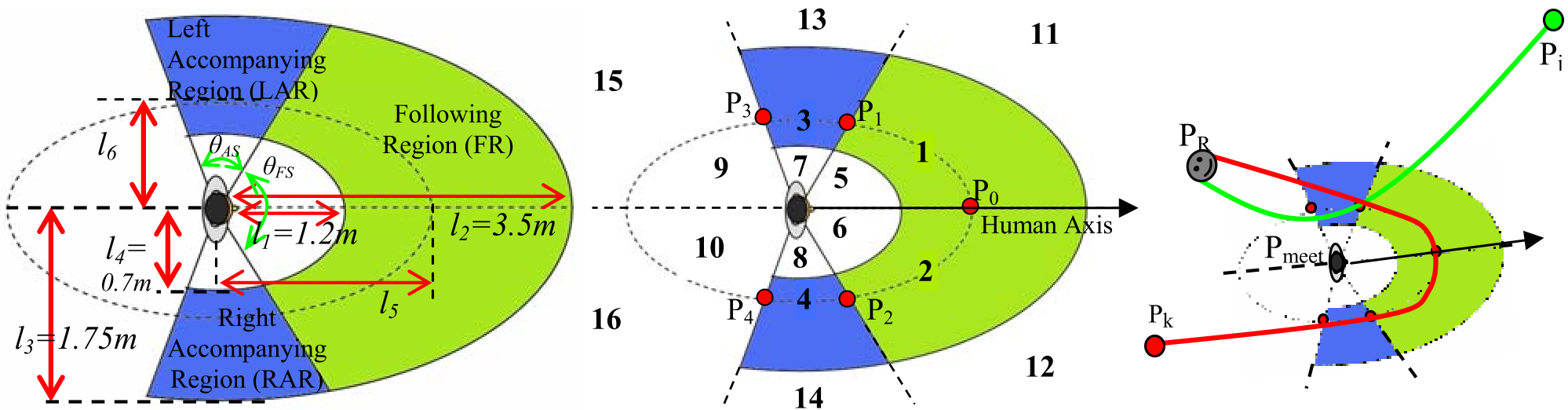 Fig. 1: Spatial zones and candidate points around the human used to plan the re-engagement path.
The robot generates a path using Cubic B-splines. Why? Because B-splines ensure that a change in one point doesn't jerk the whole trajectory, and the second derivative remains continuous—making the robot's movement look "liquid" and intentional rather than robotic.
Experimental Insights: Supporting vs. Suspending
The framework was tested using the Move3D software with the Jido robot platform. A key discovery was how the robot handles "re-engagement."
- Scenario A (Side Switching): The human moves from the robot's right to its left. The robot recognizes this as a non-leave-taking behavior and maintains its trajectory.
- Scenario B (Temporary Leave-Taking): The human walks toward another person. The robot slows down, deviates through a "passing point" (P1 or P2), and curves back toward the goal.
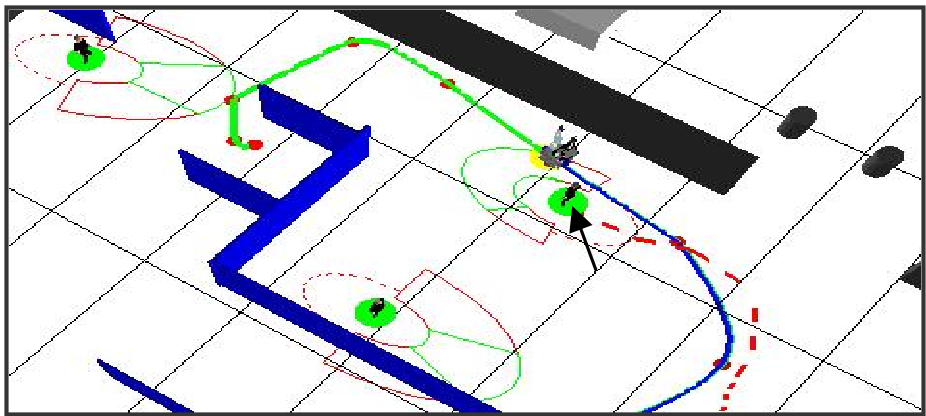 Fig. 2: Temporal relation showing how the robot maintains a "invisible string" of social commitment even as the human moves sporadically (red dashed line) relative to the robot (blue line).
Critical Analysis: Why This Matters
The brilliance of this work lies in its Inductive Bias. Most navigation stacks view human movement as noise to be filtered. Pandey and Alami view it as communication.
By relaxing parameters () based on context—like widening the acceptable orientation angle in narrow corridors—the robot exhibits a level of "empathy." It gives the human the "privilege" of movement, which is the cornerstone of social acceptance.
Limitations & Future Work
While the framework is robust in simulation, real-world dynamics (like occlusions in a crowded museum) remain a challenge. The authors noted that when a human disappears, the robot enters a "Search State," heading to the last known visible point (). Integrating more complex "Social Map" data could allow the robot to predict which room a human likely entered.
Takeaway
A sociable robot isn't one that follows a line perfectly; it's one that knows when to let go of the line to support your curiosity. This framework is a major step toward robots that feel like companions rather than tools.
References
- Pandey, A. K., & Alami, R. (2010). A Step towards a Sociable Robot Guide.
- Joint Intention Theory (Cohen & Levesque, 1990).