
The Good, the Bad, and the Unflinchingly Selfish: Predicting Cooperation with Machine Learning
5526_The Good, the Bad, and the Unflinchingly Selfish Cooperative Decision-Making can be Predicted with high Accuracy when using only Three Behavioral Type
This paper utilizes machine learning to predict human cooperative behavior in anonymous, one-shot economic games. By training models on 21,340 decisions, the authors demonstrate that a person's future cooperation can be predicted with high accuracy (AUC=0.89) using a "cooperative phenotype" model that identifies three distinct behavioral types.
TL;DR
Can we predict if a stranger will help you based only on their past actions? This research says yes, with alarming accuracy. By analyzing over 20,000 decisions, researchers found that human cooperation isn't random or just a product of the moment. Instead, people fall into three distinct "types"—the consistently helpful, the occasionally cooperative, and the purely selfish—allowing machine learning models to predict their future choices with an AUC of 0.88.
The Motivation: Moving Beyond the "Average" Human
In classical economics, researchers often use the Representative Agent assumption—the idea that we can model "human behavior" as if everyone follows the same logic. On the other end of the spectrum, psychologists often treat every individual as a unique snowflake, making it hard to create predictive models that actually work on new data.
The authors of this paper wanted to find the "Goldilocks zone":
- How much does the specific payoff (the money involved) matter versus the person’s disposition?
- How many "types" of people do we actually need to recognize to predict behavior accurately?
- Is "being nice" just a byproduct of being educated, religious, or having a certain personality, or is it its own unique trait?
Methodology: The 20-Round Challenge
The researchers recruited 1,067 participants on Amazon Mechanical Turk. Each person faced 20 binary choices between a Selfish option (more money for me) and a Cooperative option (pay a cost to give a larger benefit to a stranger).
The Model Architecture
They used Logistic Ridge Regression, a technique that handles many features while preventing overfitting. They trained the model on the first 15 decisions and tested its accuracy on the final 5.
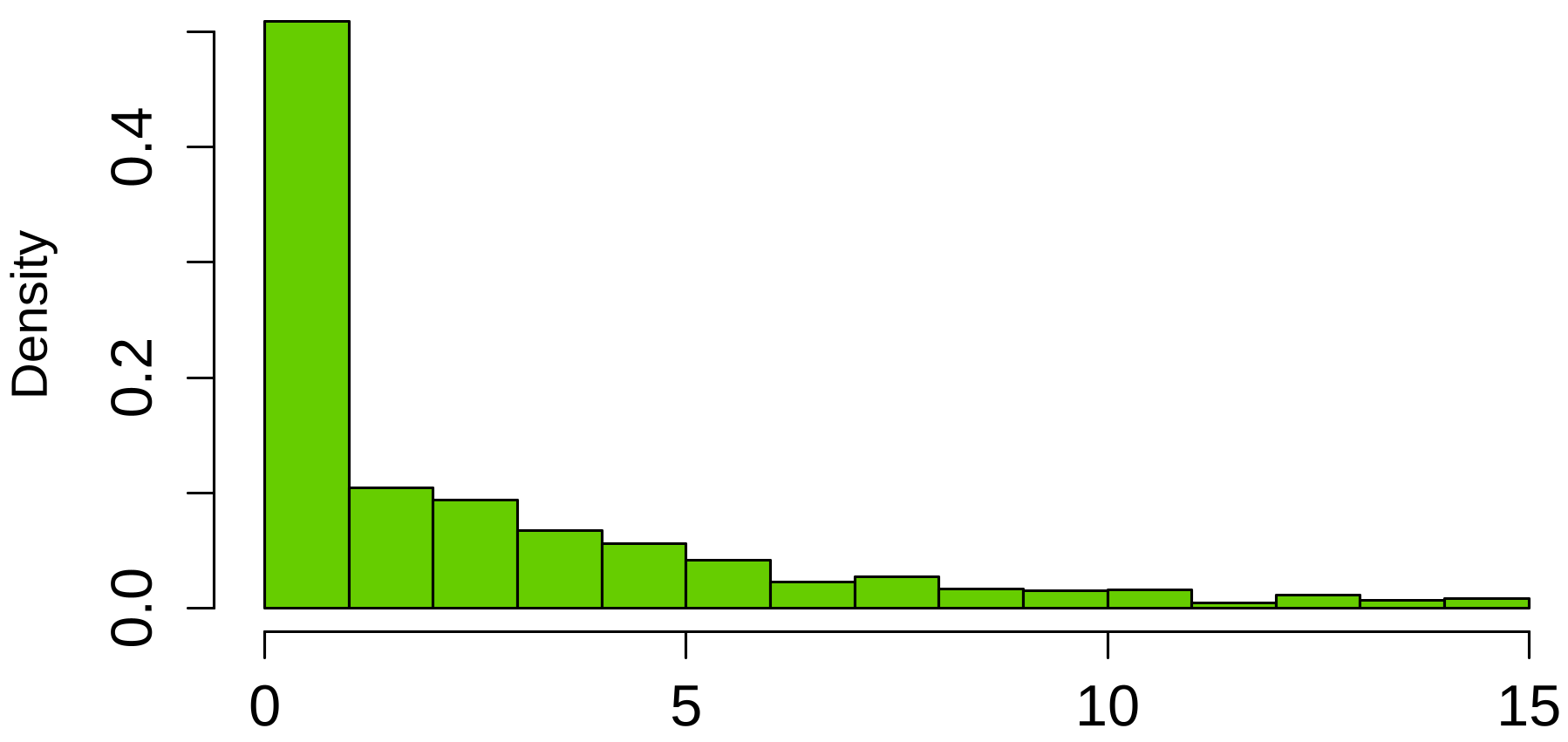 Figure 1: Distribution of cooperation frequency in the training set, showing clear clusters of high and low cooperators.
The feature set included the cost of cooperation, the efficiency gain (how much the other person gets for every dollar you spend), and various interactions between these factors.
Results: The Power of Three
The results shattered the "Representative Agent" myth but also showed we don't need to be overly complex.
- Payoffs aren't everything: A model that only looked at payoffs (Representative Agent) was mediocre (AUC 0.69).
- Individual Identity is Key: A model that only knew who the person was—but nothing about the money—was much better (AUC 0.83).
- The "Sweet Spot": By grouping people into just three types based on how often they cooperated in the past, the model achieved an AUC of 0.88.
Adding more types (like a 4-type or 5-type model) offered almost no extra predictive power. This suggests that "types" of human social behavior are discrete and limited.
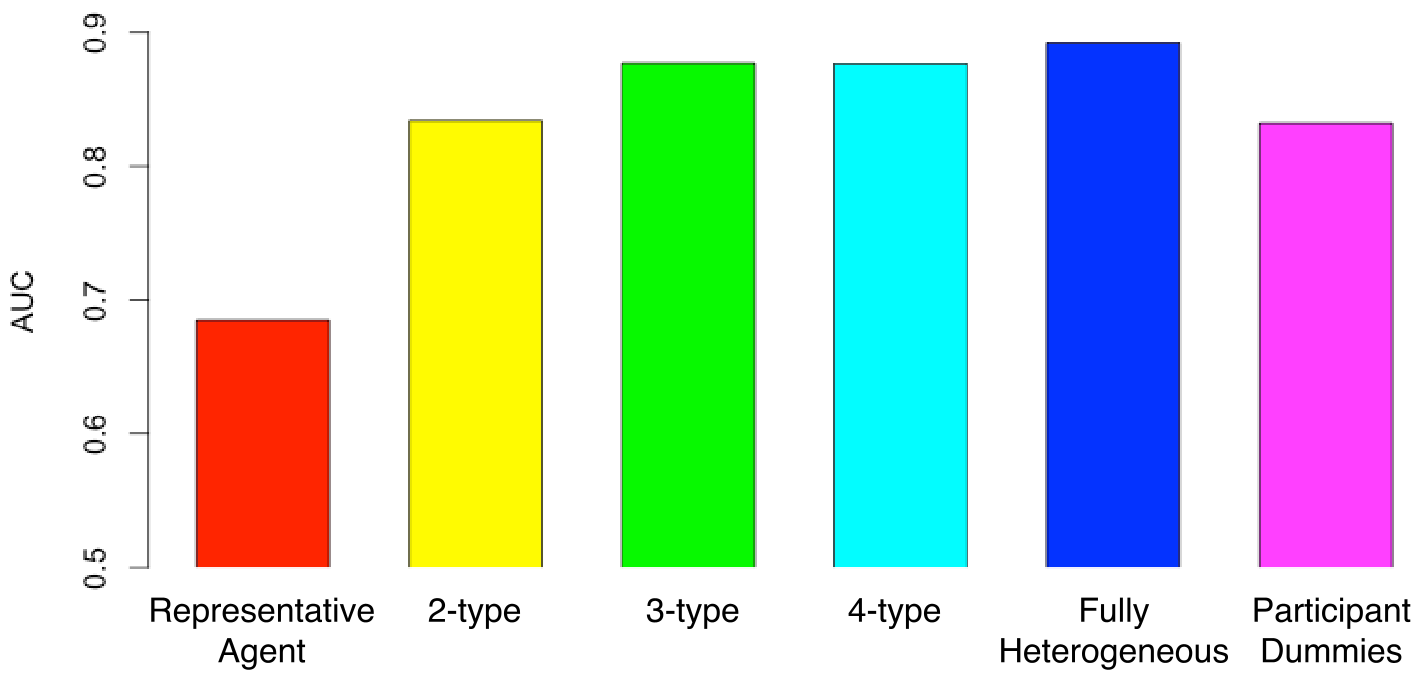 Figure 2: Comparison of model accuracy. Note how the 3-type model nearly matches the performance of the "fully heterogeneous" model that treats everyone uniquely.
The "Natural Kind" Revelation
Perhaps the most striking finding: the researchers tried to predict a person's "type" using demographics (age, gender, politics) and personality tests (Big Five, grit, etc.). They failed. The AUC for these predictions was near 0.54—barely better than a coin flip.
This suggests that cooperativeness is a "natural kind" or a "cooperative phenotype." It isn't just a subset of being "Agreeable" on a personality test; it is a stable, fundamental trait of your behavioral identity.
Critical Analysis & Conclusion
The study provides a rigorous defense of using machine learning in social science. It proves that human behavior in "small stakes" settings (like MTurk) is not noisy "junk data" but reflects stable, underlying preferences.
Takeaway
If you want to know if someone will cooperate with you tomorrow, don't look at their age, their politics, or their personality test scores. Look at how they behaved yesterday. Human altruism is consistent, predictable, and can be categorized into three simple archetypes: the Good, the Bad, and the Unflinchingly Selfish.
Limitations
The study focuses on unilateral decisions (I give to you, you have no say). In the real world, cooperation is often reciprocal (I give because you gave). Future research needs to apply these ML techniques to "strategic" games where reputations and retaliation come into play.