
ML and Hyperspectral Imaging: The New Frontier in Precision Agriculture
5642_Machine learning classification methods in hyperspectral data processing for agricultural applications.
This paper provides a comprehensive survey and preliminary experimental validation of Machine Learning (ML) and Deep Learning (DL) architectures for processing hyperspectral data in precision agriculture. It highlights the transition from satellite/aircraft platforms to Unmanned Aerial Vehicles (UAVs) and introduces a U-Net based approach for high-accuracy vineyard plot detection.
TL;DR
Hyperspectral imaging (HSI) offers unprecedented detail for agricultural monitoring, but its high dimensionality often hampers traditional analysis. This paper surveys how Machine Learning (ML) and Deep Learning (DL) bridge this gap, presenting a case study where UAV-based imagery and U-Net architectures achieve over 85% accuracy in vineyard detection, paving the way for automated, large-scale crop management.
Problem & Motivation: The Curse of Dimensionality
In agriculture, identifying specific pests, nutrient deficiencies, or early-stage diseases requires more than just standard RGB or multispectral data. We need the "spectral fingerprint" provided by hyperspectral sensors.
However, as the number of spectral bands increases, the volume of the feature space increases exponentially, making the available data points sparse. This is the "Curse of Dimensionality" or the Hughes phenomenon. When the dimension increases towards infinity, the distance between samples becomes uniform, making patterns nearly impossible to recognize for traditional parametric models.
The motivation of this study is to leverage the recent miniaturization of hyperspectral sensors for Unmanned Aerial Vehicles (UAVs) and combine them with ML/DL algorithms that thrive on high-dimensional data.
Methodology: From SVM to Deep Learning
The paper reviews several critical ML approaches:
- Support Vector Machines (SVM): Praised as the previous state-of-the-art for HSI due to their ability to handle high dimensions with relatively small training sets.
- Deep Learning (DL): Unlike traditional ML that requires manual feature engineering (e.g., Vegetation Indices), DL utilizes Representation Learning.
- The U-Net Approach: For their preliminary tests, the authors used a U-Net architecture—a type of CNN designed for semantic segmentation.
Architecture Overview
The workflow involved acquiring data via a fixed-wing UAV, generating orthophoto mosaics (RGB and Red-Edge), and training the model using the Dice coefficient as the cost function to maximize the overlap between predicted and ground-truth vineyard plots.
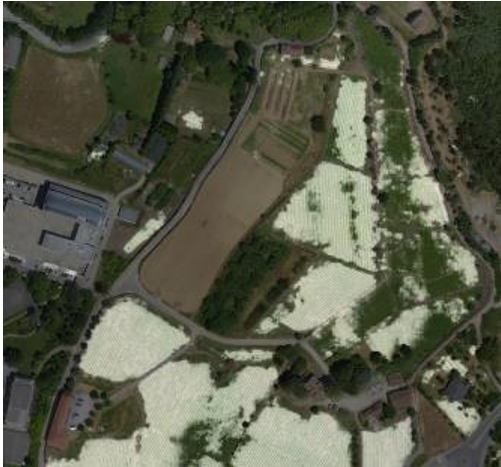 Figure: RGB (left) and RE (right) orthophoto mosaics used for training the segmented vineyard plots.
Experiments & Results
The authors validated their U-Net model on distinctive vineyard plots at the University of Trás-os-Montes and Alto Douro.
Key Metrics:
- Exact Detection: 85.07% accuracy.
- Validation Dice Coef: 0.9953.
- Error Analysis: The model struggled primarily in areas with strong shadows and low density of inter-row vegetation, which were under-represented in the training set.
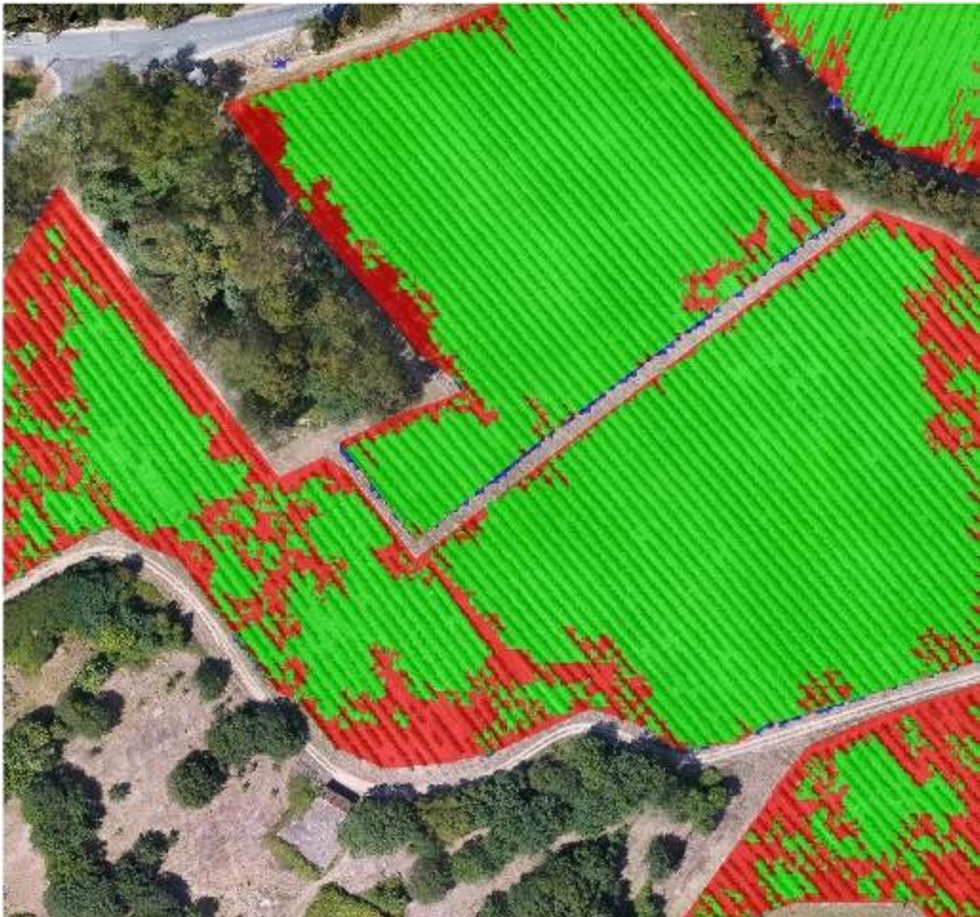 Figure: Pixel-wise comparison showing Exact Detection (green), Under-detection (red), and Over-detection (blue).
Beyond their own experiment, the survey highlights that techniques like Gaussian Process Regression (GPR) are particularly effective for leaf rust disease detection, even when training datasets are small.
Critical Analysis & Conclusion
Takeaway
The paper successfully demonstrates that the synergy between UAV-based HSI and Deep Learning can automate laborious agricultural tasks. The transition from "Black-box" solutions to more interpretable and robust segmentation models is the next logical step for Precision Agriculture.
Limitations
- Generalization: The model showed sensitivity to lighting conditions (shadows), suggesting that the training diversity needs to be improved.
- Data Scarcity: While UAVs increase data availability, labeled hyperspectral data for specific agricultural diseases remains a bottleneck for DL training.
Future Work
The authors intend to expand the application of CNNs and RNNs (Recurrent Neural Networks) to full hyperspectral data cubes (3D data) to capture both spatial and spectral dependencies simultaneously.