
Effector Detection: Pinpointing Influence Sources in Complex Social Networks
5690_Effector Detection Problem in Social Networks.
This paper introduces and solves the Effector Detection problem in social networks, aiming to find a set of seed nodes (effectors) that generate an activation state most similar to a target observation. The authors propose the Mod-Mod algorithm for unconstrained detection and the Sandwich Approximation (SA) framework with Reverse Influence Sampling (RIS) for constrained detection, achieving state-of-the-art accuracy in identifying influence sources.
TL;DR
Unlike Influence Maximization, which seeks to spread information to as many people as possible, Effector Detection seeks to find the "hidden hands" behind a specific observed state of a network. This paper tackles the inherent complexity of this problem—specifically its non-submodular nature—by introducing two novel algorithms: Mod-Mod and Sandwich Approximation (SA). These methods provide mathematical guarantees and scalability that previous heuristic-based approaches lacked.
Background: Why Effector Detection is Hard
In a social network, information (or a virus) spreads through connections. If we observe a subset of users who have adopted a piece of information, we want to know: Who started this?
This is not just "Source Detection," which looks for an exact starting point, but rather finding effectors whose influence results in a state closest to what we see. This problem is defined by two conflicting goals:
- Activating the "target" nodes (True Positives).
- Not activating the "non-target" nodes (False Positives).
Mathematically, this leads to an objective function that is neither submodular nor supermodular, meaning the "diminishing returns" property used to solve IM doesn't apply.
Methodology: Bridging the Gap with DS Decomposition
To solve the non-submodular challenge, the authors utilize DS (Difference of Submodular) Decomposition. They prove that the objective function can be rewritten as: where both and are submodular.
1. Unconstrained Effector Detection (UIED)
For cases where the number of effectors isn't fixed, the authors use the Modular-Modular (Mod-Mod) algorithm. By replacing submodular functions with their modular bounds (upper and lower), the algorithm iteratively converges to a local minimum efficiently.
2. Constrained Effector Detection (CIED)
When a budget is enforced, the authors employ the Sandwich Approximation Strategy. They "sandwich" the original difficult function between a submodular lower bound () and a submodular upper bound ().
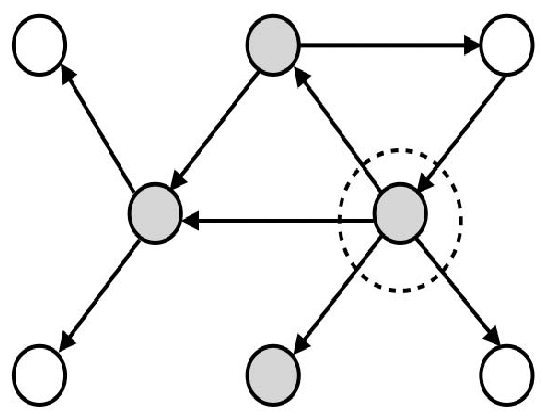 Figure 1: Conceptual illustration of finding effectors that best match an observed activation state (gray nodes).
The RIS Advantage
To ensure scalability to millions of nodes, the authors adapt Reverse Influence Sampling (RIS). By sampling "Reverse Reachable (RR) sets," the algorithm can estimate influence without running millions of costly Monte Carlo simulations.
Experimental Validation
The authors tested their methods on three major datasets: Wikipedia, Gnutella, and Amazon.
Efficiency and Performance
The SA and Mod-Mod algorithms consistently produced lower error rates (closer matches to target states) compared to standard network metrics like Out-Degree and PageRank.
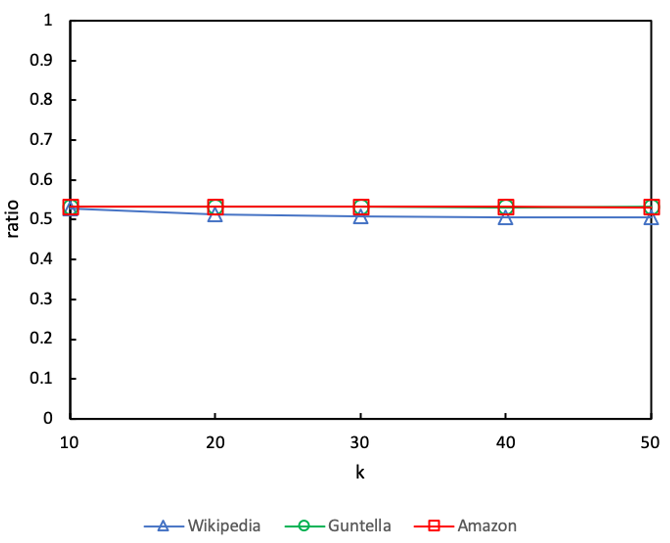 Figure 2: Performance comparison across Wikipedia, Gnutella, and Amazon datasets. Lower values indicate a closer match to the target activation state.
Key Insights from Experiments:
- The Weight of Silence: The parameter allows researchers to tune how important it is to avoid "false activations." The study found that setting often yields the most balanced results.
- Scalability: While the Mod-Mod algorithm provides high accuracy, the SA algorithm is significantly faster, making it the preferred choice for massive networks like Amazon (262K nodes).
Conclusion & Critical Analysis
This paper provides a rigorous algorithmic foundation for a problem that was previously handled largely by heuristics. By proving the DS-nature of effector detection and applying RIS, the authors have made it feasible to identify influence sources in large-scale social systems.
Limitations: The current model assumes an Independent Cascade (IC) diffusion. Future work should address more complex models like Linear Threshold (LT) or context-aware diffusion where edge weights change dynamically.
Future Outlook: Integrating these approximation algorithms with machine learning could allow for "predictive effector detection," where one identifies potential future influencers before they even start a cascade.