
Just in Time: Turning the Crowd into a Real-Time Stream Processor
5760_Just in Time Controlling Temporal Performance in Crowdsourcing Competitions.
The paper introduces a temporal utility framework and incentive mechanisms for competition-based crowdsourcing to handle streaming data with variable loads. By employing "bonus events" within a gamified competition structure, the authors demonstrate the ability to dynamically control worker throughput to meet real-time processing demands.
TL;DR
In the world of big data, algorithms process streams at light speed, but human analysis remains a bottleneck. This paper introduces a breakthrough approach using gamified competitions and dynamic incentives to force the "human crowd" to adapt to real-time data spikes. By offering "bonus" points during peak periods, the researchers achieved a 300% throughput boost, successfully syncing human effort with fluctuating data streams.
The Problem: The "Static" Crowd vs. The "Dynamic" Stream
Modern applications like crisis management (e.g., mapping earthquake data from Twitter) require near real-time human intervention. However, current crowdsourcing models are passive:
- Demographic Latency: Worker activity is dictated by their local time zones, not the urgency of the task.
- Inflexible Supply: There is no "throttle" to increase output when a data surge occurs, leading to massive backlogs during emergencies.
- Wasteful Allocation: During low-demand periods, systems might over-pay for annotations that aren't time-critical.
Methodology: The Temporal Utility Framework
To solve this, the authors don't just ask for work; they value it mathematically. They define the utility of a task based on three factors:
- Completion Factor (): Is the data only useful if 100% finished (Full), or does the value saturate (Saturated/Sigmoidal)?
- Delay Factor (): How fast does the value decay? (e.g., a "Hard" deadline where late data = 0 utility).
- Base Utility (): The intrinsic importance of the task set.
The Competitive Engine
The core mechanism is a Team-Based Competition. Workers are assigned to teams and ranked on a leaderboard. To handle "bursty" data, the system introduces Bonus Events:
- Dynamic Incentives: Points (which translate to a $100 prize pool) are multiplied (2x, 5x, or 10x) during peak hours.
- Information Policy: Workers see their rank and upcoming bonus schedules (Long Notice) or immediate alerts (Short Notice).
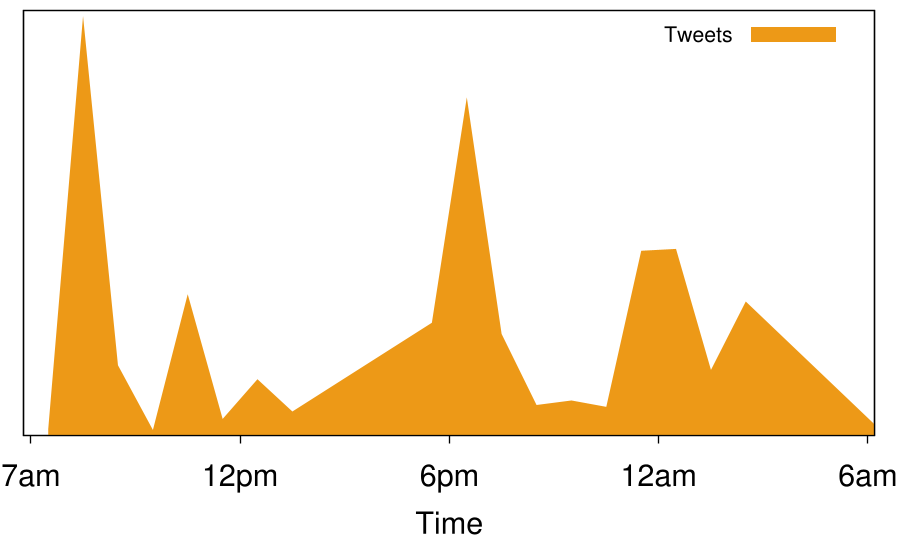 Caption: The mismatch between Tweet volumes (demand) and typical crowd output (offer) that this paper aims to synchronize.
Experimental Insights
The researchers ran a massive study: 921 participants, 6200+ work hours, and 2.36 million images matched.
1. Throughput Control
The results were stark. Without bonuses (Baseline), throughput remained flat despite high demand. With a High Bonus and Long Notice, the crowd's throughput skyrocketed by 4.21x during peak hours.
| Setting | Peak-to-Non-Peak Ratio |
|---|---|
| Baseline (No Bonus) | 1.02 |
| Short Notice (High Bonus) | 2.96 |
| Long Notice (High Bonus) | 4.21 |
2. Quality Remains Stable
One might fear that rushing workers leads to mistakes. Interestingly, the study found that accuracy remained consistent at ~95% across both peak and non-peak periods. The "Honeypot" (hidden gold standard tasks) mechanism acted as an effective guardrail.
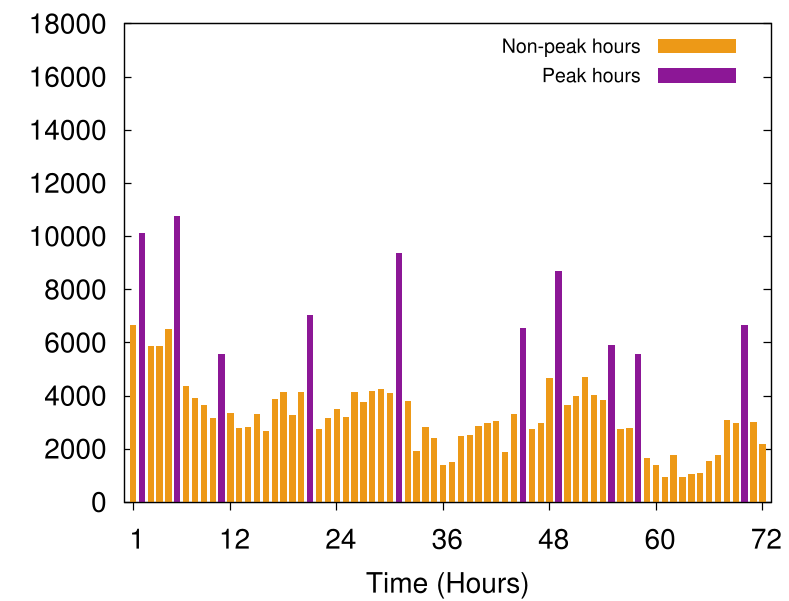 Caption: Different strategies showing how throughput (annotations per hour) spikes exactly when the bonus (and demand) is active.
3. The "Anticipation Period"
The researchers noted a fascinating human behavior: in "Long Notice" scenarios, throughput actually dropped right before a bonus hour as workers "saved" their energy to maximize their points during the high-reward window.
Critical Analysis & Takeaways
Why this works: The system taps into the "Social-Translucence" of competitions. Workers don't just work for the money; they work to beat their neighbors on the leaderboard. Bonus events provide a "game mechanic" that breaks the monotony and creates a sense of collective urgency.
Limitations:
- Worker Fatigue: While the study didn't see high drop-out rates, prolonged "bonus" pressure might lead to burnout.
- Cost Scaling: While throughput increased 4x, the bonus points effectively "inflationary" within the competition. In a per-task payment model, this would be significantly more expensive.
Conclusion: This work proves that the crowd is not a static resource. By treating crowdsourcing as a dynamic control problem and applying economic game theory, we can build human-in-the-loop systems that are as responsive as the algorithms they support. For developers of crisis-response or real-time analytics tools, this "Just in Time" framework is the blueprint for the next generation of human-powered data streams.