
Harmonizing the Lens: A Spring-Electric Approach to Group Photography
5762_A Spring-Electric Graph Model for Socialized Group Photography.
The paper introduces a "Spring-Electric Graph Model" augmented with "Color Energy" to achieve visual balance in dynamic layouts. Its primary application is a real-time group photography recommendation system that optimizes the arrangement, position, and relative size of people within a scenic frame to maximize aesthetic quality.
TL;DR
Capturing a perfectly balanced group photo is an art form that amateur photographers often struggle with. This paper introduces a novel framework that treats visual elements as physical particles in a Spring-Electric Graph Model. By embedding "Color Energy" into these virtual forces, the system provides real-time recommendations on where people should stand and how they should be arranged to create an aesthetically superior composition.
Background Positioning
In the landscape of computational aesthetics, most work focuses on post-processing—cropping or color-grading an existing image. This paper shifts the paradigm toward proactive assistance. It occupies a unique intersection between graph theory (Force-directed placement) and traditional media aesthetics (Zettl’s theory of screen forces), specifically targeting the underserved niche of group photography.
The Problem: The Complexity of Group Dynamics
Why is group photography harder than a single portrait?
- Visual Weight Imbalance: A person in a bright red shirt exerts more "visual pull" than someone in grey, yet standard algorithms treat them as identical bounding boxes.
- Dynamic Elements: Moving five people around a scenic background creates an exponential number of possible arrangements.
- Occlusion of Saliency: Amateur shots often inadvertently block the very landmark they are trying to capture.
Methodology: Physics Meets Fine Art
The core innovation is the modification of the classic Fruchterman-Reingold graph drawing algorithm.
1. The Color Energy Metric
The authors define Color Energy () as a weighted sum of Hue (warmth), Saturation, Brightness, Area, and Contrast. This energy determines the charge of the nodes. High-energy colors repel each other to prevent "visual crowding," while high-energy nodes are attracted to low-energy areas to distribute weight evenly across the frame.
2. The Spring-Electric Model
The system treats people as p-nodes (dynamic) and background segments as s-nodes (static).
- Attractive Forces (): Pull people toward their "ideal" spots based on social media priors (GMM).
- Repulsive Forces (): Pushed updated by a saliency term to ensure people don't block important background features.
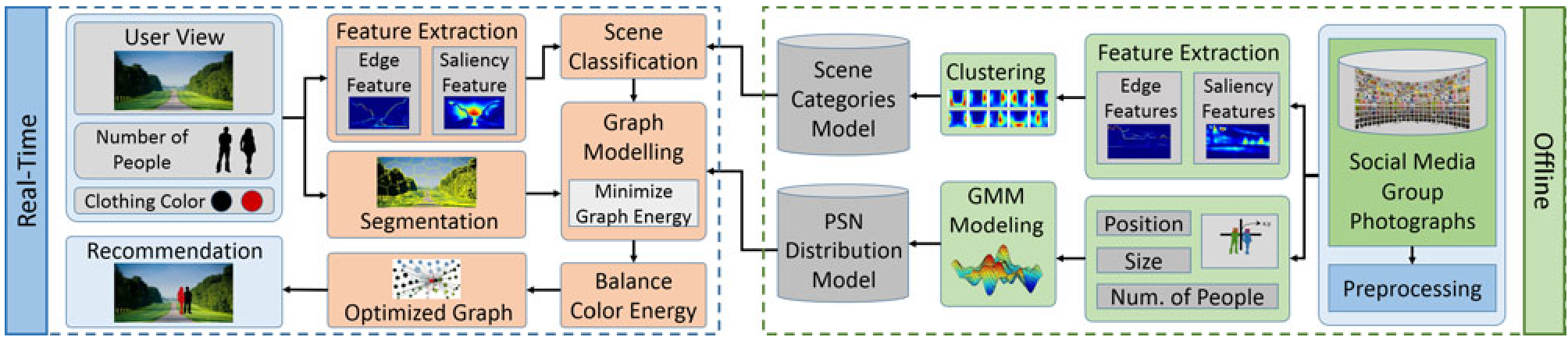 Fig 1: The workflow from scene categorization to GMM-based initial placement and graph-based optimization.
Experiments & Real-World Results
The authors validated their model against "Rule-of-Thirds" and "Rule-of-Center" baselines. While traditional rules are rigid, the Spring-Electric model adapts to the specific colors present in the scene.
 Fig 2: Comparison with state-of-the-art: Our method (bottom row) accounts for clothing color to ensure the subject doesn't blend into the background, unlike previous saliency-only methods (top/middle).
Quantitative Success
- Skilled Photographer Approval: 78.5% of professionals preferred the AI-recommended compositions over random or slightly offset variations.
- Efficiency: Despite the complexity of calculating forces for up to 60 nodes, the system runs in ~1.5 seconds, making it viable for a cloud-connected mobile app.
Critical Analysis & Future Outlook
Takeaway: The "physics of art" is a powerful abstraction. By representing visual weight as a quantifiable force, we can solve complex compositional problems that were previously left to human intuition.
Limitations: The model currently assumes a "horizontal linear formation" (people standing in a line). In reality, large groups often pose in multiple rows or clusters. Furthermore, the system occasionally struggles with non-symmetrical scenery where "balance" might conflict with "navigability" (e.g., standing on a lake).
Future Work: Integrating Scene Semantics (knowing that a "lake" shouldn't be stepped on, even if it's not marked as salient) and more diverse group formations (triangles, staggered rows) will be the next frontier for this "Socialized Photography" assistant.
Conclusion
This paper effectively bridges the gap between high-level aesthetic theory and low-level algorithmic implementation. By turning a photograph into a living graph of forces, it provides a blueprint for the next generation of "Smart Cameras" that don't just focus the lens, but direct the scene.