
Mapping the Digital Divide: Visualizing Islamist vs. Secular Tension in Egypt
5920_#Egypt visualizing Islamist vs. secular tension on Twitter.
This paper presents a visual analytics demo for monitoring political polarization on Twitter in Egypt between Islamist and Secularist camps. By analyzing hashtag usage and retweeting behavior, the system quantifies ideological "polarity" and tracks societal tension over time during a period of significant political upheaval.
TL;DR
During the turbulent aftermath of the Arab Spring, Twitter transformed from a simple communication tool into a digital battlefield for Egypt's soul. This paper introduces a public demo that maps the ideological distance between Islamists and Secularists by analyzing hashtag "polarity" and retweet networks. It provides a real-time "tension index" that correlates digital behavior with actual political crises on the ground.
Background: The Social Media Pulse
In 2013, Egypt was at a crossroads. Following the Arab Spring, the tension between the ruling Islamist bloc and the Secular opposition was palpable. While many researchers studied social media as a tool for mobilization, authors Ingmar Weber and Kiran Garimella focused on its power as a societal thermometer. By identifying who says what—and who they follow—we can visualize the invisible lines dividing a nation.
Problem: The Noise of the Crowd
Analyzing political Twitter is notoriously difficult because:
- Ambiguity: A hashtag like #Egypt is used by everyone and carries no ideological signal.
- Ephemerality: Political topics change hourly; a tool must distinguish between long-standing beliefs and sudden "trending" outbursts.
- Context Collapse: For an outsider, a hashtag like #colorado_free_alturki makes no sense without external news context.
Methodology: Mining the Ideological Latent Space
The researchers employed a clever, "bottom-up" approach to classify users without needing hundreds of manual labels.
1. The Seed & Expand Strategy
They started with a "gold standard" set of 22 prominent accounts (including Mohammad Morsi and Mohamed ElBaradei). They then tracked 20,806 users who retweeted these seeds.
- The Logic: If you exclusively retweet Islamist leaders, you are assigned a high Islamist "leaning."
- Fractional Assignment: Unlike binary classifiers, this allows for nuance (e.g., a user could be 70% Secularist and 30% Islamist).
2. Hashtag Polarity and Trending Scores
Once users were categorized, the hashtags they used were analyzed using a specific formula:
- Polarity: If a hashtag is used only by one camp, its polarity is 1.0 (highly partisan). If shared equally, it is 0.0 (neutral).
- Trending: Using a burst-detection formula, the system surface hashtags that are uniquely popular this week compared to historical norms.
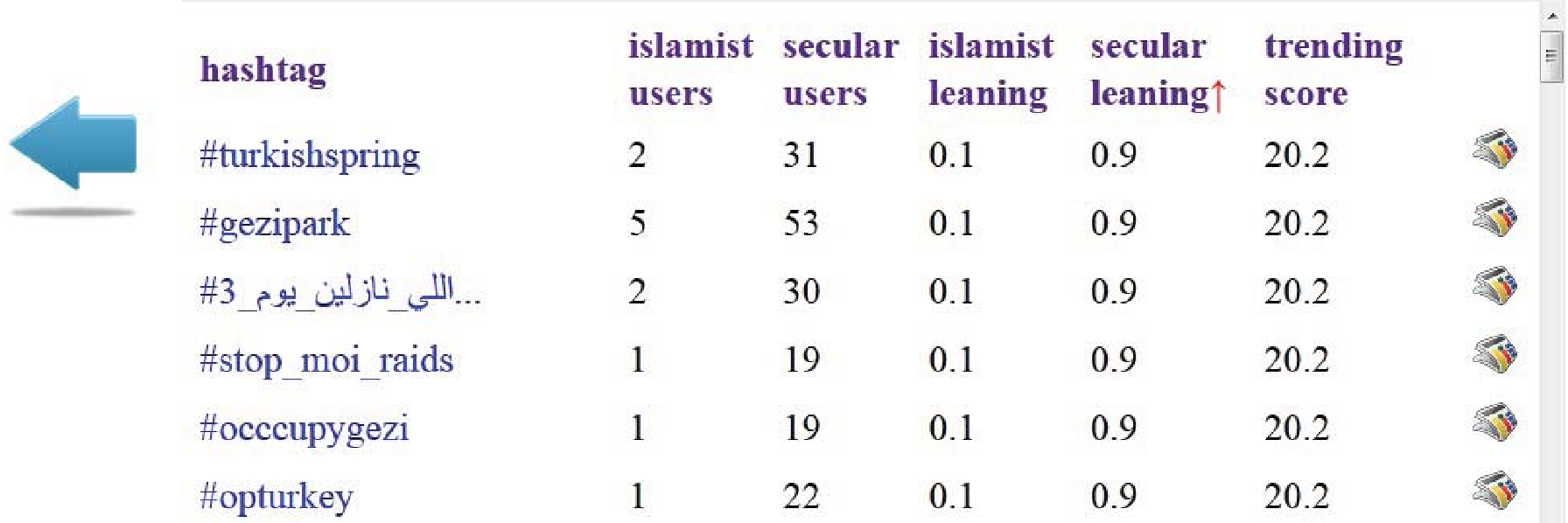 Figure 1: Example of hashtags like #turkishspring and #gezipark showing heavy Secularist leaning during a specific timeframe.
Key Insights: Measuring Tension
The most innovative feature of the demo is the Tension Plot. By macro-averaging the polarity of all hashtags in a given week, the authors created a "Tension Index." When the camps share almost no common language (hashtags), the index spikes.
- Validation: The system detected a massive spike in tension during the December 2012 constitutional crisis, proving that digital polarization is a mirror of physical-world conflict.
- Contextual Hook: The demo integrates Google News and Topsy (a legacy Twitter search tool), allowing users to immediately see the news articles driving specific hashtag surges.
Critical Analysis & Future Outlook
The beauty of this work lies in its simplicity and interpretability. Unlike "black-box" Deep Learning models, the polarity scores here are derived from transparent retweet counts.
Limitations:
- Echo Chambers: The methodology assumes retweets signify agreement, which—while generally true in high-tension politics—ignores the "hate-retweet" phenomenon.
- Bot Activity: By 2013 standards, bot detection was less critical than it is today; modern iterations would need robust filtering for coordinated inauthentic behavior.
The Takeaway: This paper laid the groundwork for Passive Polling. Instead of calling citizens, researchers can now listen to the "digital exhaust" of a population to predict when societal tension is reaching a breaking point. For modern social media analysts, the "Tension Index" remains a gold-standard concept for measuring the health of a democracy.
 Figure 2: The original demo interface showing the historical tension plot and polarized hashtag cloud.