
TopicFlow: Mapping the Ebb and Flow of Twitter Conversations Through Time
5925_TopicFlow visualizing topic alignment of Twitter data over time.
TopicFlow is an interactive visualization tool designed to track and analyze the evolution of "topics" in Twitter streams over time. It introduces "binned topic models," applying Latent Dirichlet Allocation (LDA) independently across adjacent time slices and aligning the results via cosine similarity to achieve SOTA visual transparency for topic emergence, convergence, and divergence.
TL;DR
TopicFlow is a visual analytics system that solves the "noise" problem in Twitter data by grouping tweets into semantically rich topics rather than just hashtags. By leveraging "Binned Topic Models" and a Sankey-based visualization, it allows researchers to see how public discourse emerges, merges, and splits in real-time.
Context: Why Keywords are Not Enough
In the fast-moving world of Twitter, a single hashtag like #politics doesn't capture the nuance of a specific shifting debate. Traditional Natural Language Processing (NLP) struggles here:
- Frequency metrics only show spikes, not context.
- Static Topic Models (like standard LDA) treat time as an afterthought.
- Continuous Dynamic Models often fail to show when one topic branches into two or when two discussions merge into one.
The authors of TopicFlow identified that for social media researchers, the "life-cycle" of a topic—how it starts, who it links to, and how it ends—is more valuable than a static word cloud.
Methodology: Binned Topic Models & Cosine Alignment
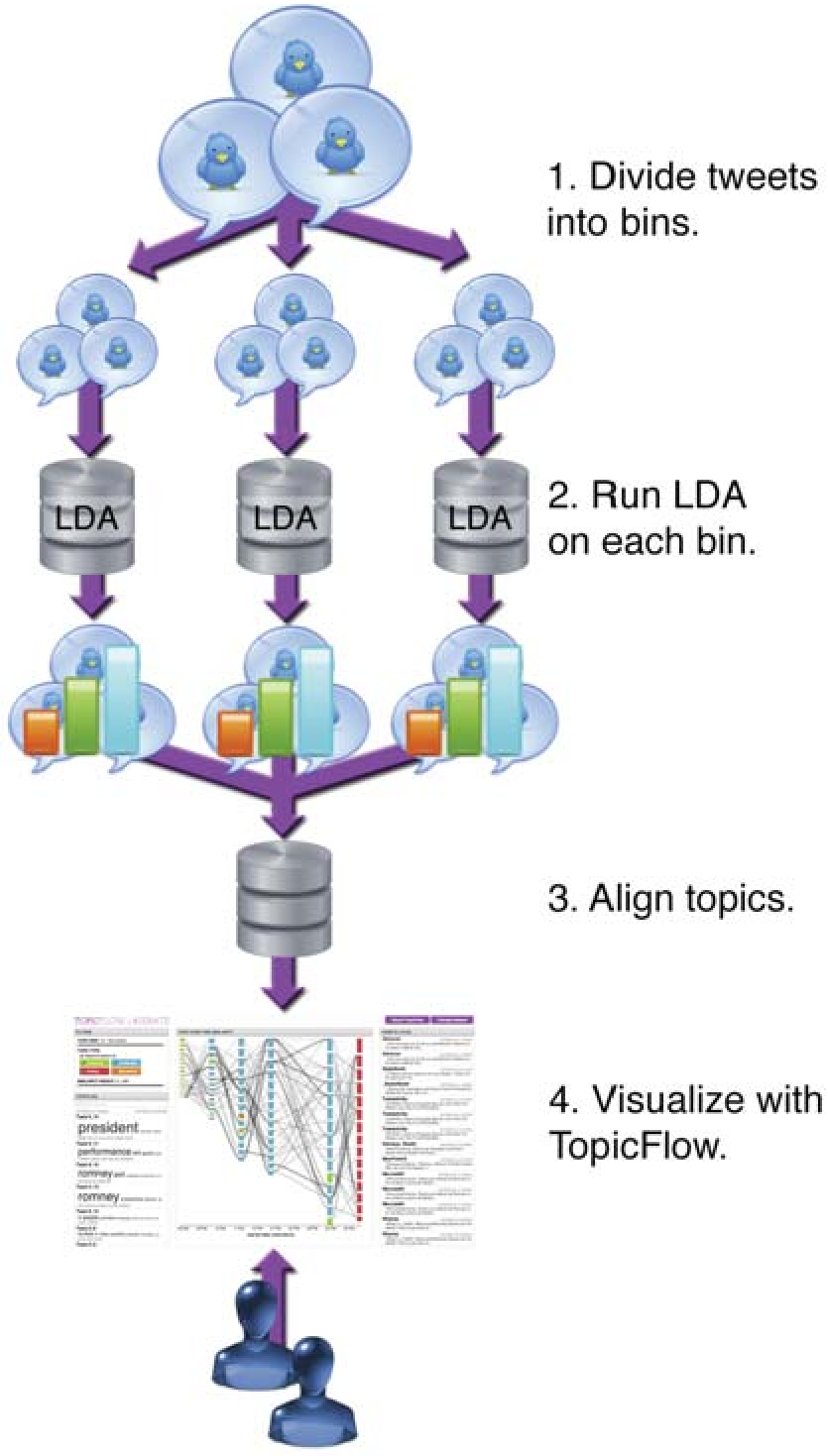
The core innovation lies in the processing pipeline, which moves away from trying to model the entire dataset as one continuous stream.
1. The Binning Strategy
Instead of one large model, the data is partitioned into "bins" (equal time slices). LDA is run independently on each bin. This allows the model to capture the unique "flavor" of a discussion at specific moments (e.g., during a presidential debate vs. after it).
2. Alignment via Cosine Similarity
Since topics in Bin A don't "know" about topics in Bin B, the system aligns them by calculating the cosine similarity of their word distributions. If the similarity exceeds a specific threshold, a "flow" is established.
3. Structural Categorization
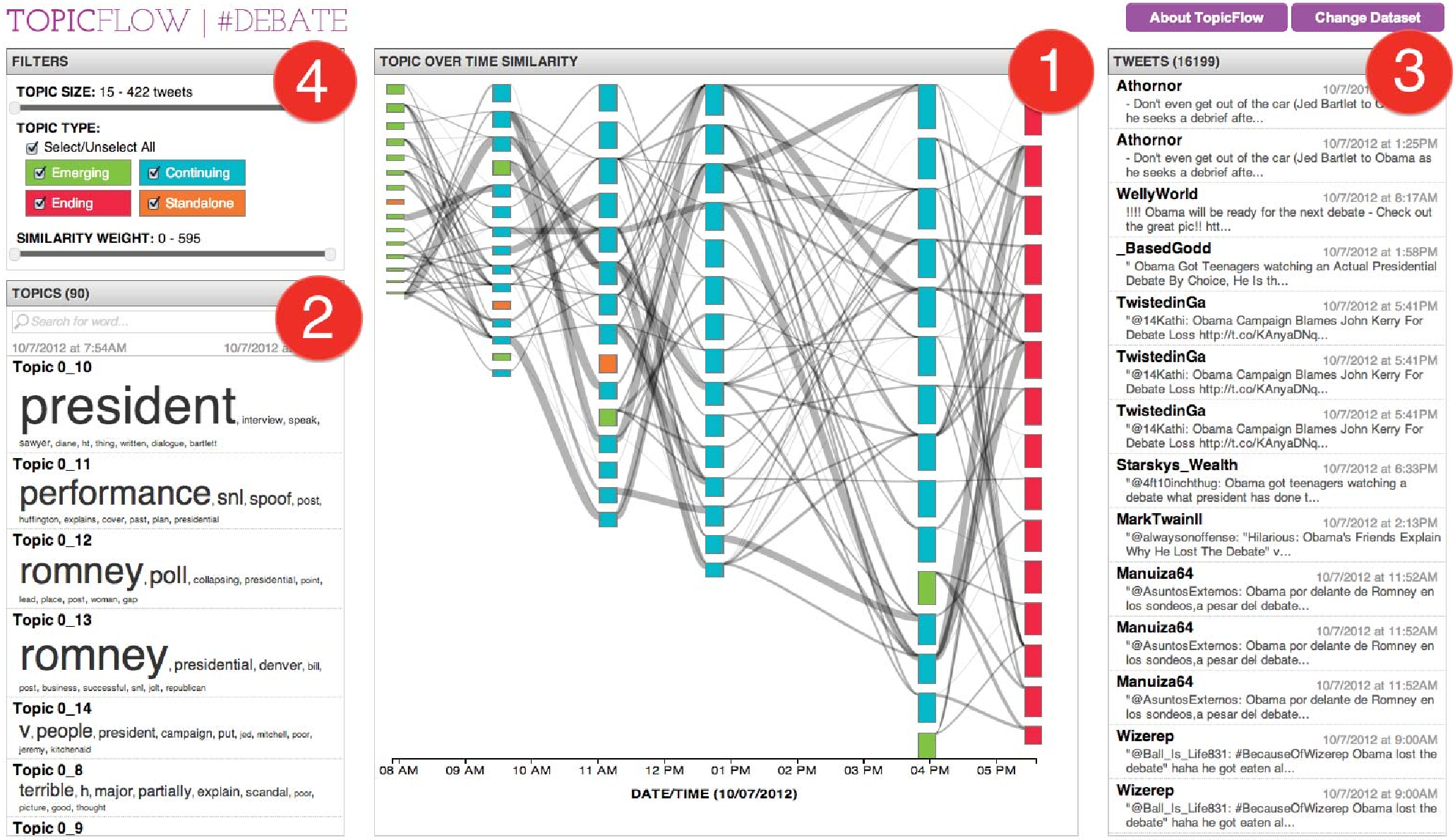
TopicFlow classifies topics into four states:
- Emerging: New discussions.
- Ending: Fading discussions.
- Continuing: Stable topics.
- Standalone: Isolated, short-lived "blips."
Visualizing the "Flow"
The tool uses a Sankey Diagram where nodes represent topics (sized by tweet volume) and edges represent similarity. This makes "convergence" (merging sub-topics) and "divergence" (splitting discussions) visually intuitive.
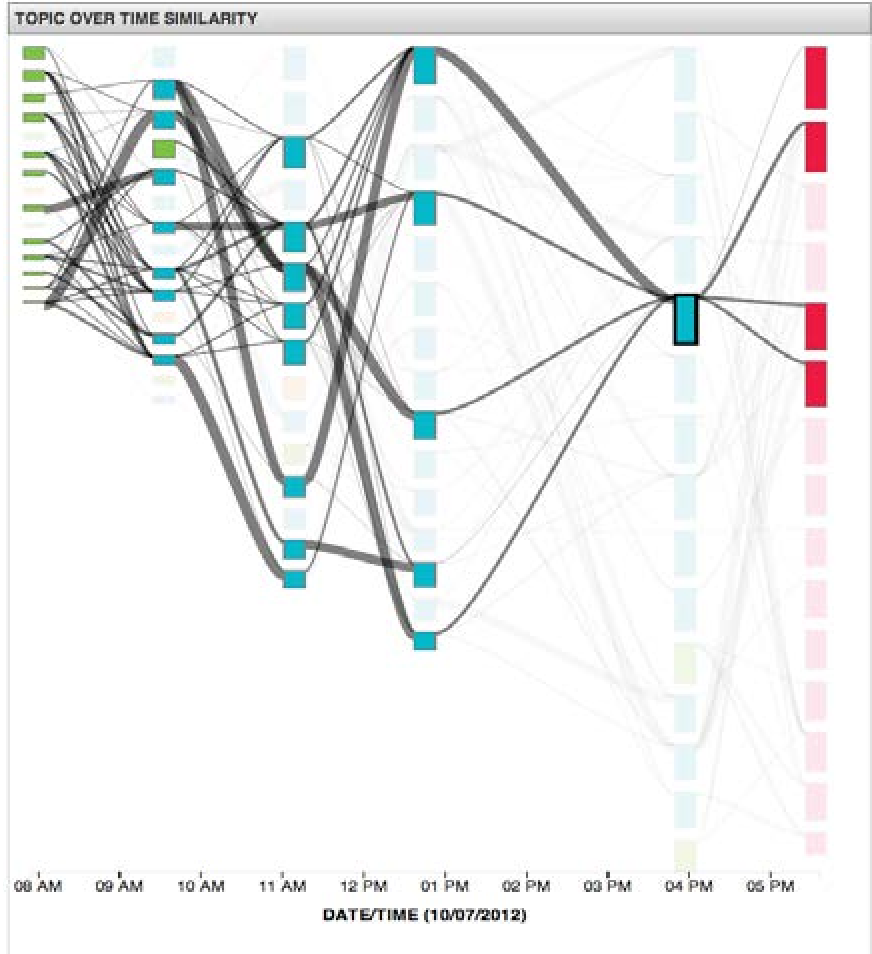
Users can click a topic to isolate its "flow" throughout the timeline, effectively filtering out the background noise of tens of thousands of other tweets.
Performance & Usability
The authors tested the tool on 16,000+ tweets from a 2012 Presidential Debate. The evaluation results (measured via a 20-point Likert scale) showed that for most exploratory tasks, TopicFlow was highly effective:
- Effectiveness for finding emerging topics: 19.1/20
- Speed for word relevance: ~17 seconds.
The main bottleneck identified by users was the "Tweet List"—navigating the raw data is still a challenge, suggesting that summarization techniques might be the next logical step for this research.
Critical Insight: The Value of "Independence"
The most interesting takeaways from this work is that independent models for each time slice—coupled with an external alignment step—can actually be more flexible than joint models (like Topics over Time). Joint models often force topics to be present across the whole timeline, whereas TopicFlow’s "binning" allows for much sharper boundaries when new events suddenly break the news cycle.
Conclusion
TopicFlow remains a foundational example of how to bridge the gap between complex statistical NLP and user-centric visualization. For future products in social listening or media monitoring, the "bin-and-align" approach offers a scalable way to handle the massive, chaotic, and fascinating data of human conversation.