
Beyond Digital PDF Archives: The Evolution Toward Intelligent Journal Systems (IJS)
5930_A Prototype of the Next-Generation Journal System for ITS Academic Social Networking and Media Based on Web 3.0.
This paper proposes an Intelligent Journal System (IJS) for Intelligent Transportation Systems (ITS), transitioning from traditional digital libraries to a Web 3.0-based paradigm. The prototype integrates Application-Specific Knowledge Engines (ASKE) and social multimedia to automate topic trend sensing, expert identification, and collaborative research.
TL;DR
The academic publishing world is on the cusp of a "fourth revolution." This paper introduces a Web 3.0-based Intelligent Journal System (IJS) specifically designed for the Intelligent Transportation Systems (ITS) community. By combining automated knowledge engines (ASKE) with adaptive ontologies, the system moves beyond hosting PDFs to actively sensing research trends, recommending peers, and facilitating global collaboration via social multimedia.
The Problem: The Static Library in a Dynamic World
While scientific publishing moved from paper to digital in the 1990s, the logic of the system remained unchanged. We still treat papers as static documents and journals as passive silos.
- Information Overload: Researchers cannot keep up with the exponential growth of publications.
- Delayed Intelligence: Identifying "hot topics" usually requires manual meta-analysis, which is often out of date by the time it is published.
- Collaboration Silos: Traditional systems do not track the social dynamics (the "Team Science") that actually drive innovation.
Methodology: The Architecture of Intelligence
The core innovation lies in the transition from Web 2.0 (Social) to Web 3.0 (Semantic/Intelligent). The system architecture is built on four pillars:
1. Application-Specific Knowledge Engine (ASKE)
Unlike Google, which is a general-purpose search engine, ASKE is "report-motivated" and "domain-specific." It uses recursive spider agents to crawl not just journals, but also technical reports, industrial news, and social media discussions.
2. Adaptive Ontologies
Knowledge isn't static. The authors utilize Adaptive Ontologies that evolve as new concepts emerge in the field (e.g., the shift from "Traffic Signal Control" to "Autonomous Vehicle Orchestration").
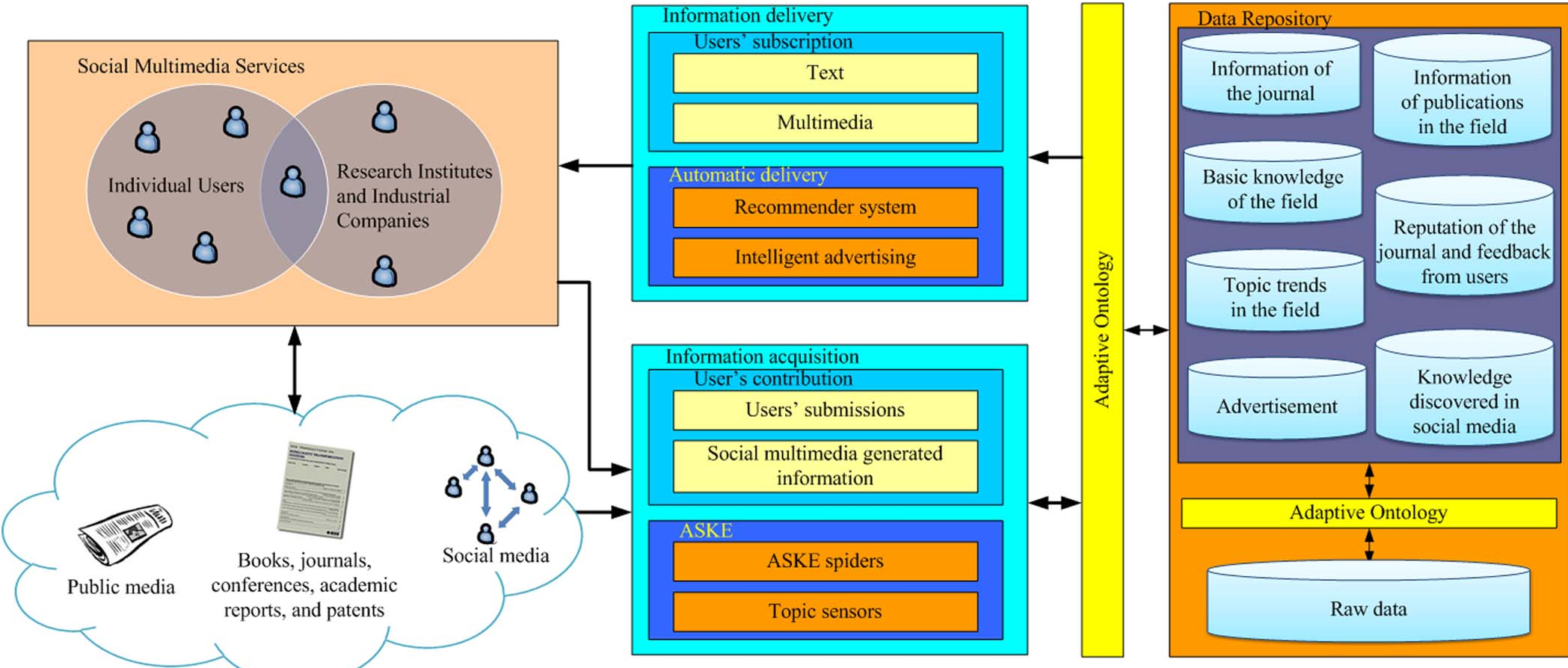 Figure 1: The Multi-layered System Architecture of the IJS, showing the flow from Raw Data to Knowledge Discovery.
Experimental Prototype: IEEE T-ITS Case Study
The authors built a working prototype for the IEEE Transactions on Intelligent Transportation Systems. They ingested nearly 27,000 articles and processed them to reveal the "social brain" of the ITS community.
Topic Sensing and Expert Localization
Through Social Network Analysis (SNA), the system can calculate metrics like Betweenness Centrality and PageRank to identify who is actually facilitating global research collaborations. This allows journal editors to find the best reviewers and for companies to identify the most influential consultants.
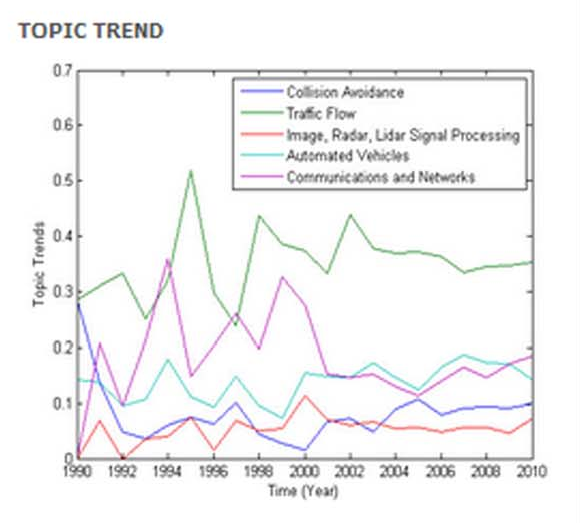 Figure 2: Prototype dashboard showing co-authorship networks (top right) and longitudinal topic trends (bottom right).
Critical Insight: Why This Matters
The fundamental shift here is from Query-Driven to Sensing-Driven. In a traditional system, you find what you know to look for. In an IJS, the system "senses" an emerging trend (like a specific spike in "connected vehicle" discussions on social media) and pushes that intelligence to the relevant stakeholders before they even ask.
Conclusion and Future Outlook
This paper represents a first step toward Academic Intelligence. However, the authors acknowledge that the next phase involves expanding this to the Science of Team Science (SciTS)—optimizing how human researchers collaborate in real-time. While the prototype is focused on ITS, the framework is a universal blueprint for how the "Journal" of the future will function: not as a graveyard for papers, but as a living, breathing social-knowledge engine.
Takeaways
- For Editors: Automated trend tracking allows for more timely "Special Issues."
- For Researchers: Social multimedia integration turns the journal into a constant seminar rather than a yearly publication.
- For Industry: Automated feeds of practical research results bridge the "Lab-to-Market" gap.