
mmETM: Bridging the Semantic Gap in Multi-Modal Social Event Tracking
6077_Multi-Modal Event Topic Model for Social Event Analysis.
This paper introduces the Multi-modal Event Topic Model (mmETM), a framework for social event tracking and evolution analysis. It effectively integrates long text and related images by separating visual-representative topics from non-visual-representative topics to capture complex social media dynamics.
Executive Summary
TL;DR: The Multi-Modal Event Topic Model (mmETM) is a generative framework designed to track and visualize the evolution of social events across modalities. By acknowledging that not all text has a visual equivalent (e.g., "policy" vs. "protester"), it separates topics into visual-representative and non-visual-representative spaces, achieving a 10.4% improvement in tracking precision (MAP) over traditional multi-modal LDA.
Background: This work addresses the shift from simple tagged images to complex documents (long articles + images) in social media analytics. It moves beyond "static" clustering to "dynamic" evolution tracking, positioning itself as a robust solution for large-scale, time-ordered social media monitoring.
Problem & Motivation: The Fallacy of Perfect Alignment
Most prior works in multi-modal topic modeling (like Corr-LDA) operate on a fundamental assumption: For every word, there is a corresponding visual feature. While this works for simple image tagging, it fails spectacularly for professional news and complex social events.
The authors identify a critical "Semantic Asymmetry":
- Visual-Representative Topics: Concrete entities like "Obama" or "Eiffel Tower" which appear in both text and pixels.
- Non-Visual-Representative Topics: Abstract concepts like "Economic Crisis," "Political Reform," or "Legislation" that dominate news text but lack a consistent visual signature.
By forcing abstract text into visual-aligned topics, existing models introduce noise and lose textual nuance. The motivation here is to build a model that knows when to "look" at the image and when to "read" only the text.
Methodology: Decoupling the Latent Space
The core of mmETM is the introduction of a binary switch variable (). This variable determines the generative path for each textual word:
- Shared Path (): The word is generated from a topic space where textual word distributions are correlated with visual region distributions.
- Private Path (): The word is generated from a purely textual topic space, allowing the model to capture abstract semantics without visual interference.
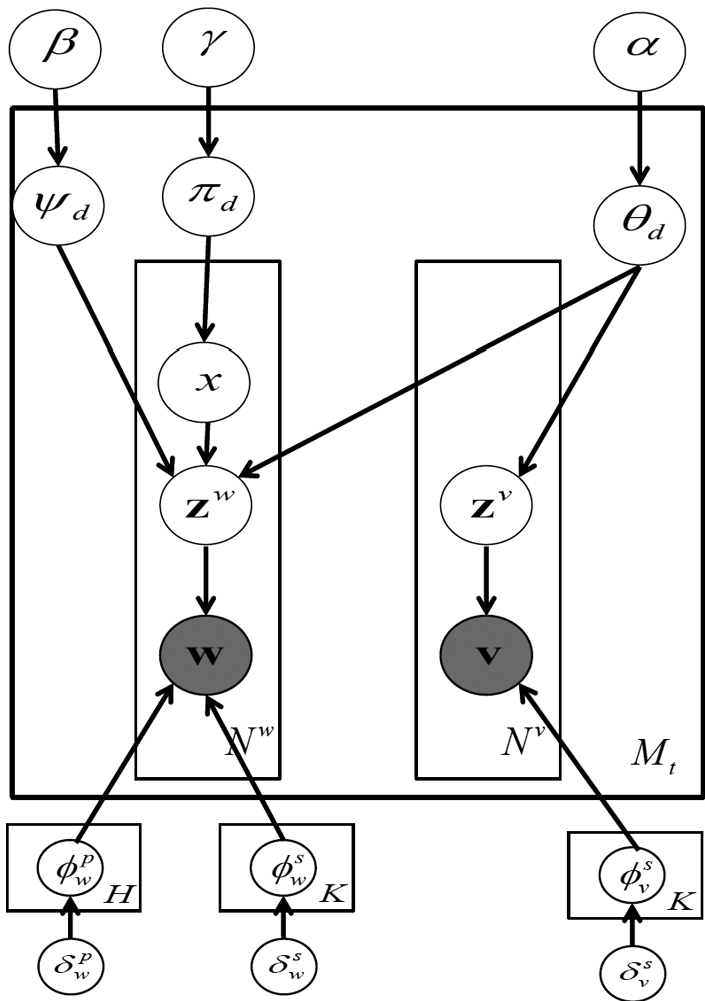
Incremental Learning for Evolution
To handle streaming data, the authors use an Incremental mmETM. Instead of retraining on all past data, the model uses the topic-word counts from the previous time slice (epoch) as the Dirichlet prior for the current slice. This "Empirical Bayes" approach allows the model to "remember" evolution trends while adapting to new stories.
Experiments & Results
The researchers curated a large-scale dataset of 8 major events (e.g., "Occupy Wall Street", "Syrian Civil War") spanning months to years.
1. Qualitative Prowess
As seen in the visualization, mmETM successfully separates concrete entities (Protester, Police) into visual-representative categories while keeping abstract concepts (Business, Rights) in the non-visual space.
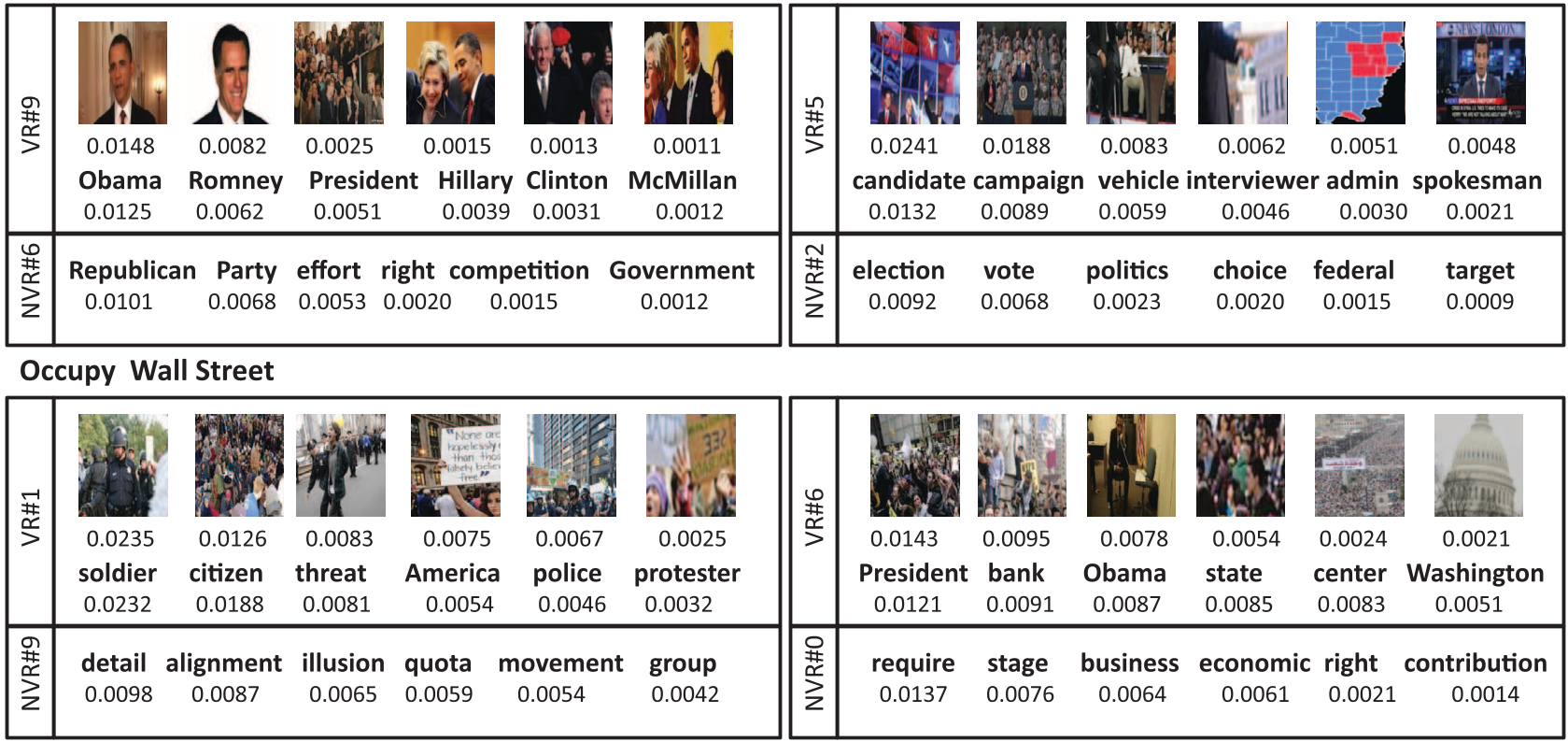
2. Quantitative SOTA
The model was compared against several baselines. The Purity score (quality of topic clusters) and Perplexity (predictive power) both showed that mmETM represents the data more naturally.
| Model | Mean Average Precision (MAP) | Complexity Handling |
|---|---|---|
| LDA (Text Only) | 0.56 | Limited |
| mm-LDA | 0.67 | Assumes perfect alignment |
| mmETM (Proposed) | 0.74 | Hybrid semantic modeling |
3. Scalability
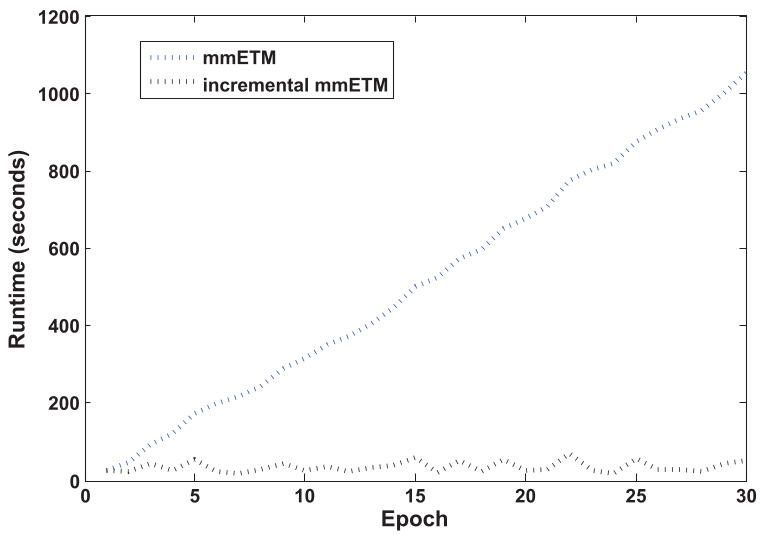
The incremental version maintains a constant computational cost over time, whereas standard batch models grow exponentially in runtime as more social media data is ingested.
Critical Analysis & Conclusion
Takeaway: The mmETM framework is a sophisticated evolution of the LDA family. Its strength lies in its Inductive Bias—modeling the reality that images and text are often complementary rather than redundant.
Limitations:
- The model relies on traditional "Bag-of-Words" and "Bag-of-Regions" features. In the era of Deep Learning, replacing these with CLIP-like embeddings or Vision Transformers (ViT) could likely yield even higher performance.
- The choice of topic numbers ( and ) remains a hyperparameter-sensitive task.
Future Outlook: This methodology provides a blueprint for "Asymmetric Multi-modal Learning." Future work could extend this to video-text fusion or sentiment-aware event tracking, potentially incorporating Large Language Models (LLMs) to define the non-visual topics more dynamically.