
SocioDim: Decoding Collective Behavior through Latent Social Dimensions
6206_Toward Predicting Collective Behavior via Social Dimension Extraction.
The paper introduces SocioDim, a framework designed to predict collective behavior in social media by extracting latent "social dimensions" from network structures. By transforming network connectivity into features through community detection and applying supervised learning, it achieves State-of-the-Art performance in predicting user actions like interests or group subscriptions.
TL;DR
Predicting what a user will do next in a social network is difficult because not all "friends" are equal. This paper introduces SocioDim, a framework that extracts latent social dimensions (like hidden clubs or affiliations) from network structures. By treating these dimensions as features for machine learning, the authors outperform traditional methods and provide a scalable solution for networks with millions of users.
The Heterogeneity Headache: Why Simple Propagation Fails
Most traditional models for predicting collective behavior rely on Homophily—the idea that "birds of a feather flock together." If your friends click an ad, you probably will too. However, the authors argue that social media connections are heterogeneous.
You might have high school friends, work colleagues, and random online followers. If you attend a university football game, your college friends might join you, but your high school friends in another city likely won't. Traditional "Collective Inference" treats all these links the same, leading to "noise" in the prediction. SocioDim solves this by identifying these distinct "dimensions" of your social life before making a prediction.
Methodology: From Links to Dimensions
The SocioDim framework operates in two distinct phases:
1. Social Dimension Extraction
The goal is to find groups of people who interact more frequently than random. The authors explore two views:
- Node-View: Uses modularity maximization or spectral clustering to assign nodes to communities.
- Edge-View: Clusters the links themselves. This is a critical insight: while a person (node) belongs to many groups, a specific friendship (edge) usually belongs to just one (e.g., you only know "User B" from "Work"). This leads to much sparser and more memory-efficient data representations.
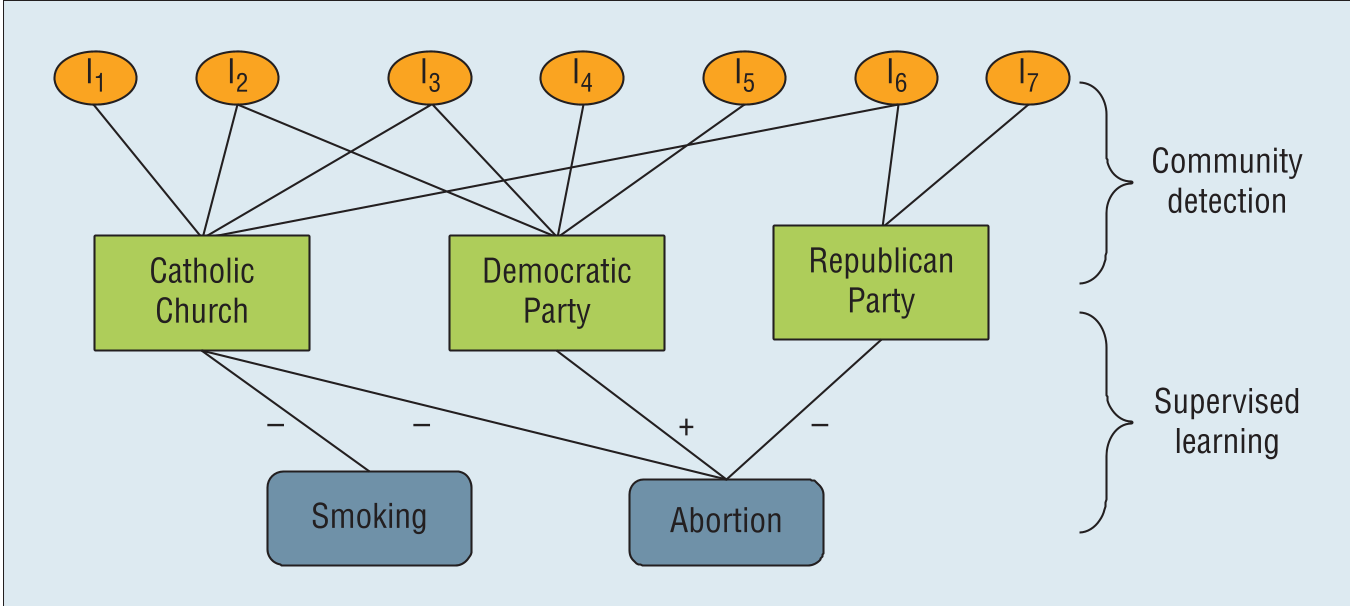 Figure 1: The SocioDim model—Latent affiliations bridge the gap between individuals and their final observed behaviors.
2. Supervised Learning
Once dimensions are extracted, they are treated as features. A classifier (like an SVM or Logistic Regression) is trained to see which dimensions "matter." For example, the "Democrat Party" dimension might be highly predictive of voting behavior but irrelevant to smoking habits.
Experimental Results: Scaling to Millions
The authors tested SocioDim on BlogCatalog, Flickr, and YouTube. The results were clear: SocioDim consistently beats the standard baseline (wvRN).
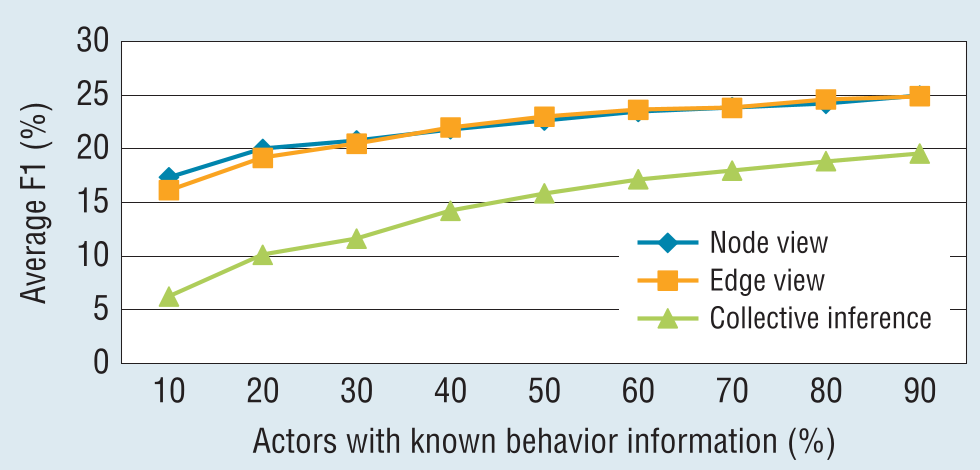 Figure 2: Performance on BlogCatalog. Note how both node-view and edge-view methods significantly outperform the collective inference baseline.
Key Benchmarks:
- Accuracy: Achieved higher F1-scores across all tested social platforms.
- Scalability: Using the edge-view approach, the authors handled a YouTube network of 1.1 million actors and 3 million links in just 10 minutes.
- Efficiency: The sparse representation reduced memory footprint from gigabytes (in node-view) to just 40 MB (in edge-view) for large networks.
Critical Insight: Why This Matters
The true brilliance of SocioDim lies in its ability to turn a linkage problem into a feature problem. By extracting dimensions, the researchers allow us to use standard, highly optimized supervised learning algorithms that we already understand well.
However, the paper acknowledges a limitation: Dynamics. Social networks change every second. Re-calculating social dimensions for a billion users every time a new friend is added remains a challenge. Future work in "online" or incremental community detection will be vital to moving this from the lab to real-time production systems.
Conclusion
SocioDim proves that "who you are affiliated with" is often more predictive than "who you are connected to." By differentiating the types of relations in a network, we move from simple propagation to intelligent, context-aware social prediction.