
Enhancing Knowledge Bases: Bridging Data Facts and Human Intelligence
6444_Knowledge Base Enhancement via Data Facts and Crowdsourcing.
This paper presents a framework for KB enhancement by combining data facts from relational databases with crowdsourcing verification. Utilizing a novel "KD Graph" to model RDF triple updates and their probabilistic confidence, the method achieves significantly higher precision in triple classification (up to 91%) compared to traditional machine-learning baselines like TransR.
TL;DR
Knowledge bases (KBs) like Freebase are essential but notoriously incomplete. This paper introduces a hybrid framework that extracts potential "Probabilistic RDF Triples" (PRTs) from existing databases and uses a budget-optimized crowdsourcing strategy to verify them. By modeling dependencies within a "KD Graph," the authors significantly boost KB precision to 91%, outperforming pure machine-learning baselines.
The Quality Gap in Knowledge Bases
Despite the scale of modern KBs, they are often riddled with "knowledge holes." For instance, 75% of individuals in Freebase lack a nationality. Prior attempts to fix this have relied on automated link prediction (e.g., TransE, TransR). While fast, these methods struggle with the "Precision-Recall Paradox": as you try to find more relationships, the number of false positives skyrockets.
The authors identify two core pain points:
- Missing Relationships: Crucial links between entities are simply not there.
- Low Accuracy: Existing links are often wrong or outdated.
Methodology: The KD Graph and PRTs
To solve this, the paper introduces the KD Graph, which acts as a bridge between structured relational data (Data Facts) and the Knowledge Base.
1. Probabilistic RDF Triples (PRTs)
Instead of a binary "true/false" existence, the authors assign a probability to each triple. This allows the system to handle uncertainty from noisy data sources. The goal is to maximize the total utility () of the KB by confirming these probabilities.
2. The Workflow
The framework follows a four-step cycle:
- Extraction: Identify potential updates from external data facts.
- Modeling: Map these to the KB and construct the KD Graph.
- Selection: Use the Dynamic Split (DS) algorithm to choose the "best" triples to verify within a limited budget.
- Verification: Ask the crowd (via "yes/no" questions) and update the graph using Confidence Voting.
 Fig 1: The overall framework combining Knowledge Bases, Data Facts, and Crowdsourcing.
Overcoming the Budget Bottleneck
The "Budget Enhancement Problem" (BEP) is NP-Hard. If you have 10,000 potential updates but only money to check 100, which 100 do you pick?
The authors' Dynamic Split (DS) algorithm introduces two key innovations:
- Inference Paths: If the crowd confirms "Film A was directed by Director B," and we know "Director B was born in City C," we can infer things about "Film A's" relationship to "City C." This "multi-update" logic makes every cent of the budget count more.
- Pruning: By estimating the maximum and minimum potential benefit of checking a triple, the algorithm can skip low-impact queries, turning an exponential problem into one that is nearly linear in execution time.
Experimental Results: Precision vs. Noise
The authors tested their system on IMDB and DBLP datasets, comparing it against heavyweights like TransR.
- Precision: The crowdsourcing-based approach achieved 91% precision, significantly higher than TransR's 86.5%.
- Robustness: Even when the source data contained 30% errors, the crowdsourcing verification kept the KB utility high.
- Efficiency: The DS algorithm achieved nearly the same utility as the exhaustive SS approach but at a fraction of the time cost.
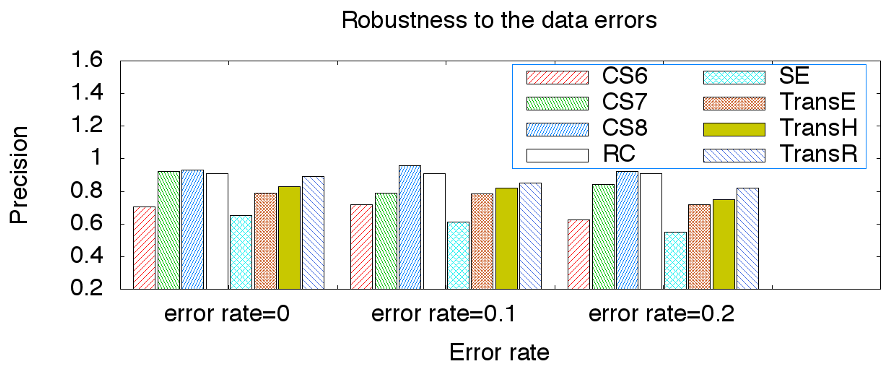 Fig 2: Comparison against baselines. The proposed method remains robust even as data error rates increase.
Critical Insights & Future Work
The real value of this work lies in its inference-based updating. By recognizing that triples are not independent, the system treats the KB as a living network where one confirmed fact ripples through the entire graph.
Limitations:
- Cost: While the budget optimization is clever, crowdsourcing is still more expensive than a GPU-only approach.
- Latency: Human verification introduces a time delay that wouldn't exist in a pure ML pipeline.
Looking Ahead: As Large Language Models (LLMs) become more reliable, we might see the "crowd" in this framework replaced by an LLM-agent, offering the same high precision at a much lower cost and faster speed.
Conclusion
This paper establishes a rigorous mathematical foundation for KB enhancement. By treating human intelligence as a sparse, high-value resource to be optimized, it provides a blueprint for building the next generation of high-fidelity knowledge systems.