
moodle2share: Breaking the LMS Silos with Automated Mobile Social Networks
647_An architecture based on web services for mobile social software.
This paper introduces "moodle2share," a mobile social software architecture based on Web Services designed to automatically create online social networks for Moodle users. By integrating with the Mobile Learning Environment Adapter (MLEA), it enables students to engage in collaborative learning communities through their mobile devices, breaking the rigid barriers of traditional Learning Management Systems (LMS).
TL;DR
The paper "An architecture based on web services for mobile social software" addresses the rigidity of traditional Learning Management Systems (LMS) like Moodle. The authors present moodle2share, an architecture that automatically harvests user interests from forum tags to build dynamic, mobile-based social networks. This allows students to transcend the boundaries of specific classrooms and engage in global "Communities of Practice."
The Problem: The "Walled Garden" of Traditional LMS
Most educational platforms operate as closed patterns. While effective for administrative management, they often replicate a hierarchical model where the student is a passive recipient of knowledge. The authors argue that:
- Geographic and Temporal Limits: Interaction is often bound to a desktop environment or specific course schedules.
- Isolation: Students cannot easily find peers with similar interests if they aren't enrolled in the same specific course module.
- Rigid Interaction: Prior solutions like Mahoodle (Mahara + Moodle) or Megg (Elgg + Moodle) required manual setup and lacked the agility needed for the mobile-first era.
Methodology: A Web-Service Driven Architecture
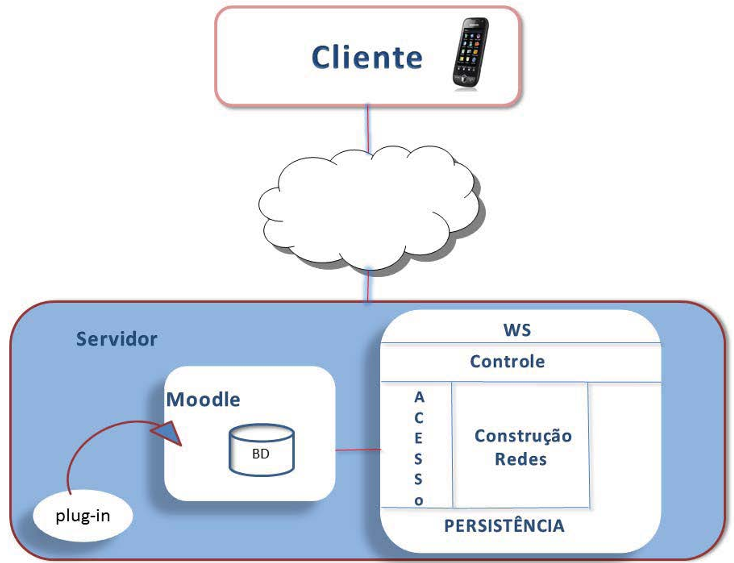
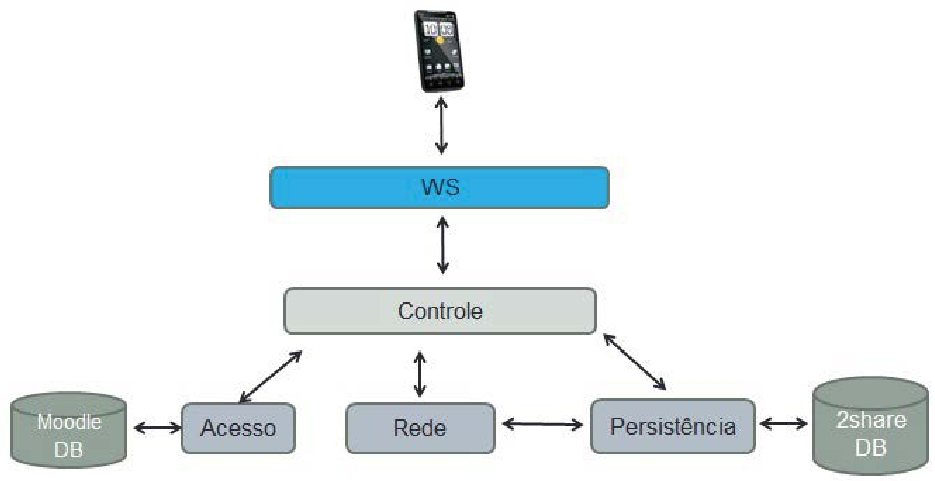
The proposed moodle2share system is built on a robust client-server model designed for interoperability. Unlike older plugins, it uses a dedicated Web Services (WS) layer as the primary communication bridge.
The Core Components:
- Mobile Client: An Android-based interface (integrated with MLEA) for user interaction.
- Access Module: The "intelligence" of the system, which queries the Moodle database to identify users based on "Tags" (keywords) associated with their forum activities.
- Network Construction Module: Orchestrates the logic of forming communities by filtering candidates who are active on the moodle2share platform.
How It Works: The "Automatic Network Construction" Pipeline
The magic happens when a student encounters a difficult topic in a forum. Instead of waiting for a single professor's reply, the student triggers the social network creation:
- Tag Extraction: The system identifies the "Tag" (e.g., #JavaProgramming) of the discussion.
- Interest Matching: The Access Module finds every student across the entire Moodle installation who has participated in threads with that specific tag.
- Instance Creation: A new social community is spawned, and candidates are invited or joined based on their preferences.
Critical Insight: Why Web Services?
By utilizing Web Services rather than deep-linking into the Moodle core code, the authors achieved an extensible system. This choice allowed them to integrate with the Mobile Learning Environment Adapter (MLEA), proving that social learning can be a "transparent" layer over existing educational tools rather than a cumbersome replacement. It transforms the LMS from a simple repository into a living social graph.
Future Outlook & Limitations
While pioneering for its time (2012), the architecture relies heavily on manual "tagging" by professors and students. Modern implementations would likely replace this with AI-driven topic modeling. However, the core takeaway remains relevant: effective M-Learning is not just about bringing the content to the phone, but bringing the community to the user's pocket.
Key Achievements:
- Deployment of an automated community formation logic.
- Seamless integration between Moodle and mobile-native environments.
- Support for "Communities of Practice" (CoP) that transcend traditional physical and digital classroom walls.