
Spread-It: Strategic Maneuvering in the Chaos of Social Diffusion
6487_Spread-It A Strategic Game of Competitive Diffusion Through Social Networks.
This paper introduces "Spread-It," a two-player strategic game designed to model competitive information diffusion through social networks. The study evaluates various AI agents, demonstrating that Monte Carlo Tree Search (MCTS) significantly outperforms traditional alpha-beta pruning methods in both competitive scenarios.
TL;DR
Information diffusion isn't just about who starts the fire; it's about how you manage the oxygen in a competitive environment. The paper "Spread-It" transforms this into a zero-sum game, proving that in volatile networks where "zero loyalty" exists, the classic obsession with "network hubs" is a strategic trap. The authors show that Monte Carlo Tree Search (MCTS) is the superior tool for navigating the unpredictable cascades of social influence.
Background: Beyond Simple "Infection"
Traditional models of influence—like the Linear Threshold (LT) model—treat social change like a terminal disease: once you're "infected" with an opinion, you stay infected. In reality, people are fickle. "Spread-It" introduces the Zero Loyalty Variant, where nodes can flip back and forth between two colors (Red and Black) indefinitely. This mimics modern political debates or brand competitions where consumers switch preferences based on the latest interaction.
The Mechanics: Tokens, Thresholds, and "Explosions"
The game is played on any undirected graph .
- Resource Allocation: Each player gets a limited budget of tokens.
- Threshold Firing: Every node has a threshold (usually its degree). When tokens on a node reach , it "explodes."
- The Winner-Takes-All Rule: Upon explosion, the player with the majority of tokens on that node wins the site, converts all existing tokens to their color, and sends one token to all neighboring nodes.
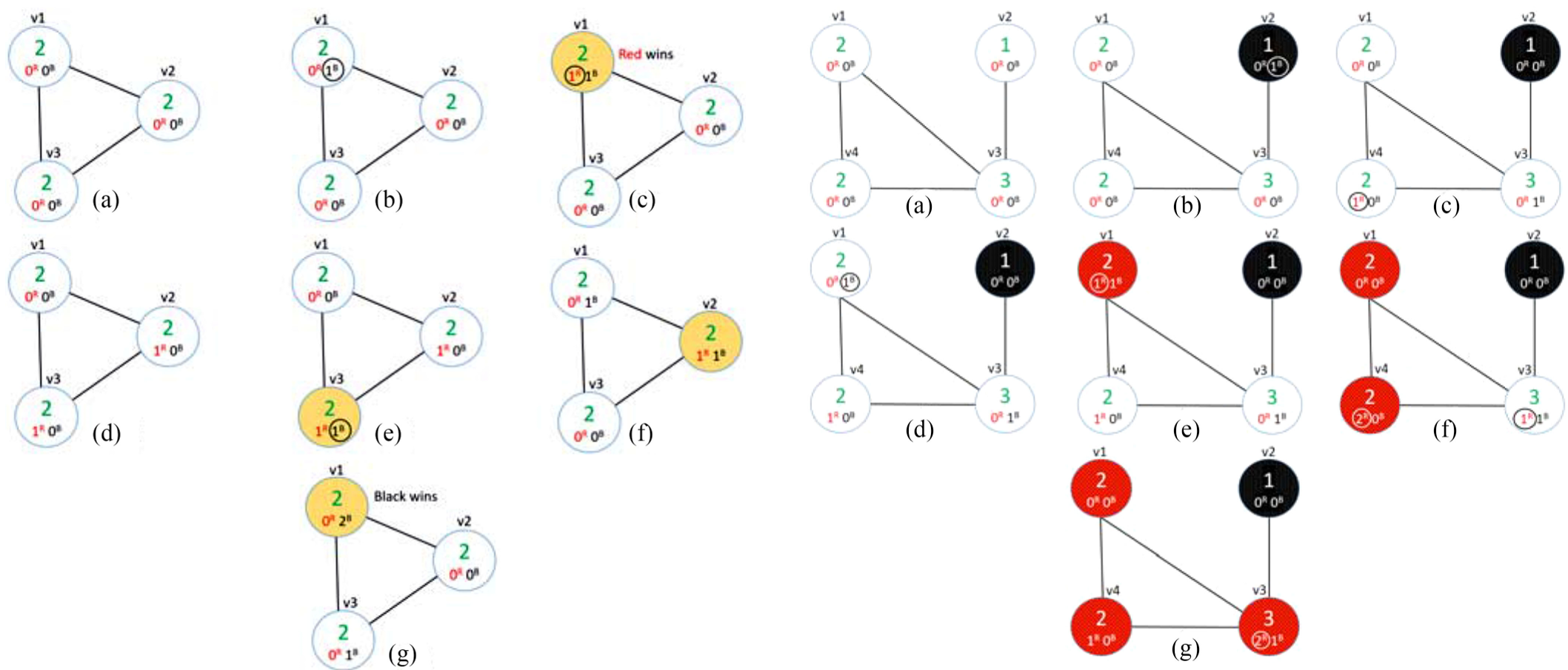 The figure above demonstrates the zero-loyalty variant where an explosion chain can flip the board state entirely.
Methodology: The AI War
The authors tested three classes of agents:
- Alpha-Beta Agent: Uses Minimax with pruning and a complex Linear Combination (LC) heuristic (Parity, Stability, Hubs, Mobility).
- MCTS Agent: Uses the Upper Confidence Bound for Trees (UCT) algorithm. It doesn't rely on heuristics but simulates games to find the most promising paths.
- Dummy Agent: Random moves to set the baseline.
Why MCTS Wins
MCTS excels because the "Spread-It" board is chaotic. A single explosion can trigger a cascade that flips nodes across the entire graph. Where Alpha-Beta's fixed depth struggles to "see" the long-term impact of these chains, MCTS's probabilistic simulations capture the deep systemic consequences of a single token placement.
Experiments & Deep Insights
The research utilized 15 synthetic graphs ranging from Small-World to Barabási-Albert (Scale-Free) models.
1. The Fall of the "Hub" Heuristic
One of the most striking findings is the role of central nodes. In the "Full Loyalty" variant (where decisions are permanent), the MCTS agent actively sought out hubs. However, in the Zero Loyalty variant, the agent treated hubs no differently than average nodes.
Reasoning: In a flipping-prone environment, "Hubs" are dual-edged swords. Winning a hub is powerful, but because it is connected to many nodes, it is also a massive target for the opponent to flip, potentially weaponizing that same connectivity against you.
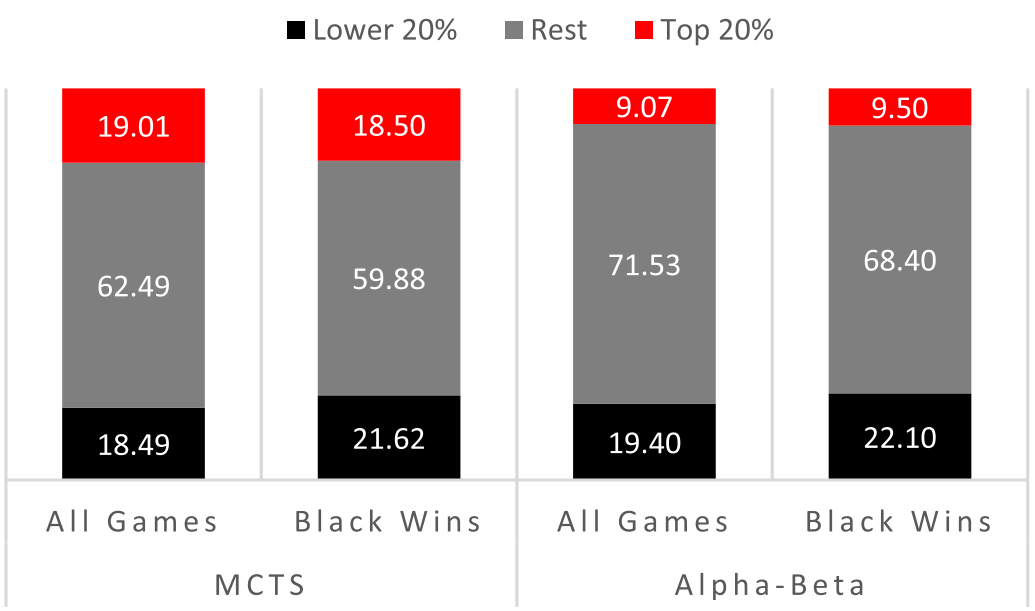 In zero-loyalty games, MCTS (Left) shows significantly less preference for hubs compared to more stable game variants.
2. Efficiency vs. Degree
When the "cost" (threshold) of a node was lower than its "degree" (potential impact), both agents immediately shifted focus to those nodes. This confirms that the ROI of influence effort is more critical than the sheer size of a node's reach.
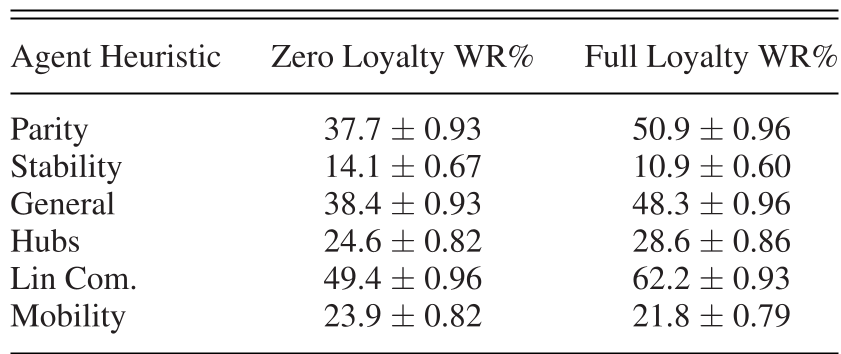 Table VII: Comparison of different heuristics within the Alpha-Beta framework. The Linear Combination (LC) heuristic, optimized via machine learning, proved the most effective baseline.
Critical Analysis & Conclusion
This work challenges the "Hub-centric" dogma of social media marketing. When loyalty is low, the network's topology matters less than the immediate dynamics of the "flipping" cascades.
Limitations: The model assumes perfect information, which is rare in real marketing or political wars. Future extensions into "Fog of War" scenarios (Incomplete Information) or dynamic graphs (where edges appear/disappear) would further ground this in reality.
Takeaway: If you are in a high-loyalty market (selling cars, premium software), go for the hubs. If you are in a low-loyalty market (viral social media trends, FMCG), focus on state-based reactivity and "energy-efficient" nodes rather than the most connected ones.