
Beyond Source Code: Formalizing Coupling Metrics for Ontology-Based Systems
6614_Coupling Metrics for Ontology-Based Systems.
This paper introduces a specialized suite of coupling metrics—NEC, REC, and RI—designed for Ontology-Based Systems (OBS) represented in OWL. These metrics evaluate the structural complexity and dependencies between ontologies to predict the maintainability and quality of Semantic Web applications.
TL;DR
As the Semantic Web and service-oriented architectures evolve, the "data" (ontologies) increasingly acts as the "interface." This paper introduces a formal suite of metrics—NEC, REC, and RI—specifically designed to measure how tightly intertwined different ontologies are. By quantifying external dependencies in OWL files, developers can predict system complexity and choose integration strategies that minimize fragility.
Background: The Shift from Code to Data
In traditional software engineering, coupling measures the strength of relationships between code modules. However, in the era of the Semantic Web (OWL/XML), ontologies are the modules. The challenge is that ontologies are declarative data structures rather than imperative code. High coupling here doesn't just mean a messy codebase—it means that if a remote URL hosting an ontology goes down, your entire business logic might collapse.
Methodology: The NEC, REC, and RI Suite
The authors define three core metrics to capture the "interconnectedness" of an ontology ():
- Number of External Classes (NEC): Counts the distinct classes defined outside of the current ontology but used within it.
- Reference to External Classes (REC): Measures the total counts of all references to those external classes (similar to "fanout" in software).
- Referenced Includes (RI): Counts the number of
includeornamespacestatements at the top of the OWL/XML document.
Formal Definitions
The metrics utilize formal set notation to map classes () to properties () and external references ():

The REC metric is particularly vital because it identifies the density of dependencies. An ontology might only reference one external class (low NEC) but reference it 100 times (high REC), creating a heavy dependency on that single external point of failure.
Experimental Validation
To ensure these metrics weren't just theoretical, the team developed the Ontology Metrics Parser (OMP) and ran it against 33 real-world ontologies.
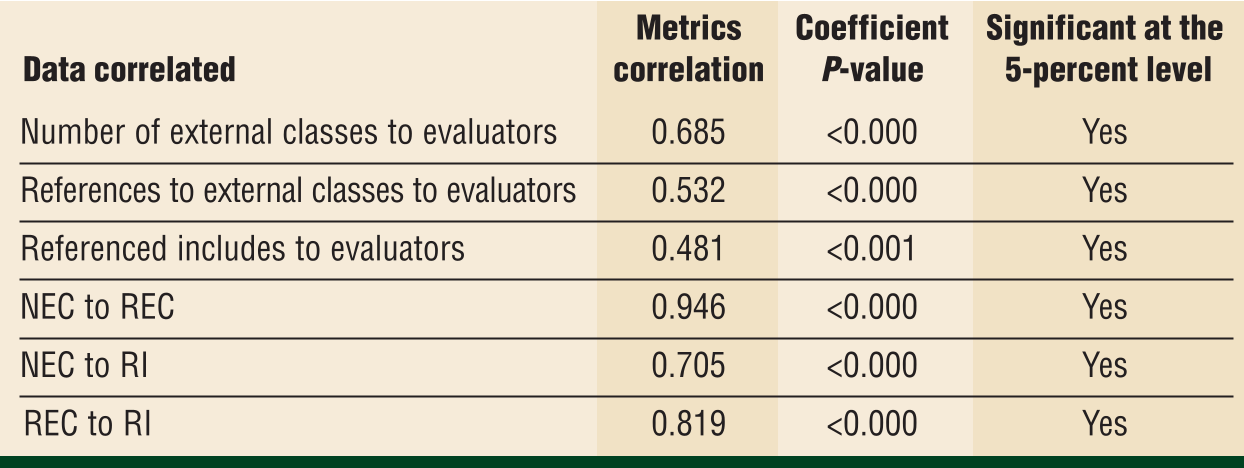
- Human-in-the-loop: 18 evaluators (averaging 3.5 years of experience) manually rated the "coupling" of these ontologies.
- Statistical Alignment: The correlation between the metrics and human expertise was "Large" (NEC: 0.685). This proves that the automated count reflects what senior developers intuitively feel is a "complex" or "tightly coupled" system.
Case Study: Genomics Integration
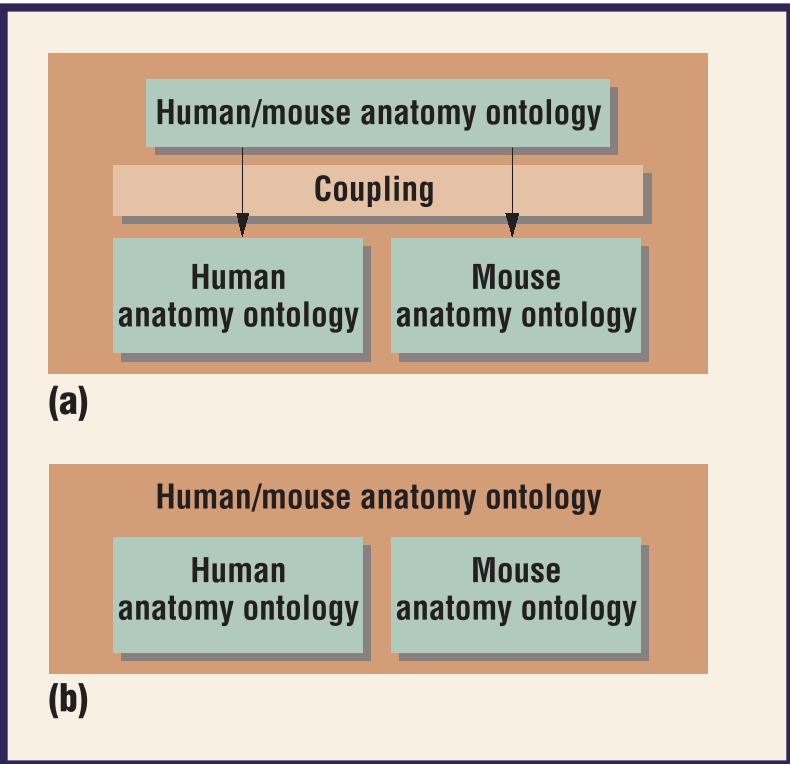
In bioinformatics, researchers often need to merge Human and Mouse anatomy ontologies. The paper compares three strategies:
- Layered: High flexibility, but maximum coupling (High NEC/REC). Very fragile.
- Non-layered: No coupling, but the resulting file belongs to a "Monolith" that is too large to comprehend.
- Hybrid: A strategic mix. Using REC metrics, developers could identify which concepts to "include locally" and which to "reference externally" to find the "sweet spot" of maintainability.
Critical Insight & Conclusion
The true value of this work lies in early-stage quality control. By measuring NEC and REC before the system is even built, architects can spot "dependency hell" in the data layer.
Limitaiton: While these metrics are robust for OWL/XML, they do not yet account for the runtime behavior of reasoners, which might infer even more couplings that aren't syntactically explicit.
Takeaway for the Industry: Software quality isn't just about clean code; it's about clean data relationships. As we move toward more "Semantic" and "Agent-based" systems, ontology metrics will become as standard as "Line of Code" or "Cyclomatic Complexity" are today.