
sonLP: Solving the "Needle in a Haystack" Problem in Social Link Prediction
6653_sonLP social network link prediction by principal component regression.
The paper introduces sonLP, a novel link prediction framework for social networks based on Principal Component Regression (PCR). It achieves a near-perfect AUC (0.997) in coauthorship prediction tasks, outperforming state-of-the-art methods like HPLP+ and various supervised learning baselines.
TL;DR
Predicting who will become friends or collaborators in a social network is notoriously difficult because "non-links" vastly outnumber "links." sonLP tackles this by moving away from purely topological data (like who your friends-of-friends are) and using Principal Component Regression (PCR). It achieves an astounding 0.997 AUC on realistic, imbalanced datasets, proving that linear statistical methods can outperform complex machine learning models when handled correctly.
The "Sparsity" Trap in Link Prediction
In a typical social network, the number of possible connections is astronomical, but only a tiny fraction actually form. This is the Link Imbalance Problem.
Most academic papers "cheat" by training and testing on a 1:1 ratio of links to non-links. However, in the real world (like the ACM coauthorship network), that ratio is closer to 11,000:1. When traditional models like SVM or Random Forests face this reality, they often collapse, producing a flood of false positives.
Methodology: The sonLP Pipeline
The authors argue that we need two things: multi-dimensional features (looking at affiliations, research interests, and citations) and a robust mathematical foundation to handle noise.
1. Feature Engineering Across Dimensions
Instead of just looking at the graph structure, sonLP looks at:
- Citations: Who cites whom?
- Affiliations: Did they work at the same university?
- Interests: Do they publish in the same sub-fields?
2. The PCR Engine
The core of sonLP is a three-step process:
- PCA (Principal Component Analysis): It takes correlated features and turns them into independent "Principal Components."
- Feature Selection: Using H-means clustering, it automatically picks the most representative features, trimming the "noise."
- Regression: It uses Linear Regression on these components to predict the probability of a link.
 Note: The model focuses on transforming raw social data into an optimal feature set before regression.
Experimental Showdown
The authors tested sonLP against powerful baselines including HPLP+ (State-of-the-art Random Forest) and SVM.
The Robustness Factor
The most striking result is found when the ratio of negative to positive links increases. While other models' performance (AUC) drops like a stone, sonLP remains near-perfect.
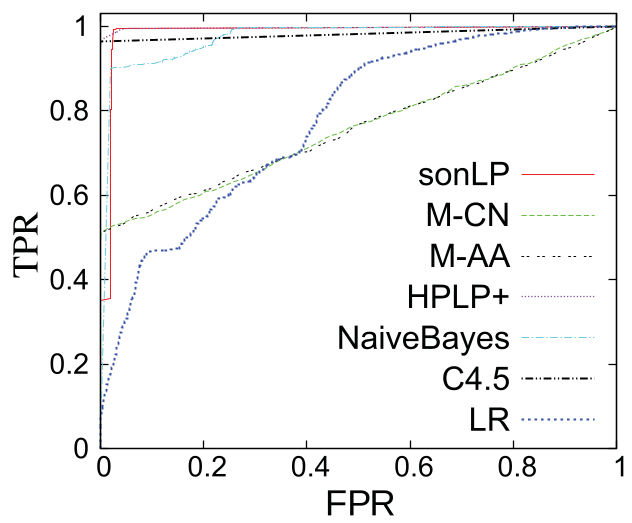 Figure 2: ROC curves for realistic samples. sonLP (top left curve) stays closest to the "ideal" predictor.
As seen in the data, sonLP achieved a Precision/Recall of 0.855 at realistic scales, while traditional supervised methods like C4.5 or SVM struggled significantly with either precision or training time.
Why It Works: Academic Insight
Why does a "simple" regression model beat a Random Forest?
- Information Gain: By using citation and affiliation data, sonLP captures the social intent that graph topology alone misses.
- Noise Reduction: PCA naturally filters out the "chatter" in the data, which is crucial when dealing with sparse datasets.
- Efficiency: With O(n) complexity, sonLP is vastly more scalable for "Web-scale" social networks compared to localized graph metrics that require complex path calculations.
Future Outlook and Limitations
While sonLP is a breakthrough in robustness, it relies on having rich "extra-dimensional" data (like publication records). In networks where only the "follow" graph is known (like a bare-bones Twitter scrape), sonLP’s advantage might narrow. However, for enterprise networks, LinkedIn, or academic graphs, this PCR-based approach is clearly the new SOTA for handling imbalanced data.
Conclusion
sonLP proves that sophisticated feature selection combined with classic regression can solve one of the hardest problems in social network analysis. By focusing on sparsity and multi-dimensionality, it provides a blueprint for the next generation of "People You May Know" algorithms.