
Strategizing the Clock: How Startups Navigate Incumbent Fire and Peer Learning
6718_Time Allocation in Entrepreneurial Selling Impact of Consumer Peer Learning and Incumbent Reaction.
This paper presents a game-theoretic model to optimize time allocation for technology entrepreneurs during the early selling phase. It identifies how the interplay between "Consumer Peer Learning" (influential buyers acting as free advertising) and "Incumbent Reaction" (defensive strategies by established firms) dictates the optimal pursuit of potential customers.
TL;DR
For a technology entrepreneur, time is the scarcest currency. This paper moves beyond the mantra of "just target influencers" and provides a rigorous mathematical framework showing that the best sales strategy often involves avoiding the biggest or most influential customers if they trigger a disproportionate defensive response from an incumbent firm.
Background: The Entrepreneur's Triad of Shortages
Most startups fail not because their technology is bad, but because they cannot navigate the "Initial Sales" phase. The authors argue that entrepreneurs face three specific shortages:
- Resources: Usually, only the founder has the passion to sell.
- Reputation: Consumers doubt the "superior" claims of a newcomer.
- Routines: There are no established sales channels to lean on.
In this vacuum, two market dynamics take over: Consumer Peer Learning (where one buyer's choice signals quality to others) and Incumbent Reaction (where the big player fights to keep its lunch).
Methodology: Selling as a Stochastic Sampling Process
The paper treats selling as a process of reducing variance.
- The Model: The entrepreneur's product has true value , while the incumbent's is .
- The Uncertainty: Consumers only see a noisy version of (reputation variance ).
- The Lever: By spending time (), the entrepreneur "samples" the product's value for the customer, helping the customer's belief converge toward the true value.
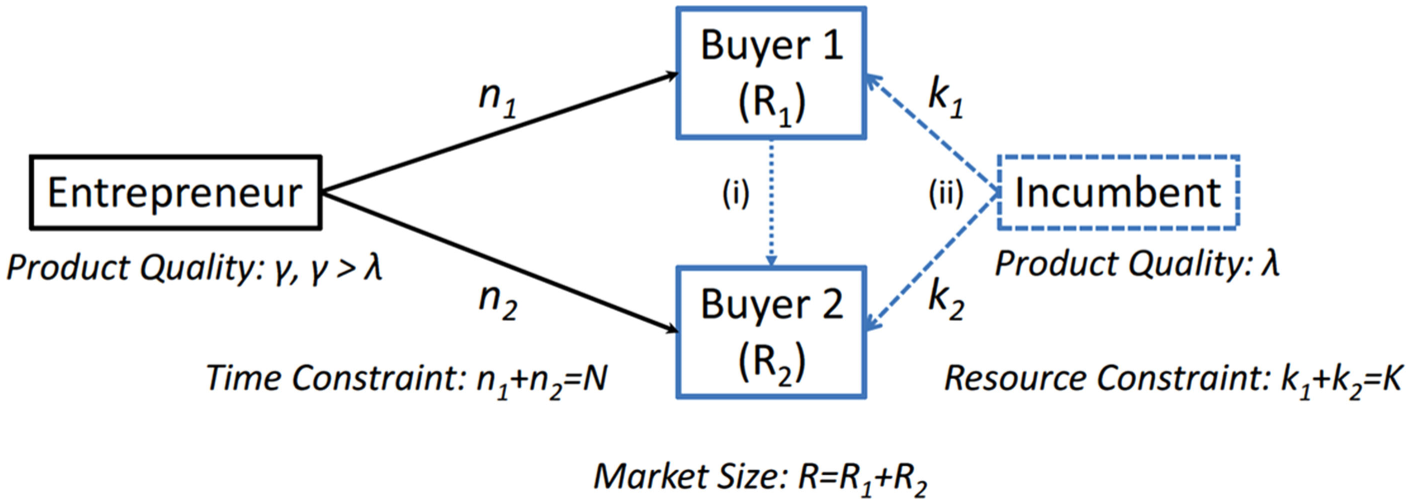 The sequence of events: Entrepreneur allocates time Incumbent reacts with benefits Buyers learn and purchase.
The "Influencer Trap" vs. The "Incumbent Shield"
The core of the paper analyzes four scenarios. The interaction of Peer Learning and Incumbent Reaction yields a fascinating counter-intuitive result (Proposition 4).
1. Peer Learning Only (The Case for Influencers)
If there is no incumbent threat, the entrepreneur should almost always focus on the influential buyer (Buyer 1). Even if Buyer 1 brings in less direct revenue, their "free advertising" effect makes it worth the effort.
2. Incumbent Reaction Only (The Tactical Retreat)
Incumbents fight harder for high-revenue customers. Because it is easier for an incumbent to retain than for a startup to acquire, the entrepreneur should often target the "smaller" customer to avoid a costly war of attrition.
3. The Combined Effect (The Non-Monotonic Reality)
When both factors are present, a "zig-zag" strategy emerges.
- High R1/R2: Target the influencer. The revenue and social proof outweigh the incumbent's fire.
- Low R1/R2: Target the influencer. The incumbent doesn't care enough to fight for a small segment, but you still get the "peer learning" bonus.
- Equal R1/R2: Avoid the influencer. This is the "trap." The incumbent will fight tooth and nail to defend the influencer to prevent the peer-learning effect, making your sales effort inefficient.
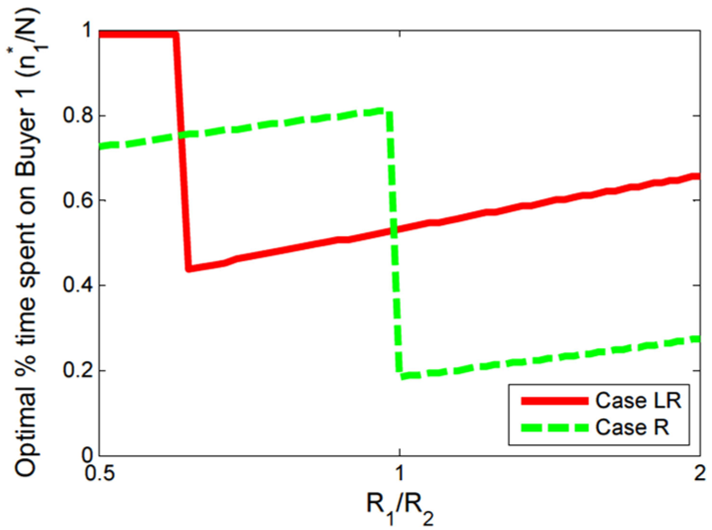 Experimental results showing the discontinuity in time allocation when incumbent reaction is introduced (Case LR).
Experimental Validation
Using numerical simulations (N=200, various R ratios), the authors show that the optimal proportion of time spent on Buyer 1 drops significantly when the incumbent realizes that Buyer 1 is influential. The incumbent is willing to over-spend on defense to "mask" the startup's success from the rest of the market.
Critical Insight & Practical Takeaway
The paper’s "Practical Rule of Thumb" (Figure 6) is a vital matrix for any B2B founder.
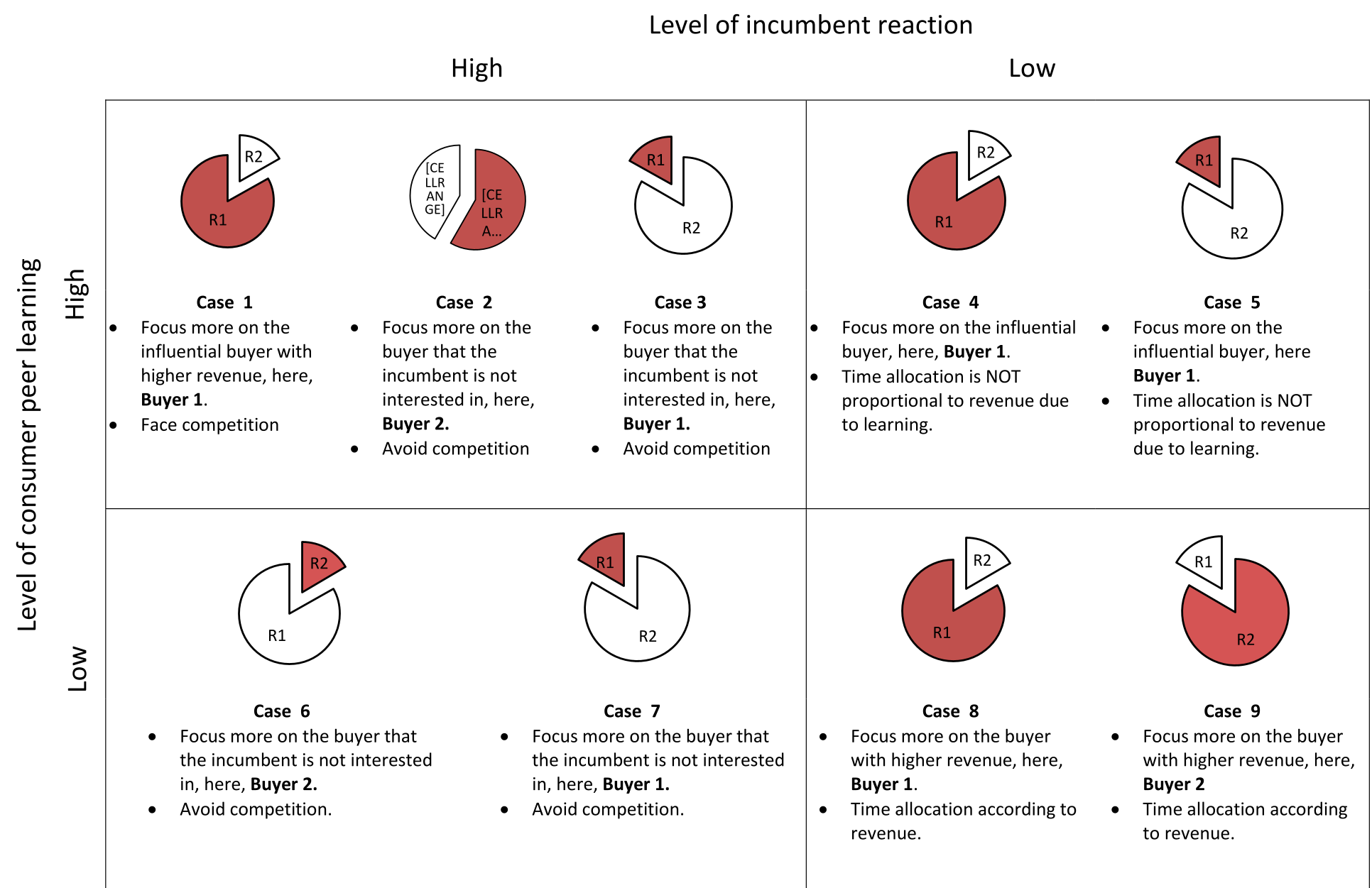
The Takeaway: Don't just follow the "influencer" hype. Analyze your incumbent. If your incumbent is reactive and your target influencer is also a major revenue source for them, you might be better off building a base in a quieter, less "influential" segment first.
Conclusion
This work bridges the gap between high-level entrepreneurship theory and tactical operations. It reminds us that "Superior Technology" is a necessary but insufficient condition for market entry. Success is found in the math of time allocation—knowing when to fight for an influencer and when to fly under the incumbent's radar.