
The Social Trap: Why "Popular" Nodes Might Be Bad for Information Spread in OSNs
6737_Dissemination in opportunistic social networks the role of temporal communities.
The paper introduces a methodology to extract "temporal communities" from opportunistic social network (OSN) traces, identifying persistent clusters of nodes that correlate with real-world social ties. It evaluates these structures across four datasets (INFOCOM, SIGCOMM, Reality, Strathclyde) to redefine the roles of nodes in content dissemination.
TL;DR
In the world of Opportunistic Social Networks (OSNs), we often assume that the most "social" people—those with the highest contact rates—are the best at spreading information. This paper challenges that dogma. By decomposing mobility traces into Temporal Communities, the authors reveal a counter-intuitive truth: the most effective information bridges are not the social butterflies settled in their cliques, but the nomadic "non-social" nodes that traverse the gaps between groups.
Background: Beyond Pairwise Contacts
Traditionally, researchers viewed opportunistic networks as a series of isolated, pairwise encounters. However, humans are social animals; we don't just bump into individuals; we gather in groups. This paper shifts the perspective from who meets whom to who belongs to which temporal group, providing a much clearer picture of the "Small World" phenomenon in mobile environments.
Methodology: Detecting the Pulse of a Community
The authors propose a robust two-step pipeline to identify these structures:
- Snapshot Partitioning: Using the Louvain algorithm, the contact graph is sliced into time-based snapshots. Each snapshot is analyzed to find dense clusters (maximizing "Modularity").
- Temporal Aggregation: These clusters are then linked across time using the Jaccard Index. If a group of nodes appears together consistently (even if not consecutively), they are flagged as a Temporal Community.
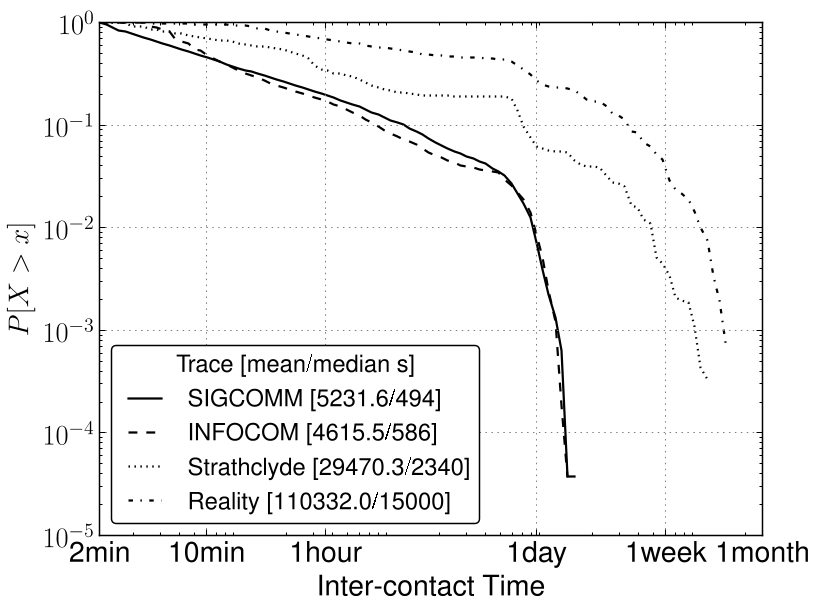 Figure 1: Comparison of contact and inter-contact durations across different experimental environments.
The Core vs. The Cover
One of the paper's key insights is the definition of the "Core"—the subset of members who are present in every session of a temporal community. While many nodes might drift in and out (the "Cover"), it is the Core that defines the social signature of the group, showing high correlation with real-life affiliations like home cities or Facebook friendships.
Results: The Power of the "Non-Social" Bridge
The most striking finding comes from the efficiency analysis of epidemic dissemination. The authors categorized nodes into four groups based on their Contact Rate (HCR/LCR) and their Sociality (time spent in communities).
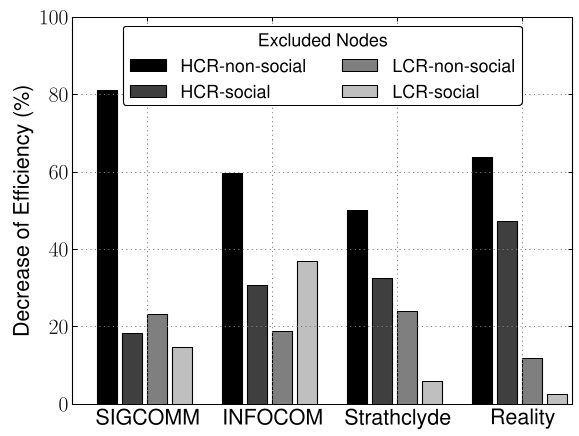 Figure 2: Performance drop when different node categories are removed. Note the massive impact of Non-Social HCR nodes.
When Non-Social High Contact Rate (HCR) nodes were removed, the network's ability to spread information collapsed by up to 80%. In contrast, removing Social HCR nodes—people who talk a lot but only within their fixed circles—had a much smaller impact.
Why does this happen?
Nodes embedded in temporal communities suffer from a "clique effect." Most of their contacts are redundant; they keep talking to the same people who already have the information. The "Non-Social" HCR nodes act as the weak ties (as per Granovetter's theory), carrying data across the "primordial soup" of the network into new, isolated clusters.
Critical Insight & Future Outlook
This work highlights a critical design flaw in many early opportunistic routing protocols: Centrality is not enough. Being "central" within a community makes you a local authority, but being "central" to the flow between communities makes you a global disseminator.
Limitations
- Data Aging: The traces used (INFOCOM 2006, SIGCOMM 2009) pre-date the era of ubiquitous 5G and ubiquitous mobile data, which might change the incentive for opportunistic "store-and-forward" behavior.
- Node Sparsity: In sparse campus environments, the community structures are harder to define than in dense conference halls.
Final Takeaway
If you want to design a robust decentralized network, don't look for the most popular people at the party; look for the ones moving between the different groups of friends. They are the true gatekeepers of information.