
Decoding Human Mobility: A Deep Dive into Geo-Social Location Prediction
6889_Survey on user location prediction based on geo-social networking data.
This paper provides a comprehensive survey of user location prediction within Geo-Social Networks (GSNs), introducing a taxonomy that categorizes research by prediction timeliness (next-location vs. any-time) and granularity. It identifies Neural-Embedding and Matrix Factorization as leading methodologies and evaluates their performance across SOTA benchmarks like Foursquare and Yelp.
TL;DR
The explosion of Geo-Social Networks (GSNs) like Foursquare and Yelp has turned "check-in" data into a goldmine for understanding human behavior. This survey systematically deconstructs how researchers use spatiotemporal patterns, social circles, and multi-modal content (text/images) to predict where you are going next. While Neural-Embedding models currently lead the pack, the industry is still searching for a "unified theory" that handles both real-time next-step prediction and long-term "any-time" forecasting.
The Core Conflict: Why Location is Harder than Movies
Predicting a location is fundamentally different from recommending a movie on Netflix. In a GSN, the data density is often less than 0.03%.
- Implicit Feedback: If you haven't visited a bar, it doesn't mean you hate it; you might just not know it exists.
- Physical Constraints: Unlike digital content, you cannot "check-in" to a coffee shop in Paris and a gym in Tokyo within the same hour. Geography imposes a strict hard constraint that traditional collaborative filtering often ignores.
- Semantic Richness: A check-in isn't just a coordinate; it’s a review, a photo of a meal, and a timestamp—all of which reveal different layers of intent.
Methodology: The Anatomy of a GSN
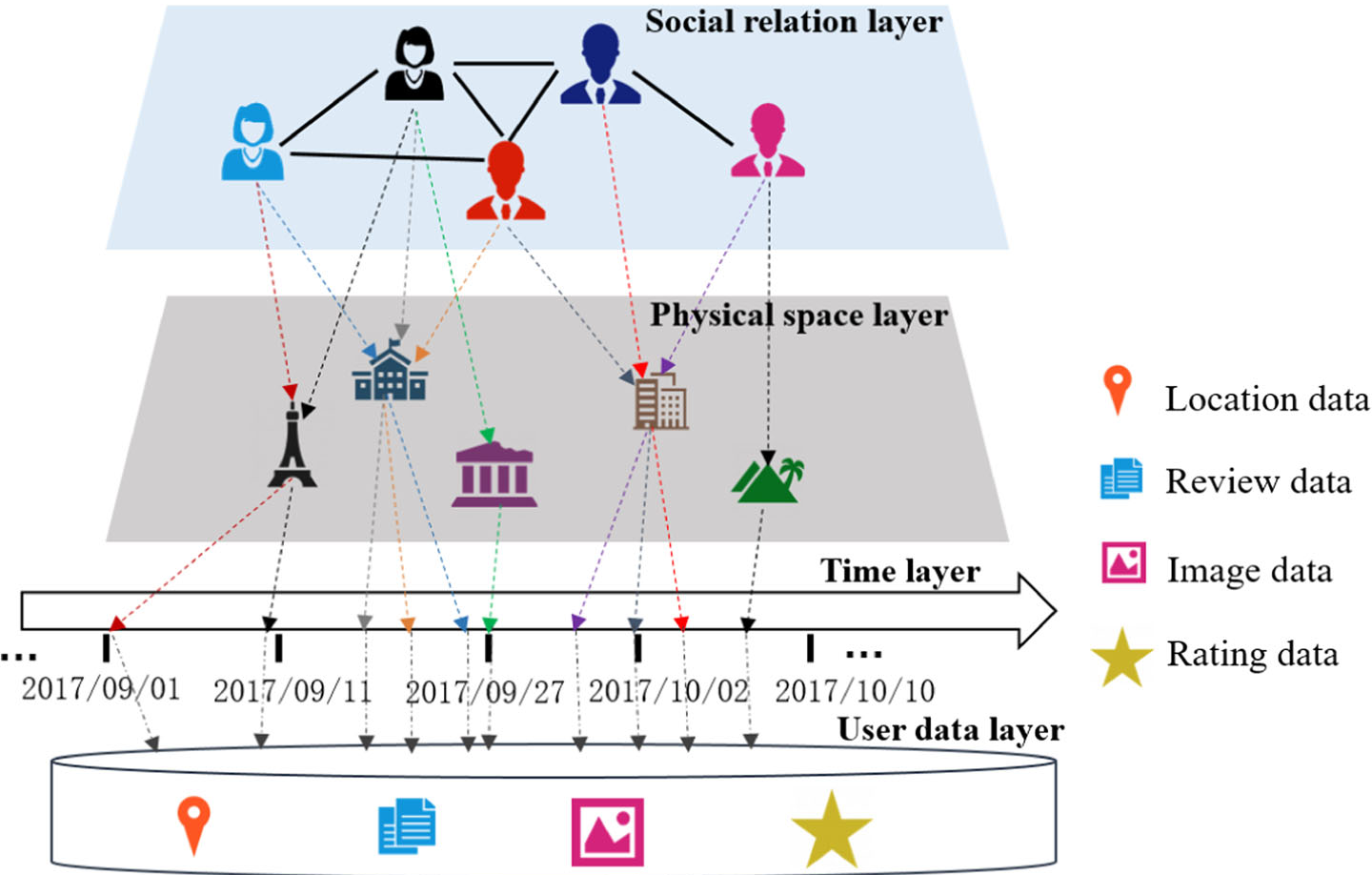
The paper categorizes the GSN architecture into four distinct layers that drive prediction models:
- Social Relation Layer: Capturing how "friends" influence each other's movements.
- Physical Space Layer: Managing POIs (Points of Interest) and their geographical distances.
- Time Layer: Modeling the cyclic nature of human life (Mondays vs. Saturdays).
- User Data Layer: The "raw material"—text, images, and ratings.
Feature Extraction: The "Five Forces"
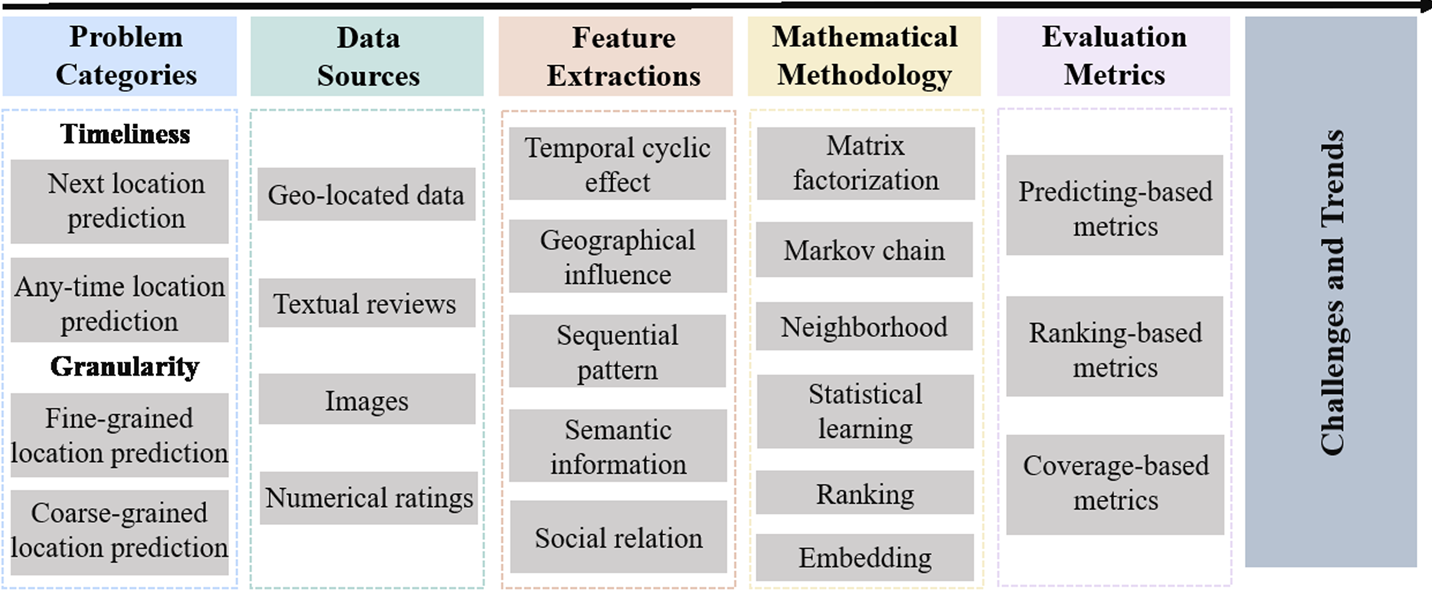
To predict a location, models look at:
- Temporal Cycles: Your behavior at 8 AM (commute) is vastly different from 8 PM (leisure).
- Geographical Influence: The "First Law of Geography"—near things are more related than distant things.
- Sequential Relations: The effect (e.g., Gym Juice Bar).
- Semantic Context: The category of the venue (Food vs. Travel).
- Social Tie: The tendency to follow the "crowd" or specific influential friends.
The Mathematical Evolution
The survey tracks the shift in the "mathematical engine" powering these predictions:
- Matrix Factorization (MF): The old guard. Great for latent features but struggles with non-linear interactions and cold starts.
- Markov Chains (MC): The sequential specialist. Excellent for "what's next" but ignores long-term preferences.
- Neural-Embedding (The Current SOTA): Models like SAE-NAD and CARA use attention mechanisms to weigh past visits differently and decode geographical influences non-linearly.
Experimental Performance: Who Wins?
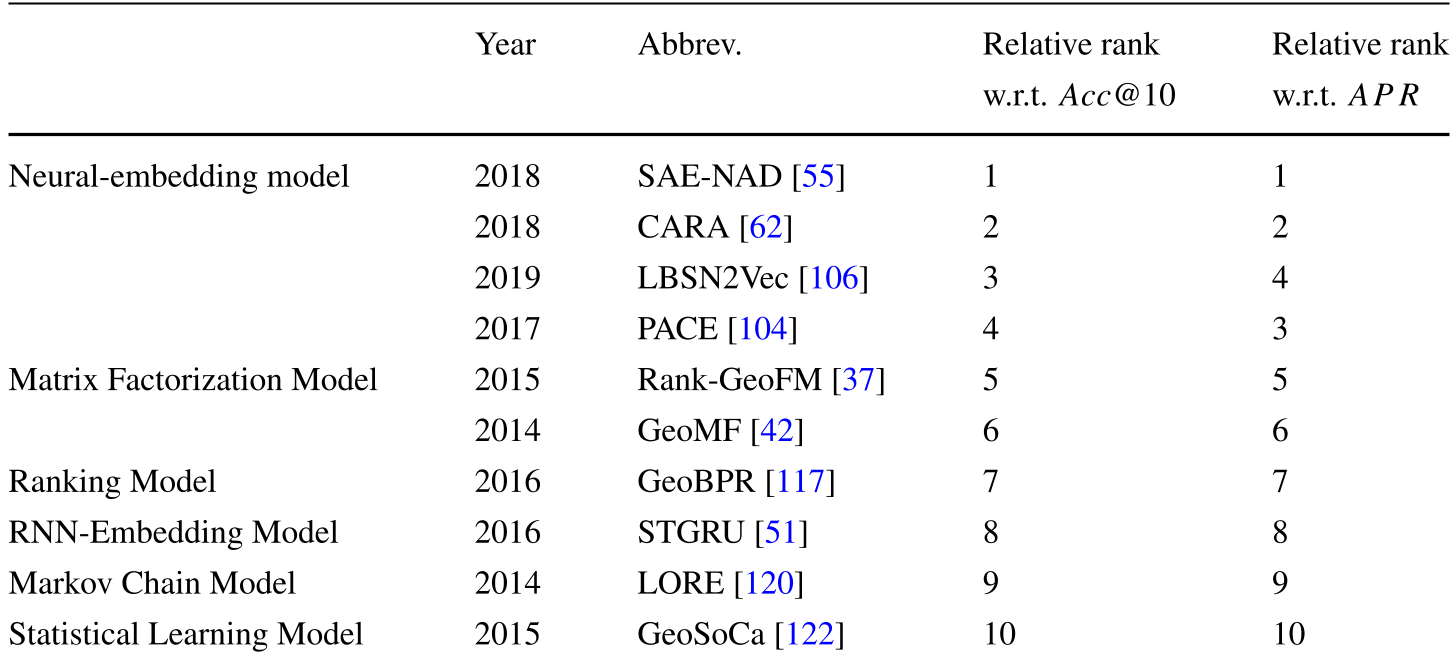
In a head-to-head comparison on Foursquare and Yelp datasets, Neural-Embedding methods demonstrated superior accuracy (Acc@10). However, the paper notes a crucial observation: performance drops significantly on the Yelp dataset compared to Foursquare.
Why? The Yelp dataset covers the entire USA, whereas Foursquare Tokyo focuses on a single city. As the geographical scope expands, human predictability naturally declines due to increased mobility options and environmental entropy.
Critical Analysis & Future Outlook
While we've made strides in "Next Location Prediction," the field of "Any-time Location Prediction" (where will you be at 4 PM next Tuesday?) remains under-researched. The survey identifies four major trends:
- Attention is All You Need: Using word and neighbor attention to weigh multi-modal inputs.
- HIN & GCNs: Treating the world as a massive heterogeneous graph where users, venues, and categories are all nodes.
- Privacy-Preserving Prediction: How to provide personalized services without creating a "stalking" engine.
- Multi-Source Fusion: Linking accounts across Foursquare, Twitter, and Instagram to create a "360-degree" user profile.
Conclusion
User location prediction is moving away from simple "where you were" statistics toward a profound understanding of "who you are." By blending deep learning with the physical laws of geography and social influence, the next generation of GSNs will not just react to our movements—they will anticipate them.