
The Physics of Influence: Why Your Arrogance Fades in a Dynamic Social Network
6898_Evolution of Social Power in Social Networks With Dynamic Topology.
This paper revisits the DeGroot–Friedkin model of social power evolution, establishing exponential convergence for constant topologies and proving that in dynamic networks, initial perceived social power is exponentially forgotten in favor of a topology-determined equilibrium. The study utilizes nonlinear contraction analysis to provide rigorous stability proofs and explicit upper bounds for individual influence.
TL;DR
A group's social power structure is not fixed; it evolves as members discuss a sequence of issues. This paper proves that regardless of how much power you think you have initially, the network "forgets" your self-appraisal at an exponential rate. In the end, your real influence is determined strictly by the network's topology—who trusts whom and how much.
Background: The DeGroot-Friedkin Model
In social psychology, the "looking-glass self" suggests we form our self-identity based on how others perceive us. The DeGroot-Friedkin model formalizes this:
- Opinion Phase: A group discusses an issue until consensus is reached.
- Self-Appraisal Phase: Individuals observe their influence on that consensus and adjust their self-confidence (social power) for the next issue.
While previous studies hinted at how this settles over time, this paper provides the mathematical "hammer"—Nonlinear Contraction Analysis—to prove exactly how fast this happens and what happens when the group's "trust map" (topology) changes.
The Core Challenge: Moving Beyond Asymptotic Stability
Early models could only say that social power eventually settles. But in the real world, we need to know the rate of change. Furthermore, real networks aren't static. In a cabinet meeting, a Defense Minister has high influence on military topics but low influence on healthcare. This creates a Dynamic Relative Interaction Matrix ().
The authors tackle two major "Why" questions:
- Why do we eventually ignore someone who is initially overconfident but lacks trust?
- How does the network maintain a stable power trajectory when the topics (and thus the influence weights) keep shifting?
Methodology: The Geometry of Power
The authors use a transformed Jacobian approach to analyze the system's stability. By defining a virtual displacement through a specific metric transformation, they prove the system enters a Generalized Contraction Region.

The beauty of contraction analysis here is that it doesn't require finding a fixed equilibrium (which doesn't exist in dynamic networks). Instead, it proves that all possible "lives" the social network could lead will eventually merge into a single, unique trajectory determined by the sequence of interaction topologies.
Key Breakthroughs:
- Exponential Forgetting: The influence of your initial self-weight vanishes. Whether you start at 99% self-confidence or 1%, the network forces you toward the same "natural" power level.
- The Power Limit: The authors provide a hard bound. An individual's power is capped by , where is the dominant eigenvector of the trust matrix. If no one trusts you more than everyone else combined, you can never become an autocrat.
Experimental Proof: Arrogance vs. Reality
The simulation in Fig. 2 demonstrates this "self-regulating" property. Two identical networks start with vastly different initial power levels (solid vs. dotted lines).
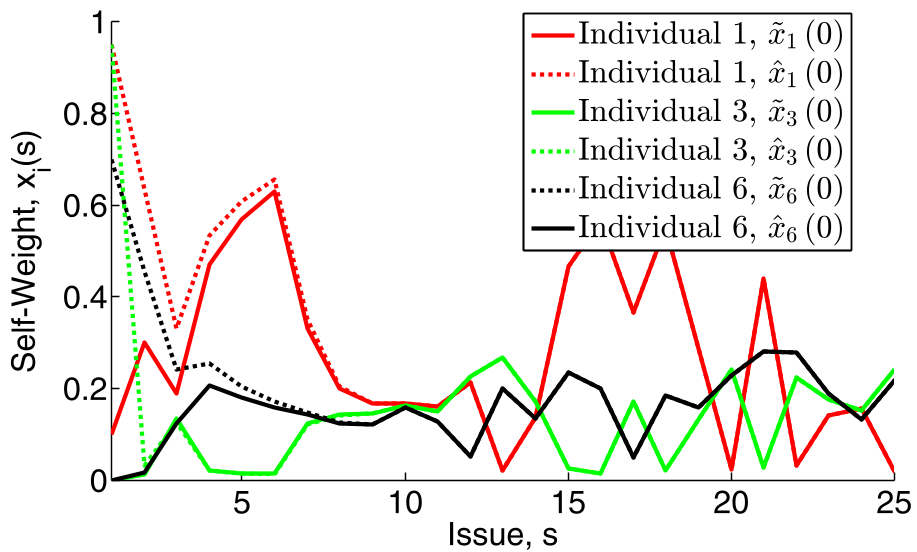
By the 10th issue discussed, the lines are indistinguishable. The "arrogant" individuals (starting with high ) and the "humble" ones (low ) have converged to the same reality-based power level. This confirms the Self-Regulation Hypothesis: social networks are robust filters for noise and initial ego.
Critical Insight: The "True" Power
In a constant topology, power converges to a point. In a Periodic Topology (e.g., regular weekly meetings on different rotating topics), power converges to a limit cycle. You might be powerful on Mondays (economic issues) and weak on Fridays (administrative issues), but that cycle becomes your fixed social identity.
Limitations & Future Work
While robust, the model assumes the network is "strongly connected." In reality, social groups often fracture into "echo chambers." Extending this math to reducible graphs (where logic doesn't flow to everyone) and adding "stubborn agents" who refuse to change their minds is the next frontier.
Conclusion
This paper elevates social power theory from qualitative observation to rigorous dynamical systems theory. It tells us that in any healthy, interacting group, the "truth" of our relationships will always outweigh our initial self-perceptions. In the math of social power, topology is destiny.