
StarClique: Defeating the Social Intersection Attack with k-Anonymity
6940_StarClique guaranteeing user privacy in social networks against intersection attacks.
The paper introduces StarClique, a graph anonymization framework designed to protect Online Social Network (OSN) users from "social intersection attacks." By augmenting the social graph with socially-close "latent edges," the method guarantees k-anonymity, ensuring any shared content can only be traced back to a group of at least k possible originators.
TL;DR
In the world of social content-sharing, your "anonymized" data isn't as private as you think. This paper identifies the Social Intersection Attack, where just two compromised friends can uniquely identify you as the source of shared content. To fight back, the authors introduce StarClique, a method of "evolving" social graphs by adding "latent edges" to guarantee k-anonymity, making it mathematically impossible to narrow the source down to fewer than k individuals.
The "Invisible" Threat: Social Intersection
We often assume that if we remove our name from a recommendation or a shared link, we are anonymous. However, social networks are defined by their structure. If Friend A and Friend B both see a specific anonymized URL recommendation, and you are the only common friend they share, the "anonymization" vanishes instantly.
The authors' measurement study across seven major networks (Facebook, Orkut, YouTube, etc.) found a chilling reality: 70% of users can be uniquely identified by an intersection attack involving only two compromised accounts.
Methodology: The StarClique Evolution
The core insight of the paper is to move beyond simple data scrubbing. Instead, they propose Graph Evolution. By strategically adding "latent edges"—friendship links that exist for data-sharing purposes but are hidden from the user's UI—they mask the true origin of data.
The StarClique Structure
To achieve k-anonymity against f colluding attackers, the system constructs a specific local topology around each node:
- The Clique: A group of nodes (including the target) where everyone is connected to everyone else.
- The Star: The remaining neighbors who are connected to the clique members but not necessarily to each other.
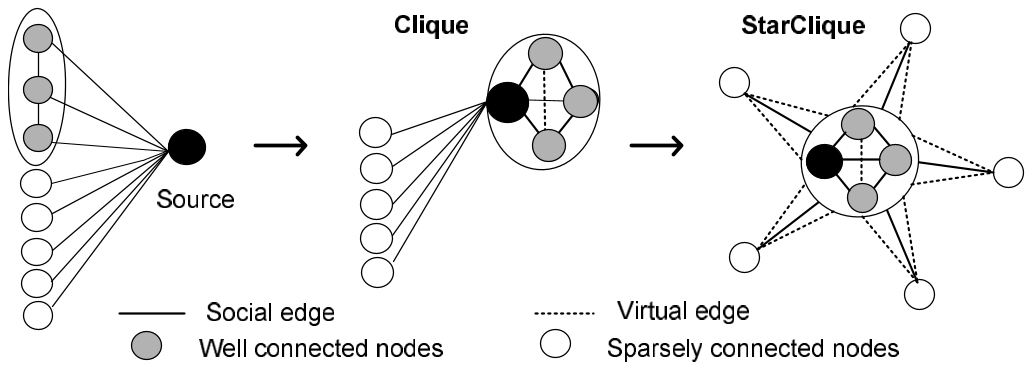
This structure is locally minimal. If you remove a single edge, the mathematical guarantee of possible sources collapses.
Solving the Overhead Problem
Adding edges to a graph sounds expensive. If every user needs a clique, wouldn't the network become a massive, unmanageable web? The authors introduced several critical optimizations:
- Edge Reuse: If a latent edge is added to help protect User A, User B should try to use that same edge to meet their own privacy requirements.
- Ordered Evolution: By processing "supernodes" (high-degree users) first, the system creates a backbone of latent edges that smaller nodes can "piggyback" on.
Results & Performance
The optimizations are incredibly effective. In a Facebook subgraph, the "Evolution Ratio" (the multiplier of new edges) dropped from 1350x to just 5x for .
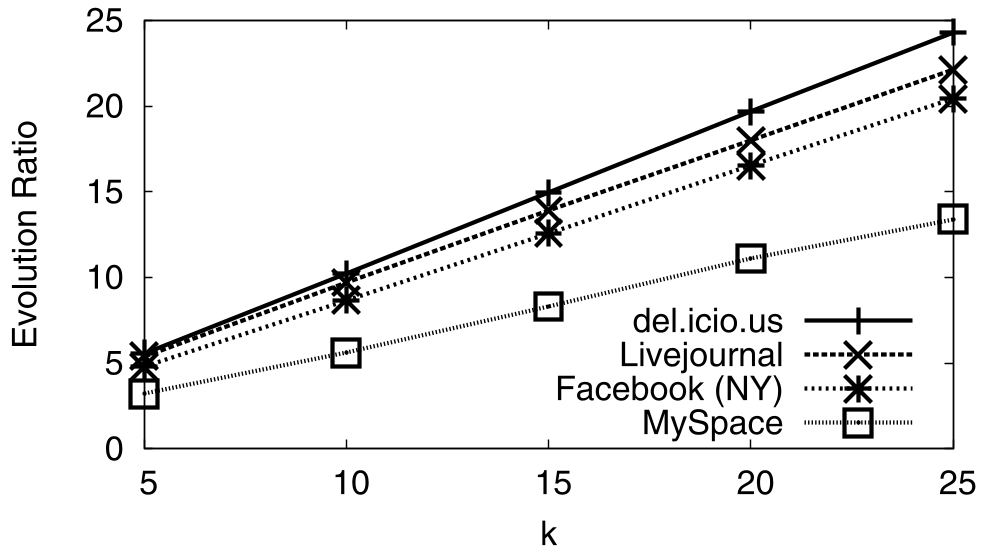
Crucially, these latent edges are not random. 99% of them connect users within 2 hops of each other. Using data from del.icio.us, the authors proved that these "socially-close" buddies still share relevant interests, ensuring that the extra traffic generated for privacy isn't just "junk" data, but content the user might actually find useful.
Critical Insight & Conclusion
StarClique represents a pivot in privacy research from content-anonymization to structural-anonymization. While it adds overhead in terms of data transfer, it provides a tunable "knob" for OSN operators: they can increase k for higher security or decrease it for better performance.
As social networks increasingly become targets for botnets and phishing, moving toward a "proven" privacy model like StarClique may be the only way to keep social content sharing truly safe from the prying eyes of compromised associates.