
CLOMADE: Scaling Social Network Reconstruction via Local Maximums
704_Reconstructing Dynamic Social Network by Choosing Local Maximum Degree Substitute.
The paper introduces CLOMADE (Choosing LOcal MAximum DEgree), a localized algorithm designed to reconstruct dynamic social networks after the disappearance of critical nodes. It replaces global centrality metrics with a local maximum degree heuristic and targeted link generation to maintain network topology with high computational efficiency.
TL;DR
The disappearance of "hub" nodes can shatter a social network's connectivity. Traditional restoration methods are bottlenecked by heavy global centrality calculations. CLOMADE shifts the paradigm from global to local, using maximum degree heuristics among immediate neighbors to find substitutes and repair links. It achieves parity in structural quality with prior SOTA methods while being up to 200 times faster.
Background: The Cost of Global Intelligence
In any dynamic social network, nodes are not created equal. When a "leader" or "mediator" disappears, the network can fragment. To prevent this, researchers typically look for a replacement based on Centrality (Betweenness, Closeness, or Degree).
However, there is a fundamental trade-off:
- Global Centrality (e.g., Betweenness) provides a perfect view of a node's importance but requires scanning the entire graph. In large-scale, fast-changing networks, this complexity is a death sentence for performance.
- Local Intelligence focuses only on the immediate blast radius of the deleted node, but must be designed carefully to avoid degrading the global topology.
Methodology: The Local Maximum Logic
The authors propose CLOMADE (Choosing LOcal MAximum DEgree). The intuition is simple: if a vital node vanishes, its most influential immediate neighbor is the most logical candidate to "inherit" its responsibilities.
1. Substitute Selection
Instead of re-calculating the importance of every node in the graph, CLOMADE:
- Identifies all immediate neighbors of the deleted node .
- Selects the neighbor with the highest degree as the substitute.
- If there’s a tie, it uses a refinement formula to choose the node whose internal (common) and external connections are most balanced:
2. Intelligent Link Repair
The goal isn't just to find a leader, but to keep the "orphaned" neighbors connected. CLOMADE utilizes a local structural property: for any node, the distance between any two of its neighbors is at most 2. After finding substitute , the algorithm checks the distance between and all other neighbors of the deleted node. If the distance is , a new link is generated.
 Figure 1: Conceptual visualization of local reconstruction.
Experiments: Performance vs. Quality
The authors compared CLOMADE against JOAN-C (a centrality-based baseline) across various graph densities and node disappearance thresholds (10% to 50%).
The Speed Gap
The most striking result is the execution time. In a graph with 1,000 nodes:
- JOAN-C: ~547 seconds.
- CLOMADE: ~2.5 seconds.
This represents a massive leap in scalability, making it viable for near real-time network maintenance.
Preserving the Core
Despite being significantly faster, CLOMADE does not sacrifice the network's architectural integrity. Metrics such as Diameter, Density, and Average Path Length remain nearly identical to the original graph and the JOAN-C results.
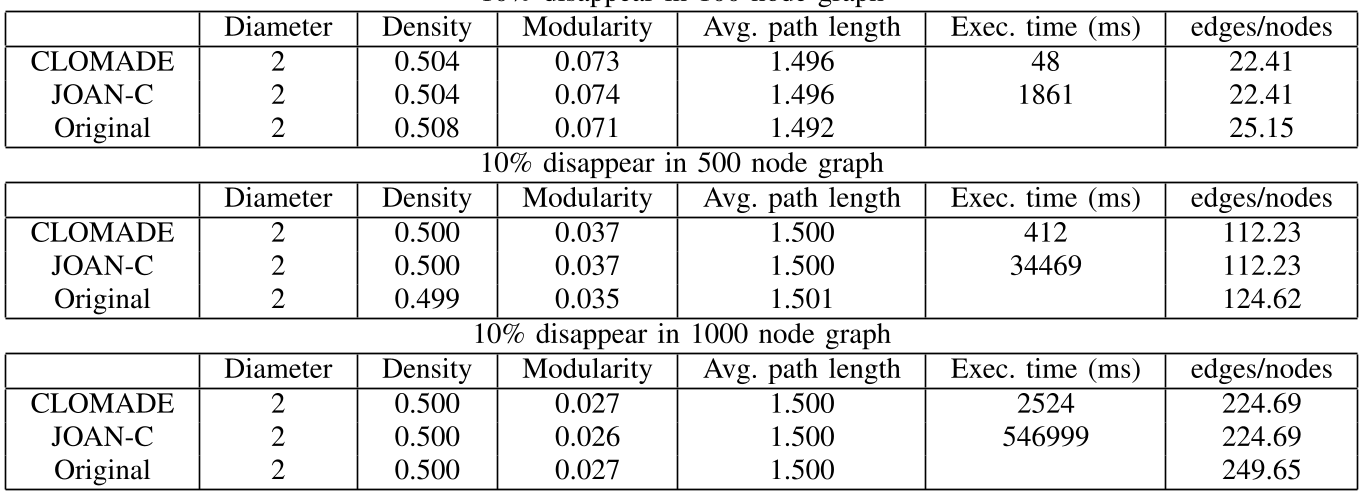 Table 1: Performance comparison showing CLOMADE preserving network properties while slashing execution time.
Critical Analysis & Conclusion
CLOMADE proves that in social network analysis, local efficiency can often mimic global accuracy. By focusing on the "local maximum," the algorithm respects the natural clustering behavior of social entities.
Limitations:
- The study primarily uses synthetic graphs. Real-world social networks (like Twitter or LinkedIn) often exhibit power-law distributions and noisy connections that might challenge a purely degree-based heuristic.
- The approach is currently unweighted and undirected; modern networks often require handling edge weights (strength of relationship) and directionality (influence flow).
Final Takeaway: For engineers managing dynamic graphs where latency is a concern, CLOMADE offers a robust blueprint: stop scanning the whole world when the answer is usually right next door.