
The Visibility Paradox: Why Global Algorithms Bury Web Minorities
7055_Social networks and web minorities.
This paper examines the visibility bias of global ranking algorithms like Google's PageRank, proposing a transition from centralized search to distributed architectures. It introduces a cognitive model employing "Deep" and "Shallow" intelligent agents to protect "web minorities"—small, high-quality communities currently eclipsed by popular general-interest content.
TL;DR
Popularity does not equal quality. This classic 2003 paper from Gori et al. critiques the inherent bias in global ranking schemes like Google’s PageRank. It argues that such algorithms mathematically favor large, interconnected communities, effectively burying "web minorities"—small but high-quality information hubs. To solve this, the authors propose a move toward distributed architectures and intelligent agents that prioritize semantic relevance over raw link counts.
Background: The Illusion of Accessibility
We often view the web as a "Borgesian Babel’s library"—a place where all knowledge is accessible. However, the authors argue that our view is highly filtered. Search engines act as "crazy librarians" who only show us books from the most crowded shelves. In the early 2000s, as PageRank became the standard, the "rich-get-richer" phenomenon began to stifle the diversity of the internet.
The Problem: The Mathematical Trap of PageRank
The core of the issue lies in the social network model of the web. PageRank calculates authority based on the number of incoming links and the authority of the sources.
The Cardinality Curse
The authors perform a "circuital analysis" of web energy. They define the total energy () of a community and prove a sobering reality:
This formula indicates that a community's energy is directly proportional to its size (). Consequently, small linguistic minorities or niche scientific groups can almost never compete for visibility against massive commercial or general-interest hubs, regardless of how expert their content is.
 Figure 1: A simple graph showing how PageRank scores are distributed. Even in small sets, nodes with fewer connections (niche topics) are mathematically relegated to the bottom of research results.
Methodology: Challenging the Centralized Monopoly
The authors propose a cognitive shift in how we build search engines, moving away from a "one-size-fits-all" index toward a multi-agent system.
1. Deep vs. Shallow Agents
- Deep Agents: These are intelligent software agents involved in focused crawling. Instead of cataloging the whole web uniformly, they hunt for specific topics, using learning-based models to predict page relevance before following links.
- Shallow Agents: These act as personal intermediaries. They take the "basket" of results from various sources and re-organize, cluster, and filter them according to the user's specific profile and feedback.
2. Topic-Based Transition Probabilities
Instead of a "Random Surfer" moving blindly between links, the authors suggest a model where transition probabilities are weighted by topic relevance. If a user is interested in "Fiction," an agent will assign a much higher probability to a link leading to a Spielberg gallery than a generic link to a shopping site.
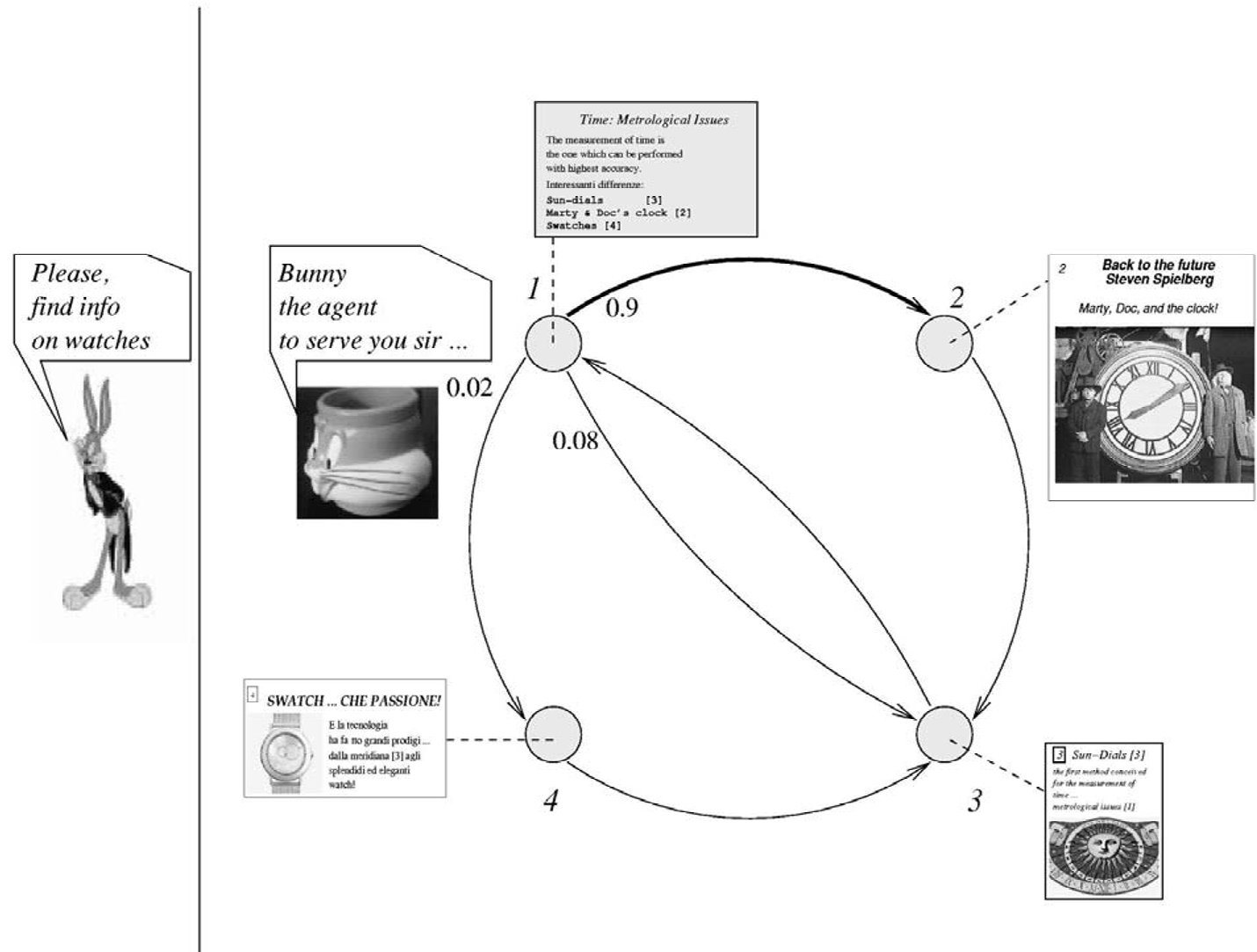 Figure 2: The proposed architecture where personal agents interact with distributed topic-specific indexes, ensuring that smaller groups are not averaged out by the global web population.
Experiments & Case Study: Linguistic Minorities
A striking example provided is the search for "Arte moderna" (Modern Art). Because the term exists in both Italian and Spanish, Italian-speaking users often find their results dominated by massive US-based collections (like MOMA) or larger Spanish sites. The specific, high-quality Italian galleries—the "web minorities"—are pushed to the 10th page of results, effectively ceasing to exist for the average user.
Deep Insights: The Risk of Information Monopolization
The paper warns that when we trust global search engines blindly, we allow for the monopolization of information. This isn't just a technical problem; it's a social and democratic one.
- Artificial Manipulation: The authors highlight how "artificial web communities" (link farms) can purposely pump up the visibility of low-quality pages, a pre-cursor to modern SEO spamming.
- Loss of Knowledge: High-quality information in scientific niches or cultural minorities is lost because it lacks the "social weight" to surface in a globalized ranking.
Conclusion: Toward a More Democratic Web
The work of Gori and Numerico serves as a foundational critique of algorithmic bias. While PageRank brought order to the chaos of the early web, it also created a "visibility bubble."
The takeaway for modern AI and LLM researchers is clear: as we move from search engines to Answer Engines (like Perplexity or GPT-4o), we must ensure that our "agents" are not just echoing the most popular parts of the internet, but are actively protecting and surfacing the "minorities" of high-quality, niche information that constitute the true depth of human knowledge.