
tOWL: Bringing Time and Change to the Semantic Web
7121_tOWL A Temporal Web Ontology Language.
This paper introduces tOWL, a temporal extension of the OWL Description Logic fragment SHIN(D). It enables the representation of and reasoning with time-dependent information in the Semantic Web via a layered architecture incorporating concrete domains, Allen's interval relations, and 4D fluents.
TL;DR
The Semantic Web has long struggled with a "static world" bias. tOWL (Temporal Web Ontology Language) breaks this limitation by extending OWL-DL with a layered temporal infrastructure. By combining concrete domains for precise time-mapping and a "4D Fluent" approach for representing change, tOWL allows machines to reason about processes—like financial buyouts—where "what is true" changes over time.
Perspective: The Static Debt of the Semantic Web
In the standard OWL-DL universe, if "Individual A" is the CEO of "Company B," that fact is traditionally represented as a static triple. If a new CEO takes over, the old information is typically overwritten or lost. This creates a significant gap for domains like finance, law, or logistics, where the history and sequence of events are as critical as the current state.
The authors identify a fundamental tension: we need a language expressive enough to describe time intervals and state transitions, but constrained enough to remain decidable (so that a reasoner doesn't get stuck in an infinite loop).
Methodology: The Layered Temporal Stack
tOWL doesn't reinvent the wheel; it adds specialized layers onto the existing SHIN(D) fragment of OWL-DL.
1. The Concrete Domains Layer
To handle time points mathematically, tOWL introduces a concrete domain based on rational numbers (). This allows the use of predicates like , , and to define temporal constraints directly within the logic.
2. Temporal Reference Layer (Interval Logic)
Building on the concrete domain, tOWL implements Allen’s 13 interval relations (e.g., Meets, Overlaps, Starts). This is achieved through "syntactic sugaring"—providing a user-friendly way to describe intervals that the underlying reasoner interprets as conditions on interval endpoints.
3. The 4D Fluents Layer
To represent an object that changes over time without losing its identity, the authors adopt a perdurantist view. An individual is seen as a collection of "timeslices."
- Timeslices: Represent the state of an entity during a specific interval.
- Fluents: Properties that point to these timeslices, allowing the model to distinguish between "EmployeeOf" in 2020 vs. 2024.
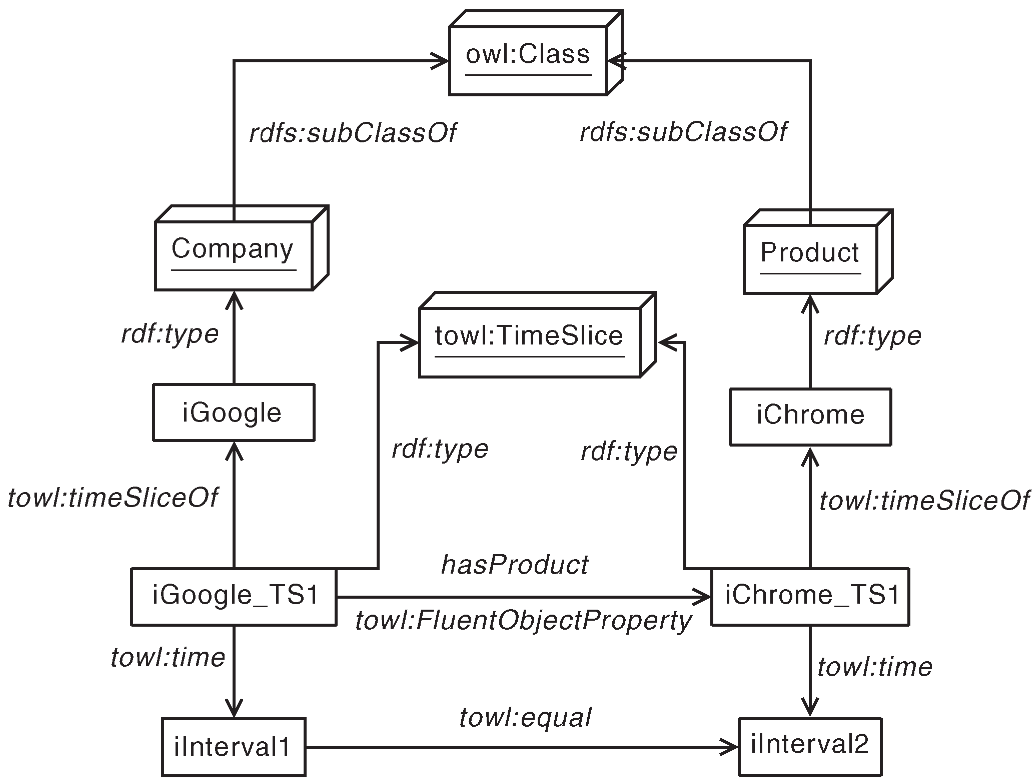 Figure: Graphical representation of how timeslices and intervals connect to individuals via fluents.
Case Study: Modeling Financial "Leveraged Buyouts" (LBO)
The paper demonstrates tOWL's power using an LBO process. An LBO involves stages: Early Stage Due Diligence Bidding Acquisition.
In a tOWL knowledge base, if high-level news indicates a company moved from "Due Diligence" to "Raise Bid," the reasoner can automatically infer that the "Bidding" stage must have occurred in between, even if it wasn't explicitly stated in the data. This "Temporal Inference" is a major leap forward for automated market analysis.
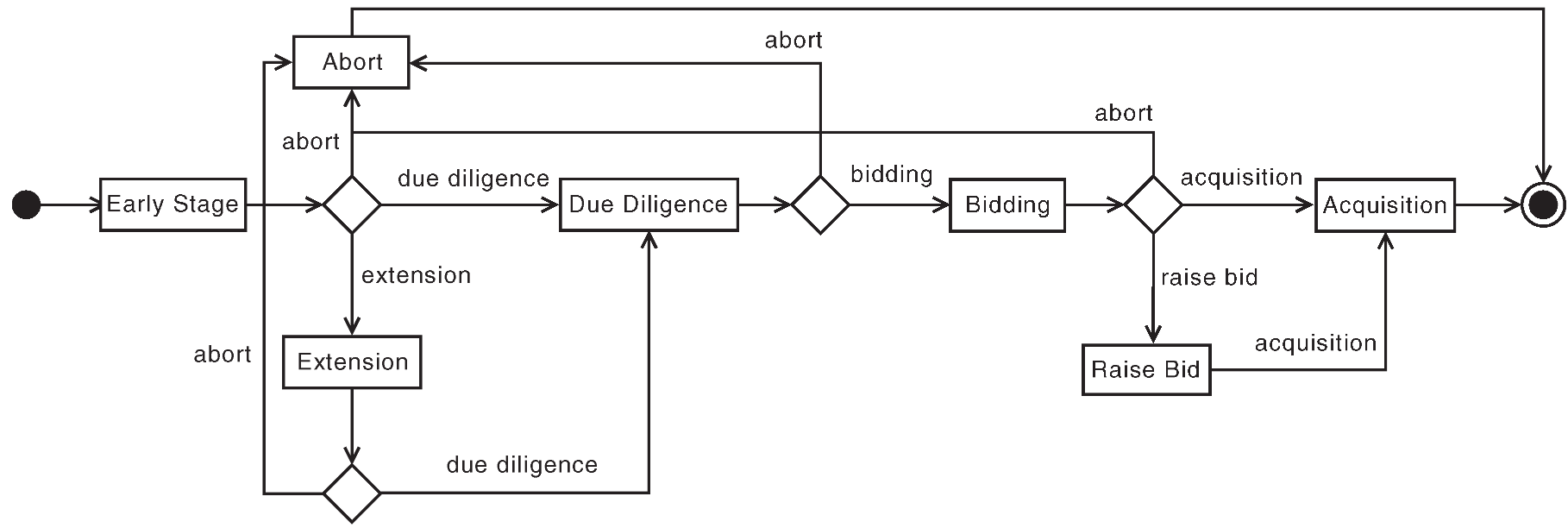 Figure: The activity diagram of an LBO process, which tOWL translates into logical axioms.
Critical Insight: Balancing Complexity and Utility
One of the standout features of tOWL is its handling of FluentDatatypeProperties. By distinguishing between fluents that track other objects and fluents that track data values (like stock prices), the authors mitigate the "object proliferation" problem that plagued earlier 4D fluent ontologies.
Limitations
- Reasoning Cost: While tOWL-Lite is ExpTime-complete, the computational overhead of complex temporal TBoxes remains high.
- Perspective: The focus is strictly on Valid Time (when things happened in the real world) rather than Transaction Time (when the data was recorded).
Conclusion
tOWL successfully transitions the Semantic Web from a collection of static snapshots to a dynamic, "diachronic" representation of the world. For developers of intelligent financial systems or automated legal reasoning tools, tOWL offers the necessary vocabulary to treat time not just as a metadata tag, but as a core logical dimension.