
GLP: Boosting Viral Marketing via Group-Level Location Promotion in Geo-Social Networks
7236_GLP A Novel Framework for Group-Level Location Promotion in Geo-Social Networks.
The paper introduces GLP, the first framework for group-level location promotion in geo-social networks (GSNs). By mining "geo-communities" and selecting groups rather than individuals as seed units, it optimizes viral marketing to attract users to specific Points of Interest (POIs).
TL;DR
Researchers have developed GLP (Group-level Location Promotion), a framework that shifts the paradigm of "influencing individuals" to "influencing geo-communities." By aggregating sparse check-in data into reliable group mobility models, GLP achieves a 10x increase in influence spread and a 100x speedup in computation compared to traditional individual-level methods.
Problem & Motivation: The Sparsity Trap
Most location-aware viral marketing relies on Influence Maximization (IM): finding the most influential "seed" users to start a word-of-mouth chain reaction. However, in Geo-Social Networks (GSNs), this approach faces three major hurdles:
- Data Sparsity: Individuals don't check in everywhere. Their data is sporadic, making it nearly impossible to predict their likelihood of visiting a new restaurant or store accurately.
- Scalability: Searching for optimal individual seeds in a network of millions is an NP-hard nightmare.
- Cost: Convincing specific high-influence individuals (like local celebrities) is often far more expensive than placing an ad where a specific community congregates.
The authors' core insight is based on the "geo-community" phenomenon: users belonging to the same social group (students at a university, residents of a housing estate) share remarkably similar and regular mobility patterns.
Methodology: The GLP Framework
The GLP framework operates in three distinct phases:
1. Mining Geo-Communities
Because user groups aren't always explicitly labeled, GLP uses an iterative learning approach. It models mobility as a Hidden Markov Model (HMM) where the hidden states represent local contexts (e.g., "working," "shopping").
- EM Algorithm: Trains parameters to find core well-visited locations for groups.
- Bayesian Classifier: Assigns users to groups based on the posterior probability of their check-in trajectories.
2. Constructing the Group-Level Graph
GLP transforms the individual social graph into a group-level graph .
- Intra-group Influence: Measures how members of the same group influence each other based on "closeness" ().
- Inter-group Influence: Measures weights () between different groups, accounting for users who might belong to multiple communities.
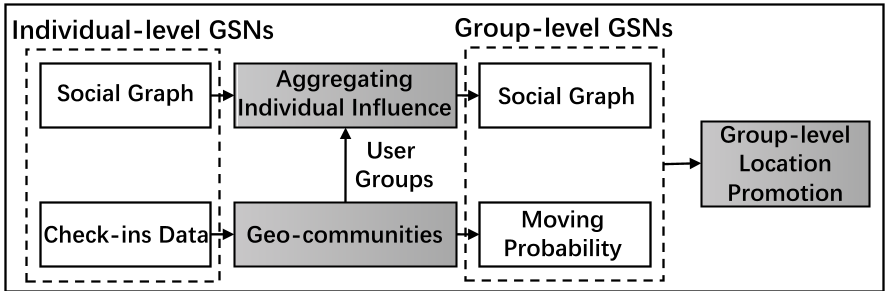
3. Seed Group Selection
Instead of selecting individuals, GLP selects groups. It chooses the "core location" of the group for the initial promotion (e.g., a cinema or a campus library). To solve the selection problem, the authors propose a greedy algorithm with a provable approximation ratio of .
Experiments & Results
The framework was tested on three massive real-world datasets: Brightkite, Gowalla, and Foursquare.
1. Influence Spread
GLP outperformed baselines like Greedy and TPH by significant margins. In several scenarios, the influence spread (number of people visiting the promoted location) was 10 times higher than individual-based strategies. This is because targeting a group's hub activates a massive "seed" population at once compared to the limited reach of individuals.
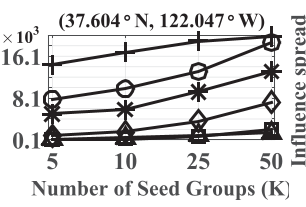
2. Computational Efficiency
By reducing the number of nodes from individuals to groups, the search space for seed selection shrinks exponentially. The experiments recorded a 100x speedup in the selection process, making it viable for near real-time marketing decisions in large cities.
Critical Analysis & Conclusion
Takeaway
GLP proves that in the context of physical movement and location promotion, communities are more predictable than individuals. By aggregating sparse data, we gain a statistically significant model of human behavior that individual-level analysis misses.
Limitations
- Dynamic Groups: The current model assumes geo-communities are relatively static. In reality, city dynamics change (e.g., seasonal student movements).
- Initial Propagation Probability: The model assumes a fixed probability that an initial ad convinces a user, which may vary wildly between different advertising mediums (billboards vs. mobile ads).
In conclusion, GLP is a robust step forward for location-aware viral marketing, offering a theoretically grounded and empirically superior alternative to individual-based influence models.