
DRR: Balancing Relevance and Diversity in the Age of Social Media Search
7252_Towards a Relevant and Diverse Search of Social Images.
This paper introduces the Diverse Relevance Ranking (DRR) scheme for social image search, which optimizes both relevance and diversity by exploring image content and tag semantics. It extends the traditional Average Precision (AP) metric into a novel Average Diverse Precision (ADP) and employs a greedy ordering algorithm to achieve state-of-the-art results in balancing content accuracy with result variety.
TL;DR
The explosion of social media has made tag-based image search ubiquitous, yet it remains flawed. Search results are often either irrelevant or repetitive. This paper proposes Diverse Relevance Ranking (DRR), a framework that moves beyond simple relevance by optimizing for Average Diverse Precision (ADP). By combining visual features with semantic tag analysis, DRR ensures that search results are not only accurate but also cover a broad range of information.
The Core Challenge: The Redundancy Trap
Most search engines follow the "Probability Ranking Principle": rank documents by their probability of relevance. However, in social media (Flickr, etc.), images are often uploaded in batches. A search for "Waterfall" might yield 20 nearly identical shots from the same photographer. Even if all are "relevant," the information gain for the user is near zero after the first image.
Existing solutions like clustering or duplicate removal are often heuristic-based, requiring hard thresholds that either fail to diversify or accidentally remove high-quality relevant content.
Methodology: Fusing Vision and Semantics
DRR approaches this as a global optimization problem. The workflow involves two critical components:
1. Relevance Estimation via Regularization
The authors don't just rely on tags. They use a regularization framework where:
- Consistency: Relevance should align with how closely an image's tags match the query (calculated using a Google-like semantic distance).
- Smoothness: Visually similar images should have similar relevance scores.
2. The ADP Metric and Greedy Ordering
The traditional Average Precision (AP) is blind to redundancy. The authors propose Average Diverse Precision (ADP), which weights each image's contribution by its "Diversity Score"—defined as its distance from all previously ranked images.
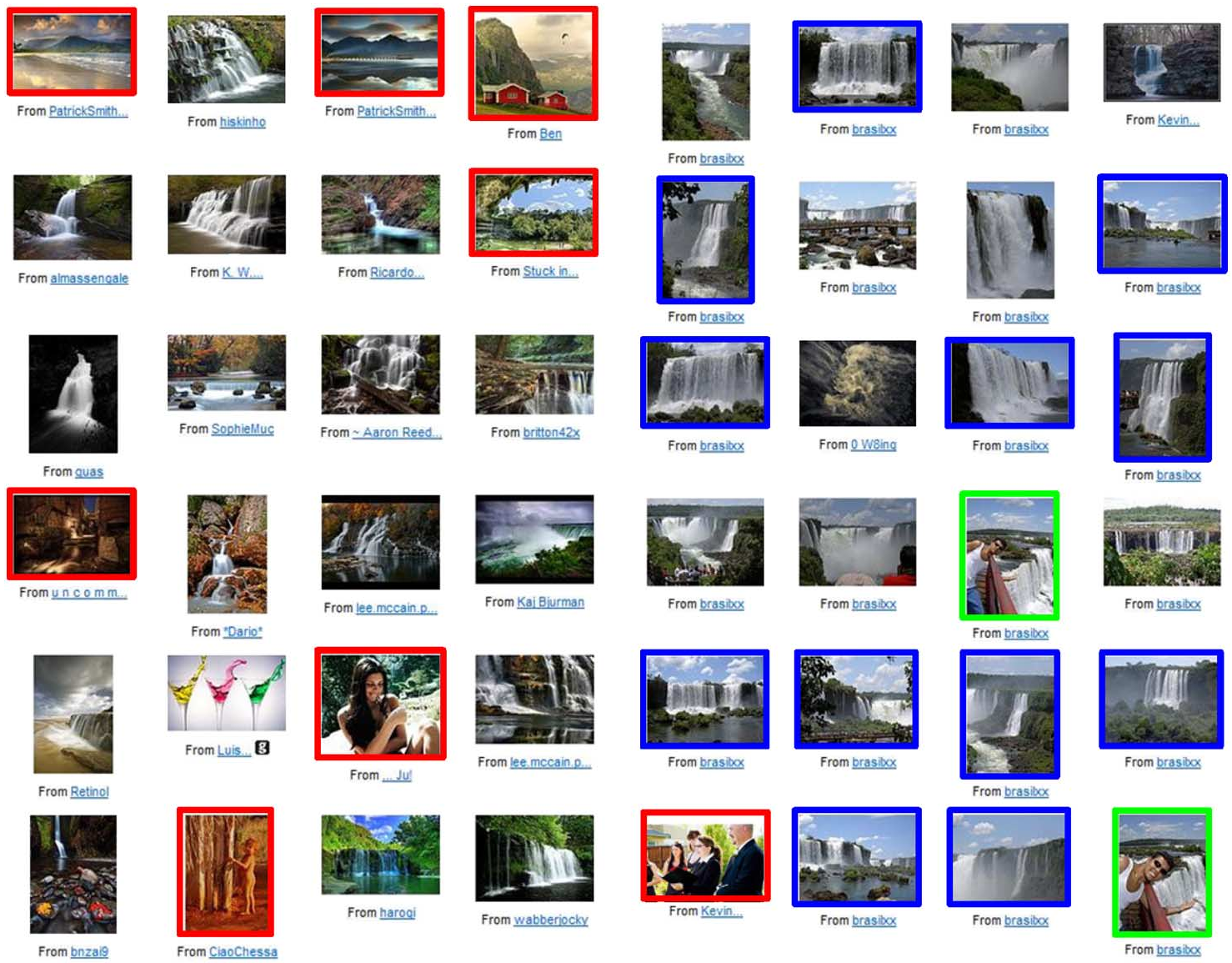 Figure 1: Comparison of traditional ranking (which produces redundant results) vs. the proposed diverse ranking.
To solve the optimization (which is NP-hard), a greedy algorithm is used to select the next best image that offers the highest marginal increase in expected ADP.
Results: Why Semantic Diversity Wins
One of the paper's most profound insights is the comparison between Visual Diversity and Semantic Diversity. The authors found that relevant images are "tighter" in visual space than semantic space. Consequently, enforcing visual diversity often forces the search engine to pick irrelevant images just to find something "different-looking."
By using Semantic Similarity (based on tags), the system maintains high relevance while providing varied content (e.g., showing different breeds of "Dogs" rather than just different colored backgrounds).
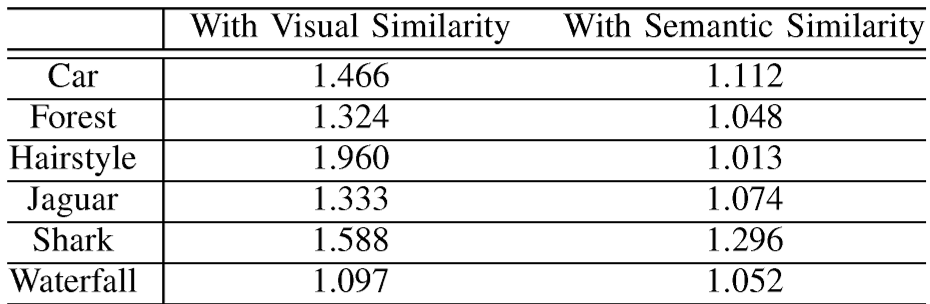 Table 1: Aggregation scores showing that relevant images are visually much more similar than they are semantically similar.
In head-to-head comparisons, DRR achieves a Mean ADP (MADP) of 0.411, significantly higher than the 0.308 of standard time-based ranking.
Critical Insight & Future Outlook
The beauty of DRR lies in its flexibility. While designed for social images, the authors successfully applied it to Web Image Search Reranking, proving that even without tags, the DRR logic can improve commercial search engines by diversifying result pages based on visual signatures.
Limitations: The system is sensitive to "tag noise." If users provide misleading tags, the semantic similarity breaks down. Future work in tag refinement or using LLM-based embeddings (like CLIP) could potentially solve this bottleneck.
Conclusion
DRR demonstrates that "relevance" is not a static property of a single image but a dynamic value that changes based on what the user has already seen. This shift from independent ranking to context-aware diversity is essential for any modern information retrieval system.