
RoleNet: Bridging the Semantic Gap via Character Social Networks
7324_RoleNet Movie Analysis from the Perspective of Social Networks.
RoleNet is a novel framework for movie analysis that shifts the focus from low-level audiovisual features to high-level social network analysis (SNA). It quantifies character relationships based on co-occurrence in scenes, enabling automated leading role determination, community identification, and social-based story segmentation.
TL;DR
RoleNet transforms the paradigm of movie analysis by treating a film not as a sequence of pixels, but as a "small society." By mapping character interactions into a weighted social graph, it outperforms traditional signal-based methods in story segmentation by nearly 230% and provides an intuitive framework for community identification.
Background: Beyond the Signal
For decades, researchers have tried to bridge the "semantic gap"—the distance between raw data (frames/audio) and human meaning. Most previous efforts stayed at the "frame-level" (shot detection) or "event-level" (dialogue detection). RoleNet argues that the true bridge lies at the "story-level", which is defined by the mise-en-scène: how characters are arranged and interact within a shared space.
Methodology: The Architecture of RoleNet
The core innovation is the construction of a weighted graph . If two characters share a scene, an edge is formed. The more scenes they share, the "thicker" the connection.
1. Leading Role & Community Analysis
Using Centrality Metrics, RoleNet identifies the "impact" of each role.
- Macro-communities: Grouping supporting roles around leading roles using Max-flow/Min-cut algorithms.
- Micro-communities: Using a hierarchical clustering approach (visualized as a dendrogram) to find finer social structures, such as a hero's family vs. his coworkers.
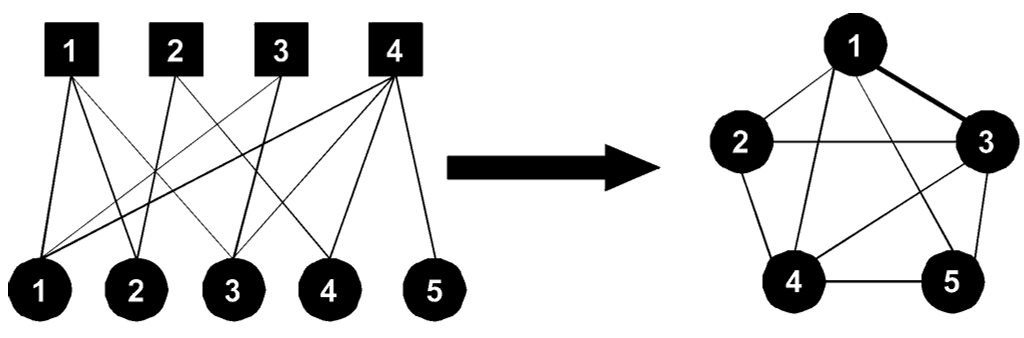 Figure 1: The transition from a bipartite scene-role graph to a weighted social network (RoleNet).
2. The Storyshed Algorithm
Standard story segmentation looks for visual changes. RoleNet looks for contextual changes. Each character is assigned a "profile vector" representing their relationships. By tracking the difference in these vectors across scene boundaries, the Storyshed algorithm (inspired by topographical watershed transforms) identifies where the "narrative flow" shifts.
Experimental Performance
The researchers tested RoleNet on Hollywood blockbusters like The Devil Wears Prada and Gladiator.
Community Precision
The system demonstrated a remarkable ability to correctly group characters into their respective "factions" (as seen in the hero/heroine groups of You've Got Mail).
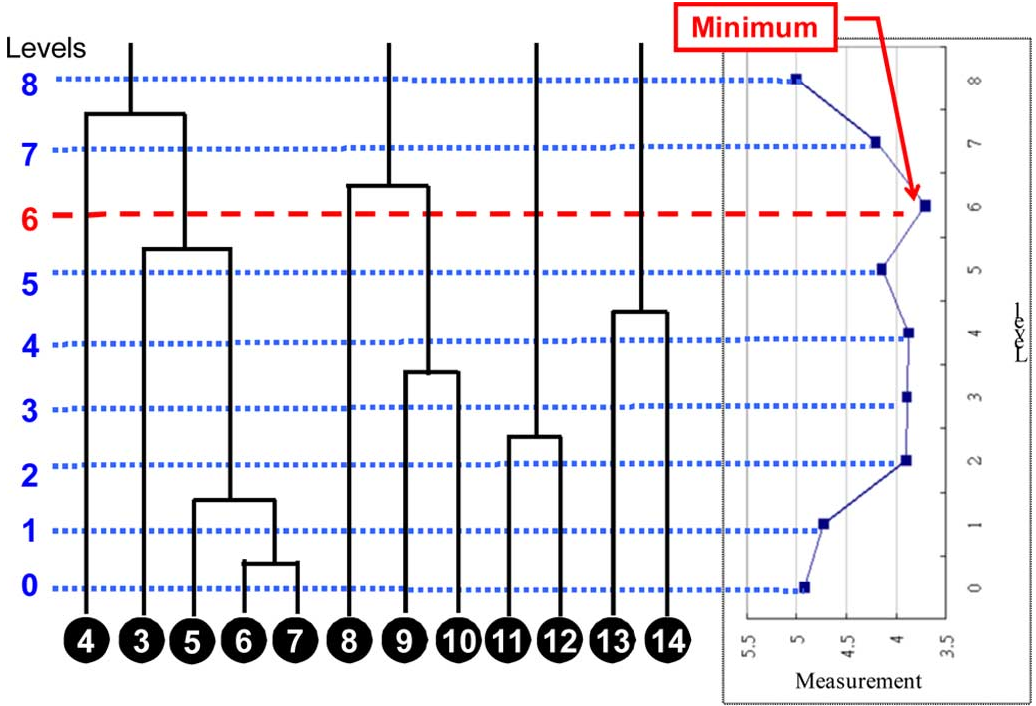 Figure 2: A dendrogram illustrating how characters are iteratively merged into micro-communities based on social link strength.
Segmentation Superiority
The results for story segmentation were the most striking. Compared to "tempo-based" methods (which rely on motion activity and shot frequency), RoleNet's "Social-based" approach saw the Purity metric jump from 0.21 to 0.69. This confirms that story boundaries are defined by character dynamics rather than just editing speed.
| Method | Overall Purity |
|---|---|
| Tempo-based | 0.21 |
| RoleNet (Storyshed + Global) | 0.69 |
Critical Insight & Future Outlook
The genius of RoleNet is its Inductive Bias: the assumption that character co-occurrence is the primary vehicle for narrative progression.
Limitations:
- The system's performance is tied to the accuracy of face detection. In dark scenes or side-profile shots, the social graph can become "noisy."
- It is less effective for "Art House" films where directors intentionally break standard spatial arrangements.
The Future: RoleNet paves the way for a "Community-Based Hierarchical Browsing System." Imagine searching a movie not by time, but by "scenes involving the hero's family members before the conflict." This context-aware indexing is the next frontier for media management.
Conclusion
RoleNet successfully demonstrates that social intelligence can be quantified. By treating movies as societies, we move closer to a machine "understanding" of stories that matches our own.