
Decoding Leadership: Predicting Autocratic vs. Democratic Styles Through Multimodal Nonverbal Cues
7371_Prediction of the Leadership Style of an Emergent Leader Using Audio and Visual Nonverbal Features.
This paper introduces a multimodal framework for predicting the leadership styles (autocratic vs. democratic) of emergent leaders in small group interactions. Utilizing Localized Multiple Kernel Learning (LMKL) on "in-the-wild" audio-visual datasets, the study achieves state-of-the-art predictive performance by integrating nonverbal features such as speaking activity, prosody, and visual focus of attention.
TL;DR
Is a leader born, or is their style hidden in the way they speak and look? This paper presents a machine learning approach to distinguish between autocratic and democratic emergent leaders in "in-the-wild" group meetings. By leveraging Localized Multiple Kernel Learning (LMKL), the researchers achieved significant accuracy in predicting leadership styles using purely nonverbal data like interruptive speech, vocal energy, and gaze patterns.
The Problem: Beyond Role-Playing
Historically, studying leadership styles was a manual, painstaking process for social psychologists. When computer science stepped in through Social Signal Processing (SSP), early models often relied on role-playing—where subjects were told to "act like a boss."
The authors argue that true leadership is emergent and behavioral. The real challenge lies in:
- Naturalistic Data: Predicting styles in "in-the-wild" scenarios where no roles are assigned.
- Multimodal Complexity: Effectively fusing disparate data types (like the frequency of successful interruptions with the duration of mutual eye contact).
The Methodology: Localized Multiple Kernel Learning (LMKL)
The core technical innovation is the application of LMKL. Unlike standard Support Vector Machines (SVM) that use a single kernel for all features, LMKL allows for a "gating model."
Why LMKL?
In social interactions, different modalities (Audio vs. Video) have different notions of similarity. LMKL assigns different kernel weights to different regions of the feature space. This "local" focus allows the model to prioritize specific nonverbal cues based on the context of the interaction.
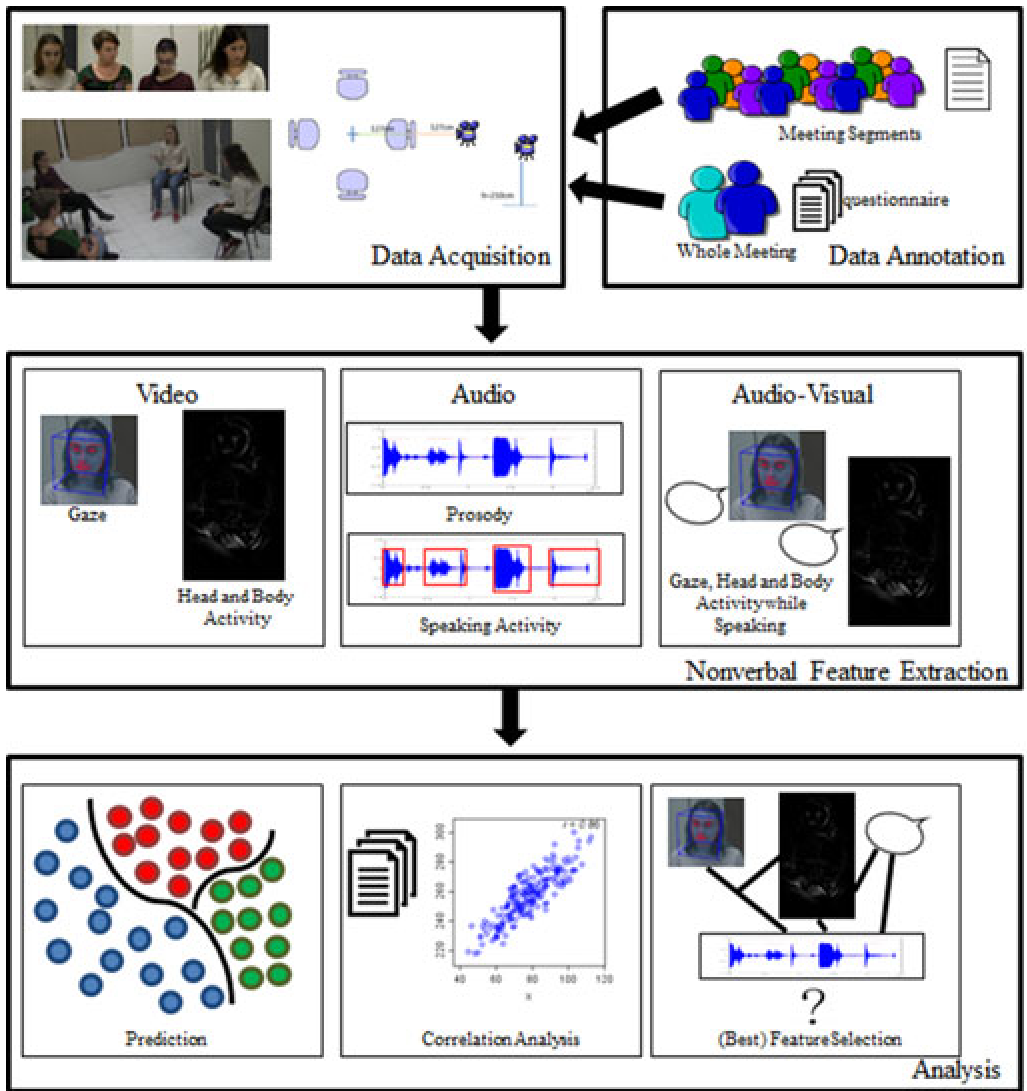 Figure 1: The proposed workflow, from data acquisition and feature extraction to LMKL-based classification.
Key Features Extracted:
- Audio: Speaking length, successful vs. unsuccessful interruptions, pitch, and vocal energy (prosody).
- Visual: Visual Focus of Attention (VFOA), head activity, and body movement.
- Audio-Visual: Looking while speaking vs. looking while listening.
Experimental Insights
The researchers tested their model on two types of data: 5-minute segments and "holistic" whole-meeting impressions.
1. The Power of Audio
Interestingly, audio-based features (specifically Speaking-Act based) proved to be the most robust predictors. Features like the ratio of successful interruptions and vocal energy were significantly correlated with the social psychology gold-standard (SYMLOG friendliness scores).
2. LMKL vs. The World
As shown in the results, All-LMKL consistently achieved higher Geometric Means (GeoMean) compared to standard SVM and Generalized MKL (GMKL).
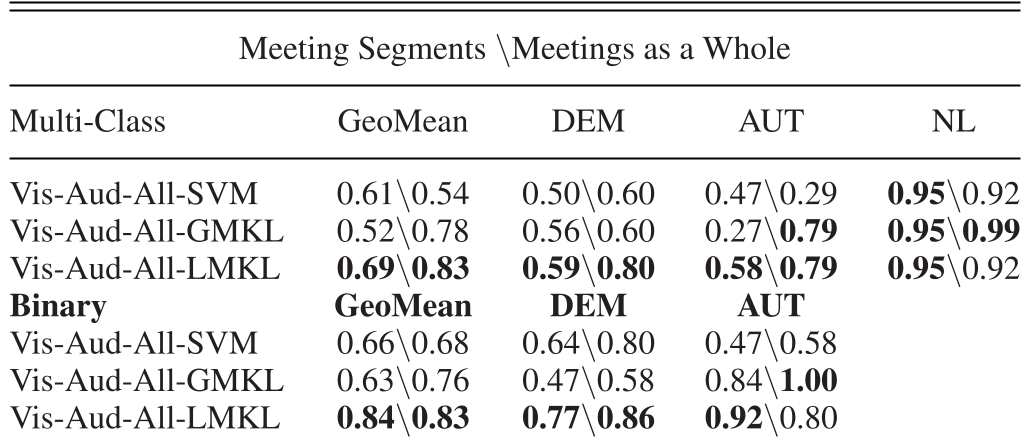 Table Snapshot: Comparing classification performance of different modalities using LMKL vs competitive methods.
3. Feature Selection: "Less is More"
Using a simple heuristic, the authors found that by using only the top-performing features (identified by their kernel weights in LMKL), they could actually improve classification accuracy. For instance, using just 6 out of 17 visual features (mostly VFOA-related) led to better results than using the full set.
Critical Analysis & Takeaways
The study provides a powerful "social microscope." Autocratic leaders were characterized by higher vocal energy, more frequent floor grabs, and longer speaking turns. Democratic leaders, by contrast, tended to have more mutual gaze and higher participatory scores from other group members.
Limitations: The dataset size (16 meetings) remains a bottleneck for modern deep learning. However, the use of kernel methods is a brilliant way to handle high-dimensional nonverbal data with limited samples.
Future Outlook
This work sets the stage for "AI Leadership Assistants" that could provide real-time feedback during corporate meetings, or help HR departments identify natural leadership potential in recruitment phases without the bias of resume-screening.
Key Takeaways:
- Nonverbal cues are sufficient to distinguish leadership styles.
- Multiple Kernel Learning is superior for multimodal social signal integration.
- Gaze (VFOA) and Speaking Activity (Interruptions) are the "signals of power" in human groups.