
Monitoring Social Interactions: The Privacy vs. Precision Trade-off
7378_Trade-offs in monitoring social interactions.
This paper presents a novel mobile sensing framework for monitoring face-to-face social interactions using non-visual and non-auditory sources. By fusing RSSI-based distance estimation and compass-derived body orientation from mobile phones with chest-mounted accelerometer data for speech detection, the system achieves a 90% interaction detection accuracy while preserving participant privacy.
TL;DR
Researchers have developed a mobile sensing platform that tracks face-to-face social interactions without using cameras or microphones. By combining smartphone signals (Wi-Fi/Bluetooth RSSI and Compasses) with chest-mounted accelerometers that detect vocal cord vibrations, the system achieves ~90% accuracy in identifying interactions while maintaining strict user privacy.
Context: Beyond the "Big Brother" Observer
Aristotle famously claimed, "Man is by nature a social animal." Yet, measuring this social nature accurately has haunted researchers for a century. Traditional methods like diaries suffer from memory bias, while modern video/audio monitoring suffers from the Hawthorne Effect: people act differently when they know they are being recorded.
The core challenge in social behavior analysis is a zero-sum game between data quality and unobtrusiveness. This paper breaks that cycle by asking: Can we detect a conversation without actually "listening" to it?
The Problem: Why Current Sensors Fail
Existing sensor-based methods face three main hurdles:
- Spatial Constraints: Video systems require a direct line of sight and are confined to specific rooms.
- Coarse Granularity: Early "Reality Mining" used Bluetooth, which has a 10m range—too wide to distinguish a conversation from two people just being in the same building.
- Privacy Concerns: Even if audio is "processed" to remove verbal content, the mere presence of an active microphone intimidates subjects.
Methodology: Fusing Proximity with Phonation
The authors suggest that a face-to-face interaction is defined by two prerequisites: Spatial Configuration (being close and facing each other) and Speech Activity.
1. Inferring Spatial Settings
Instead of generic models, the team uses RSSI (Received Signal Strength Indicator) from Wi-Fi signals to estimate distance. By using a supervised learning approach with a quick 1-minute calibration, they achieved a median distance accuracy of 0.5 meters. To determine if people are actually facing each other, they leverage the smartphone's internal compass (magnetometer) to calculate relative body orientation.
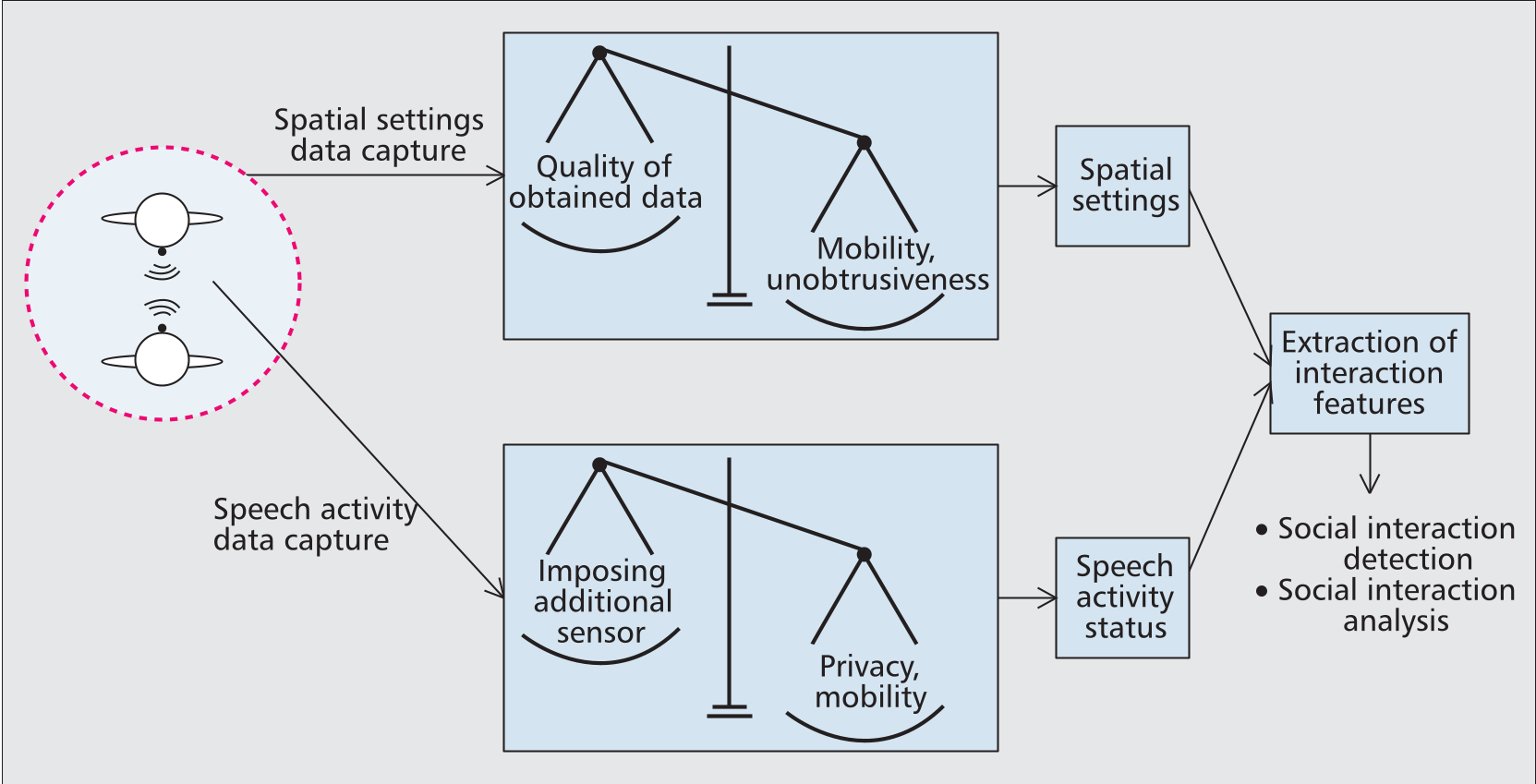 Figure: The trade-offs between data quality, privacy, and obtrusiveness in the proposed approach.
2. Speech Activity via Vibrations
To solve the privacy dilemma, the system uses an accelerometer mounted at the chest level. Rather than recording sound waves in the air, it records the physical vibrations of vocal cords (typically between 100-200 Hz). This ensures that only the wearer's speech is detected, ignoring ambient conversations and protecting the privacy of others.
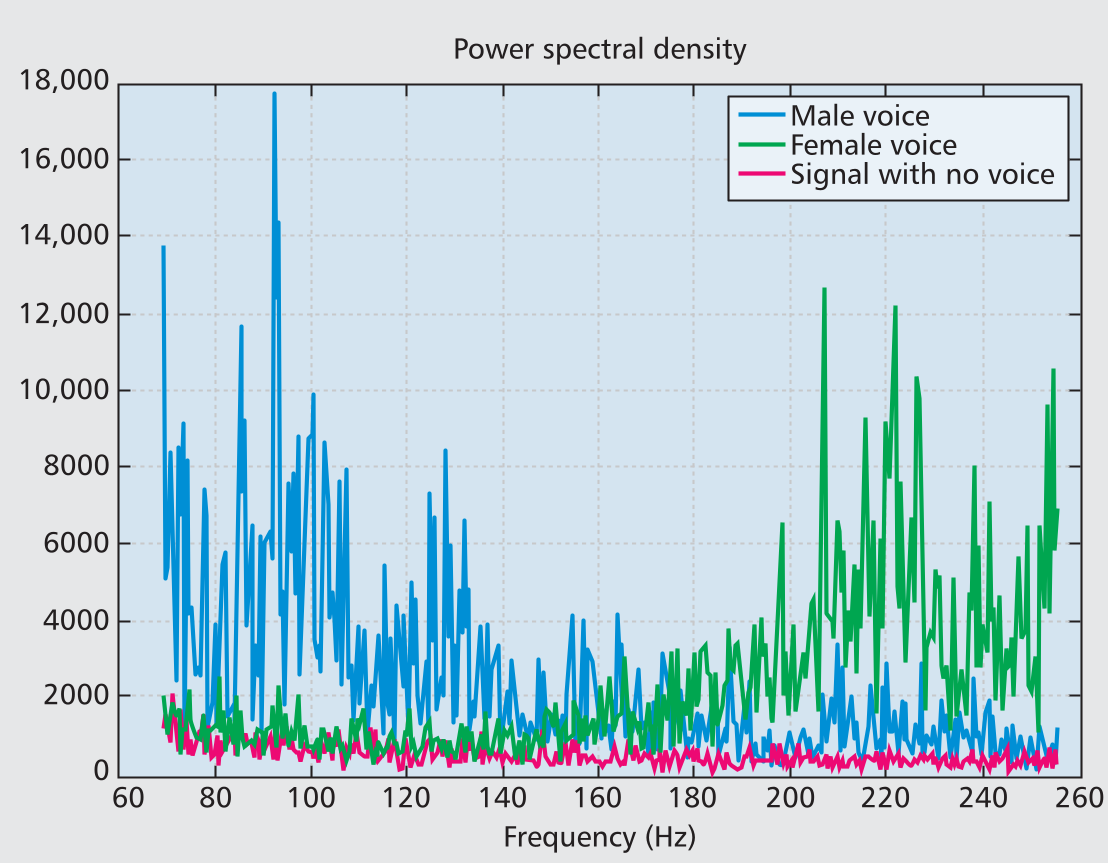 Figure: Frequency spectra showing the distinct signature of vocal chord vibrations compared to silence.
Experimental Results
The researchers tested the system with 43 participants across various indoor and outdoor environments.
- Speech Detection: Achieved 93% accuracy. While physical activities (like running) or vehicle vibrations can cause false positives, the specific frequency range of human phonation remains a highly reliable marker.
- Interaction Classification: Using a 3-feature vector (distance, orientation, and orientation stability), they successfully identified 89% of social interactions.
- The Power of Fusion: By combining spatial data with speech activity, the system can distinguish between "two people sitting silently in an office" and an "active conversation," reducing false positives significantly.
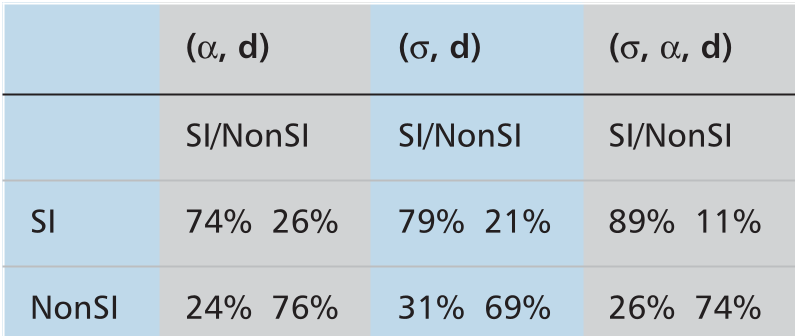 Table: Classification results for different feature combinations. The combination of orientation and distance (σ, α, d) provides the highest performance.
Critical Insight: The "Why" Behind the Success
The brilliance of this work lies in its Inductive Bias. The authors recognized that social interactions have physical "signatures" that don't require high-fidelity data like 4K video or 44kHz audio. By distilling a conversation down to "Proximity + Orientations + Phonation," they created a system that is robust, mobile, and—most importantly—socially acceptable for long-term wear.
Summary & Future Outlook
This paper provides a blueprint for the future of social science research. While a chest-mounted accelerometer might still feel slightly obtrusive today, the rapid adoption of wearables (like the Fitbit or smartwatches) suggests these sensors will soon be invisible parts of our daily wardrobe.
Future Work will need to address high-movement scenarios (like playing sports) where motion noise interferes with voice vibration detection. However, as it stands, this approach proves that we can monitor the "Social Animal" without turning the world into a Panopticon.