
Competition and Cooperation: Deciphering the Interplay of Multiple Social Messages in Multiplex Networks
7447_Competition and Cooperation Dynamical Interplay Diffusion Between Social Topic Multiple Messages in Multiplex Networks.
This paper proposes a novel diffusion model for multiple social messages within the same topic using multiplex networks and a discrete-time Microscopic Markov Chain Approach (MMCA). By introducing time-dependent variables to characterize inter-message competition and cooperation, the framework achieves a state-dependent infection rate that accurately simulates complex information dynamics on social platforms.
TL;DR
In the modern social media landscape, topics are rarely composed of a single message. Instead, they are a swarm of competing and cooperating narratives. This paper introduces a sophisticated multiplex network diffusion model that uses a Microscopic Markov Chain Approach (MMCA) to quantify how concurrent messages influence each other's spread. By moving beyond static infection rates, the authors reveal the "hidden hand" of inter-message dynamics that dictates which information survives and which fades into obscurity.
Background: Beyond the Single-Layer Assumption
Most traditional diffusion models treat social networks as single-layer graphs. However, in reality, different messages—even those under the same topic—propagate through different "logical paths" based on user interests and engagement triggers. The core motivation of this study is to address the heterogeneity of diffusion paths and the dynamics of user interaction. When message A (e.g., a breaking news rumor) and message B (e.g., an official clarification) spread simultaneously, their interaction is not constant; it depends on the current state of the nodes in the network.
Methodology: The Mechanics of Interaction
The authors define a two-layer multiplex network where each layer represents the diffusion path of a specific message. Unlike standard models, the infection rates are modified by interaction coefficients .
1. The Interaction Terms
- Cooperation (): Message A makes users more susceptible to Message B.
- Competition (): Message A provides a "buffer" or "immunity," making it harder for Message B to take hold.
2. State Mapping with MMCA
The model tracks nodes through four distinct states: (susceptible to both), (infected by message 2), (infected by message 1), and (infected by both). By using Microscopic Markov Chains, the authors can calculate the probability of a node transitioning between these states at any discrete time step .
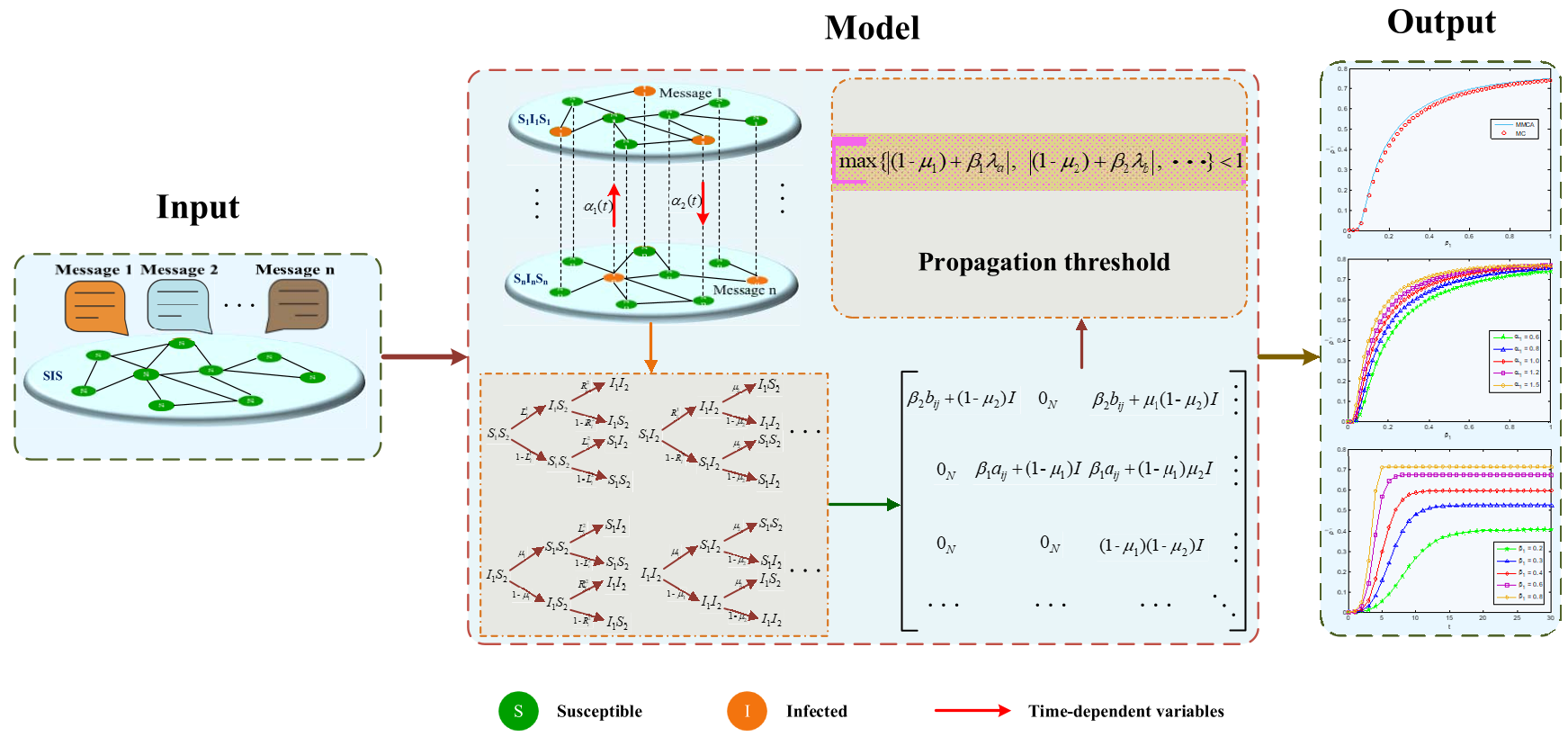 Figure 1: The framework showing how messages are mapped to multiplex spaces and transitioned via MMCA probability trees.
Experiments and Critical Results
The authors validated their model against Monte Carlo (MC) simulations and applied it to real-world data from Sina Microblog.
SOTA Comparison and Accuracy
The MMCA equations were found to be highly accurate. As seen in the performance charts, the theoretical thresholds derived by the authors align almost perfectly with stochastic MC simulations, proving that the Markov chain approach effectively captures the non-linear dynamics of coupled networks.
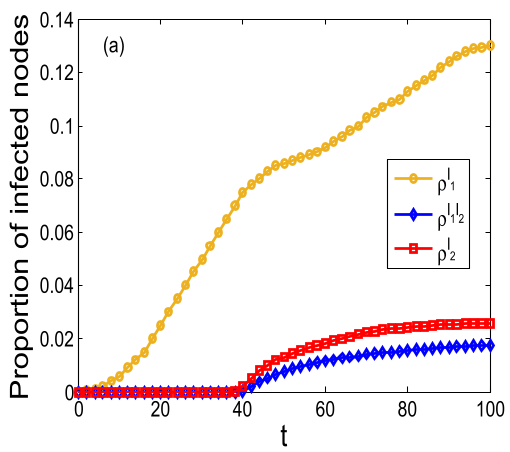 Figure 2: Validation of MMCA (Line) against Monte Carlo (Circles) showing the fraction of infected/susceptible nodes.
The Impact of "Alpha"
The study reveals a profound insight into Diffusion Thresholds:
- In cooperative environments, the "epidemic threshold" is lowered. This means information can "break out" even with lower initial infection rates because the messages assist each other.
- In competitive environments, the threshold is pushed higher. The messages effectively "crowd each other out," requiring a much higher degree of virality to achieve a widespread outbreak.
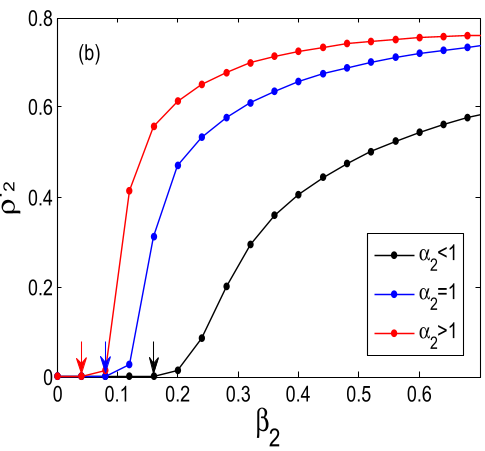 Figure 3: Infection rates as a function of the interaction parameter alpha, demonstrating how cooperation advances the threshold.
Critical Analysis & Conclusion
Takeaway
The paper successfully demonstrates that information diffusion is not just a property of the network or the message itself, but a product of the dynamical interplay between multiple messages. The transition from constant to state-dependent infection rates is a significant step toward realistic social simulation.
Limitations & Future Work
While the model is robust, it primarily focuses on two-message interactions. Although the authors propose an inductive method for "n" messages (merging messages into a unified fusion state), this may oversimplify the complex, simultaneous interactions of dozens of competing narratives found in real social crises. Future research could look into Asymmetric Interaction, where Message A promotes Message B, but Message B inhibits Message A—a common scenario in aggressive marketing or political campaigning.
Ultimately, this framework provides a powerful mathematical lens for platform moderators and researchers to predict how new information will integrate into—or disrupt—the existing social discourse.