
Visualizing the Law: Bridging Data Mining and Legal Expertise
7518_Visualizing Association Rules for feedback within the legal system.
This paper introduces a visualization-based framework for discovering and refining association rules within the Victorian Legal Aid (VLA) dataset. By employing the Apriori algorithm combined with interactive visualization, the authors transform raw legal data into actionable "feedback" rules that help legal practitioners understand decision-making patterns.
TL;DR
This research tackles the "interpretability gap" in legal data mining. By applying association rule mining to legal aid data and presenting the results through specialized visualization interfaces, the authors enable legal experts to discover hidden patterns—such as gender-based differences in legal aid grants—effectively turning raw data into policy feedback.
Problem & Motivation: The Black Box of Legal Data
The legal system generates vast amounts of data, yet this data is rarely used to provide feedback for systemic improvement. Traditional association rule mining often produces thousands of rules that are impossible for a human lawyer to parse. The authors argue that without a way to visualize and interact with these rules, the "Knowledge Discovery in Databases" (KDD) process remains disconnected from the actual legal practitioners who need it most.
Methodology: The Two-Stage Discovery Process
The core of the paper lies in its structured approach to making data mining "human-centric":
1. The Pre-hypothesis Stage
Before running complex queries, the system uses visualization to help experts form "gut-feeling" hypotheses. This involves looking at the raw distribution of legal aid cases across different demographics and matter types.
2. Explaining Hypotheses through Visualization
While the Apriori algorithm discovers the rules, the visualization layer is where the "Why" is answered.
- Attribute Grouping: Experts can group specific legal codes (e.g., different types of family law matters) to see broader trends.
- Confidence Metrics: Rules are evaluated based on their Confidence () and Support (). For example, the likelihood of a legal aid grant given specific applicant traits.
 Figure 1: The framework for extracting and visualizing association rules from the VLA database.
Key Insights: What the Data Revealed
The most striking result of the study was the identification of a significant "gender-matter" correlation. By visualizing the rules, the researchers found:
- Rule A: If Applicant is Female, the Matter Type is likely Family Law (Confidence: 52.2%).
- Rule B: If Applicant is Male, the Matter Type is likely Family Law (Confidence: 17.4%).
This massive disparity highlighted that legal aid for men was heavily skewed toward criminal law, while women sought aid primarily for domestic/family issues. Such insights are vital for legal policy makers to allocate resources effectively.
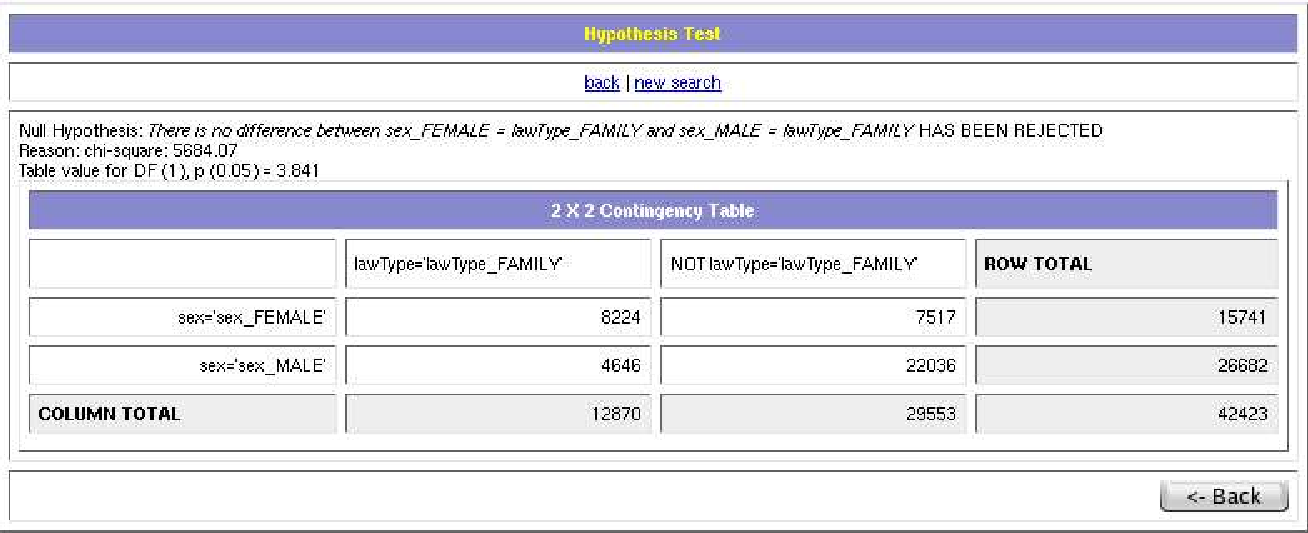 Figure 2: Interactive interface showing how rules are clustered to identify significant legal aid patterns.
Critical Analysis & Conclusion
This paper serves as an early but foundational example of Explainable AI (XAI) before the term became mainstream. Its strength lies in its "Human-in-the-loop" philosophy—acknowledging that data mining cannot replace legal judgment but should instead augment it.
Limitations: The study is limited by the quality of the VLA metadata. If the initial data entry is biased or incomplete, the visualized rules will simply reflect those existing flaws (the "Garbage In, Garbage Out" principle).
Future Outlook: Today, as we move toward using LLMs for legal reasoning, the principles of this paper remain relevant: we need visual and logical bridges that allow human experts to audit, verify, and interact with the patterns found by machines.
Takeaway for Practitioners
In any domain involving high-stakes decisions, never present "raw" mining results. Use visualization to cluster attribute values and filter by "Interestingness" to turn noise into actionable feedback.