
Beyond Passive Consumption: The Convergence of Social TV, Flexible Power, and Physical Security
7539_New Approach Combines TV and Social Networking.
This brief analyzes a convergence of technologies: "Social TV" frameworks (MIT/BT), carbon-nanotube-based "Paper Batteries" (Stanford), and physical-layer security for RFID tags (University of Calgary/Microsoft). These advancements aimed to bridge the gap between passive consumption and interactive networking while optimizing hardware portability and security.
Executive Summary
TL;DR: This technical brief explores a transitional era in consumer technology. It highlights a three-pronged shift: transforming the "lean-back" TV experience into a social "lean-forward" activity (Social TV), replacing bulky lithium-ion components with carbon-nanotube-infused paper batteries, and adding physical "kill switches" to RFID tags to protect sensitive personal data.
Academic Positioning: This work represents the early-stage prototyping of "Converged Applications"—the point where the Internet of Things (IoT), social networking, and material science intersect to solve long-standing usability and security bottlenecks.
Problem & Motivation
The "Digital Experience" of the late 2000s faced three distinct friction points:
- Interactive TV Friction: Over-the-top (OTT) video and social networking were siloed. Using a laptop while watching TV was "kludgy," and on-screen pop-ups were intrusive.
- The Weight Penalty: Portable electronics remained heavy due to the rigid form factor of traditional batteries.
- Privacy Leakage: RFID tags in passports and credit cards were "always-on," allowing hackers to skim data without the user's knowledge or consent.
Methodology: The Core Innovations
1. Social TV (The MIT NeXtreme System)
MIT and BT researchers developed a system that uses a central database to aggregate video (e.g., from YouTube) and metadata. The "Insight" here was to use the smartphone (specifically the iPhone) not just as a remote, but as a secondary interaction layer.
 Figure 1: The Social TV ecosystem, integrating broadcast, wireless access, and OTT video.
2. Material Science: Paper Batteries
Stanford's approach turned standard office paper into a conductive energy storage device. By dipping paper into carbon-nanotube (CNT) ink, the nanotubes permeate the fibers rather than just coating the surface. This creates a flexible, chemically stable electrode with a high surface-area-to-volume ratio, facilitating rapid ion transfer.
3. Physical-Layer RFID Security
Researchers at the University of Calgary and Microsoft Research shifted security from complex encryption to physical intentionality. They prototyped tags that only activate via:
- Manual Switches: A slider or button to close the circuit.
- Environmental Triggers: Photo-transistors that only enable the tag when exposed to light (i.e., when pulled out of a wallet).
- Haptic Interface: Activation based on the electrical resistance detected when a human hand touches the tag.
Experiments & Results
In the realm of energy, the Stanford team found that the ink-infused paper offered performance similar to metal electrodes but at a fraction of the weight. By swapping CNTs for silver nanowires, they achieved a tenfold performance increase in conductivity.
Meanwhile, the necessity for such security was underscored by a Symantec study during the global financial crisis. Despite the recession, phishing and cybercrime remained steady, with a specific focus on the financial sector.
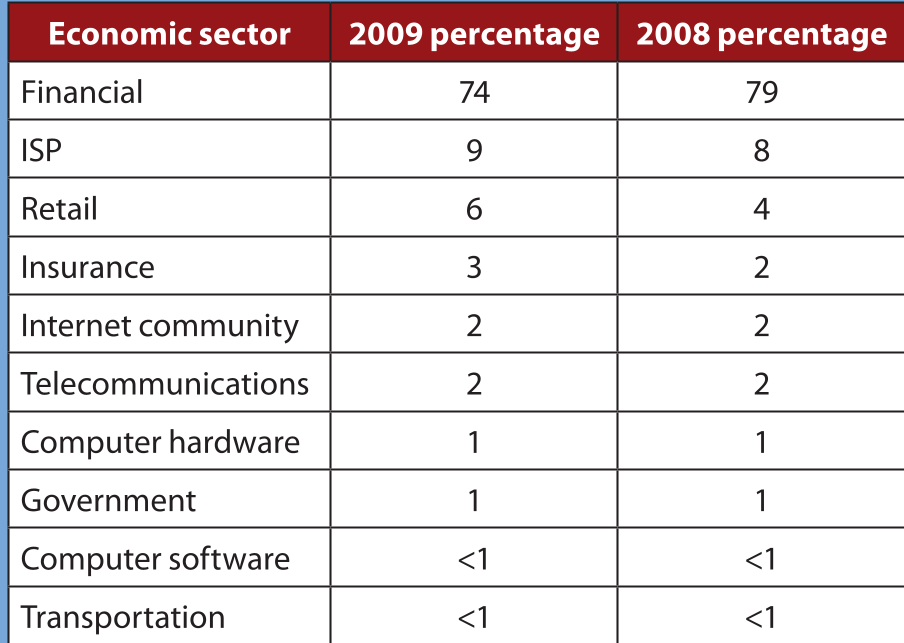 Table 1: Percentage of phishing attacks by sector (2008-2009).
Critical Analysis & Conclusion
Takeaway
The common thread across these studies is Context-Awareness. Whether it's a TV that knows what your friends are watching, a battery that bends with its device, or an RFID tag that "knows" when its owner intends to use it, the future of tech lies in hardware that responds to physical and social contexts.
Limitations
- Social TV: The early prototypes still struggled with privacy—users needed the ability to hide their viewing habits easily.
- Paper Batteries: Commercialization was estimated at 3-5 years, but scaling the printing of CNT ink without defects remains a manufacturing hurdle.
- RFID: The current prototypes (2.5 x 4 inches) are far too large for standard ID cards and require further miniaturization to be practical.
Future Outlook
We are moving toward an era where the boundary between "digital content" and "physical substrate" disappears. The use of inkjet printing for batteries and physical haptics for security suggests that the next generation of SOTA devices will be printed, flexible, and fundamentally more secure.