
Adaptive Hot Set Identification: Bridging Social Signals and Predictive Patterns
7598_Adaptive Algorithms for Efficient Content Management in Social Network Services.
The paper introduces a novel class of adaptive algorithms (Rank-Age, Linear-Adaptive, and Rank-Adaptive) for "hot set" identification in Social Network Services (SNS). By merging predictive models (EWMA) with social connection data, these algorithms achieve near-ideal accuracy (up to 95%) in identifying popular resources for efficient content management.
TL;DR
In the hyper-dynamic world of Social Network Services (SNS), traditional "hot set" identification (predicting which content will be popular) is broken. Static algorithms fail to account for the sudden spikes caused by social sharing. This paper proposes a suite of Adaptive Predictive-Social algorithms that dynamically merge historical access data with social connection metrics, achieving up to 95% accuracy and robust performance across varying workloads.
Context: Why Web 1.0 Strategies Fail Social Networks
Traditional content management (caching, replication, pre-fetching) relies on the "hot set"—a small fraction of resources that receive the vast majority of traffic. In the Web 1.0 era, popularity changed slowly. However, in modern SNS:
- User-Generated Content (UGC): Constant uploads create a "cold start" problem for predictive models.
- Social Graph Influence: A resource uploaded by a user with many "reverse contacts" (followers) can become hot instantly, regardless of its past history.
- Dynamic Volatility: The correlation between social status and actual views fluctuates, making static weights for these variables unreliable.
The Core Innovation: Adaptive Merging
The researchers argue that the secret lies not just in what data you use, but how you combine it at any given moment. They propose two primary adaptive strategies:
1. Linear-Adaptive (Statistical Normalization)
Because access counts (predictive) and follower counts (social) follow different heavy-tailed distributions, they cannot be mixed directly. This algorithm uses a percentile filtering technique.
- It calculates weights () based on the first, second, and third quartiles of the current working set.
- This ensures the combined score is independent of the absolute magnitude of the underlying metrics.
2. Rank-Adaptive (Feedback-Loop Control)
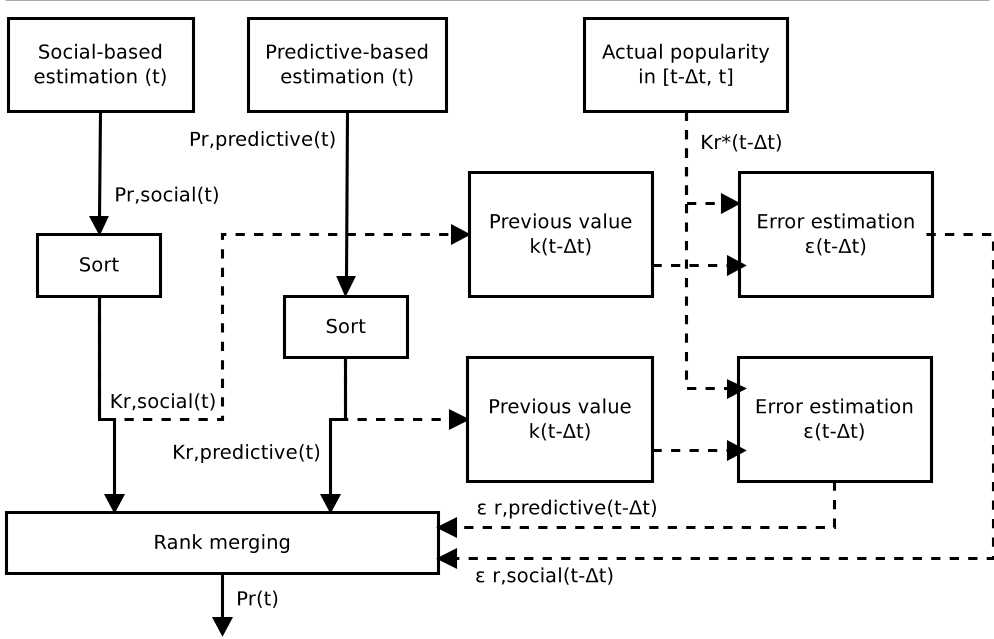
This is perhaps the most robust approach. It uses a "Rank Merging" technique borrowed from search engines but adds a runtime feedback control.
- The system looks at its previous window's prediction error.
- If the predictive model was more accurate than the social model in the last 20 minutes, it automatically increases the weight of the predictive component for the next period.
Experimental Validation
Using a discrete event simulator (Omnet++), the authors compared their adaptive models against traditional single-metric models and static hybrids.
Performance & Stability
The Rank-Adaptive algorithm performed closest to an "Ideal" theoretical algorithm (which has 100% future knowledge). More importantly, while static models like "Rank-Age" saw their accuracy plummet by 30% as the "Upload Percentage" (workload dynamism) increased, the adaptive models remained perfectly stable.
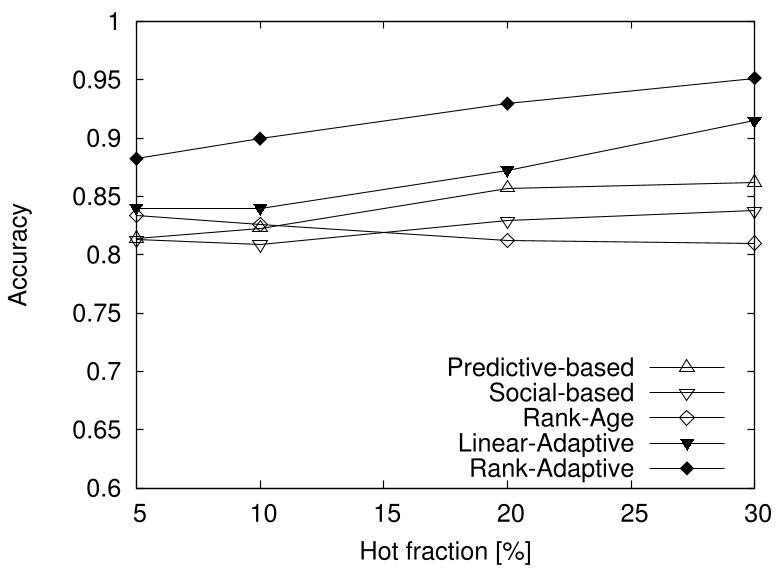 Figure: Note how Linear-Adaptive and Rank-Adaptive (top lines) stay at the peak while others fluctuate or drop.
Academic Insight: The Importance of Sensitivity Analysis
The paper excels in its Sensitivity Analysis. By varying parameters like "Hot Fraction" (size of the hot set) and "User/Resource Popularity Correlation," the authors proved that their adaptive mechanisms act as a "buffer" against the inherent chaos of social media traffic.
When the social signal is weak, the adaptive weight () naturally shifts toward the predictive history. When a "viral" event occurs, the social signal takes over before the predictive model can even register the first few hits.
Conclusion & Future Outlook
This work provides a foundational framework for modern CDNs and Social Cloud providers. By moving away from static heuristics and toward feedback-driven adaptation, we can significantly reduce the computational overhead of content pre-adaptation and replication.
Future Work: As social networks move toward algorithmic discovery (e.g., TikTok's For You Page), the social graph becomes less important than the "content graph." Integrating AI-based content embeddings into this adaptive framework would be the logical next step in hot set identification.
Takeaway for Engineers: Don't just tune your weights; build a system that tunes its own weights based on the error of the last 15 minutes.