
Beyond Type: Multi-Modal Voice Dictation for Historical Document Transcription
7680_Multimodal Crowdsourcing for Transcribing Handwritten Documents.
The paper introduces a multimodal crowdsourcing framework for transcribing historical handwritten documents by combining Handwritten Text Recognition (HTR) with Automatic Speech Recognition (ASR). Using a mobile-based dictation app, the system enables volunteers to transcribe text via voice, achieving significant Word Error Rate (WER) reductions through language model interpolation and Confusion Network combination.
TL;DR
Transcribing 16th-century Spanish manuscripts is a grueling task for scholars. This paper presents a novel crowdsourcing framework that lets volunteers talk instead of type. By combining Handwritten Text Recognition (HTR) and Automatic Speech Recognition (ASR) via a mobile app, the researchers achieved a 35.6% relative improvement in accuracy, significantly easing the burden on expert paleographers.
The Paleographer's Bottleneck: Why Typing Fails
Historical documents are the DNA of cultural heritage, yet they are notoriously hard to digitize. Ancient scripts, ink degradation, and complex vocabulary make fully automated HTR systems unreliable.
While crowdsourcing (using volunteers) seems like a solution, it has hit a wall:
- The Mobile Ergonomics Gap: Typing archaic Spanish on a smartphone keyboard is frustrating.
- User Friction: Professional transcription requires specialized training.
- Resource Inefficiency: Volunteers often spend time transcribing lines the AI already "understands" well, while failing on the truly difficult segments.
The Innovation: Multimodal Intelligence
The authors propose a "Multimodal Crowdsourcing" loop. Instead of treating HTR and ASR as separate silos, they use them to reinforce each other.
1. Language Model Interpolation
The system doesn't just record audio. It takes the "best guess" from the initial HTR scan and uses it to bias the ASR engine. If the HTR sees a word that looks like "Toledo," the speech recognizer becomes more likely to hear "Toledo," even in a noisy environment.
2. Bimodal Confusion Networks (CN)
Since speech and handwriting are asynchronous, they cannot be aligned perfectly in time. The system converts both recognition outputs into Confusion Networks—probabilistic graphs that represent multiple word hypotheses. A custom algorithm then searches for "anchor subnetworks" to align and fuse these two sources into a final, more accurate transcript.
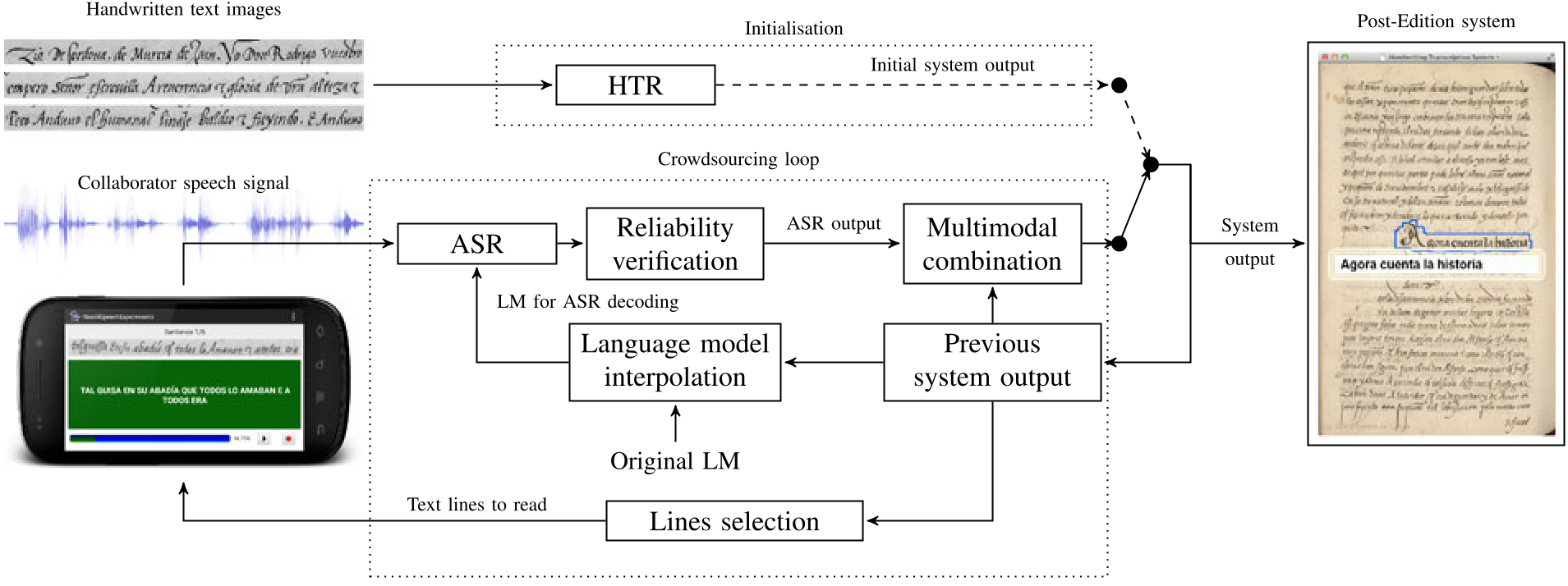 Figure 1: The architecture showing the feedback loop between HTR-adapted language models and the final multimodal combination.
3. "Smart" Line Selection
To optimize volunteer time, the system calculates a Reliability Score (using re-normalized posterior probabilities) for every line. It then feeds the "hardest" lines (those where the AI is most confused) to the mobile app for human dictation.
Experimental Results: Real-World Gains
Testing on the "Rodrigo" corpus (a 1545 Spanish book), the results were striking:
- Baseline HTR Quality: 39.3% Word Error Rate (WER).
- Enhanced Multimodal Quality: 25.3% WER.
- Efficiency: Using the line selection module, the system achieved significant improvements with only 60 total utterances—meaning a tiny amount of volunteer work can fix a huge portion of the AI's errors.
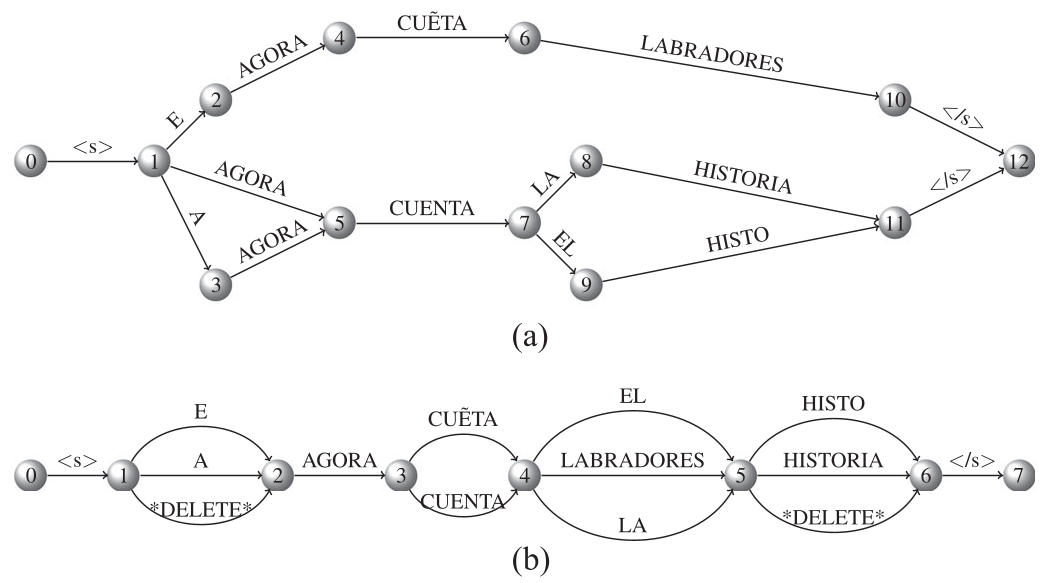 Figure 2: Examples of Word Graphs (a) transformed into Confusion Networks (b) for asynchronous modality merging.
Critical Insight: The Reliability Threshold
One of the paper's most salient findings is the correlation between HTR reliability () and volunteer effort. The authors found a "clear border" at . Lines below this threshold absorbed 76.9% of the collaboration effort, proving that uncertainty-based line selection is not just theoretical—it is an essential operational strategy for crowdsourcing.
Conclusion & The Future
This work bridges the gap between expert paleography and public interest. By moving from a keyboard-centric model to a multimodal voice-driven model, the authors have made cultural preservation more accessible and efficient.
The next frontier? The authors suggest moving from HMM-based models to Deep Neural Networks (DNNs) and Recurrent Neural Networks (RNNs) to further squeeze out transcription errors. In an age where digital humanities are expanding, this "multimodal loop" provides a scalable blueprint for preserving history.