
Bridging Social Logic and Network Coding: A New Frontier for DTMSNs
8051_Inter-Session Network Coding-Based Policies for Delay Tolerant Mobile Social Networks.
This paper introduces an online Inter-Session Network Coding (ISNC) protocol tailored for Delay Tolerant Mobile Social Networks (DTMSNs). By integrating decentralized coding criteria with social-aware routing (SimBet), it achieves significant gains in message delivery rates and fairness while reducing buffer congestion in intermittently connected environments.
TL;DR
In the chaotic realm of Delay Tolerant Mobile Social Networks (DTMSNs), standard routing often leads to bottlenecks. This paper demonstrates that Inter-Session Network Coding (ISNC), when paired with social-aware intelligence, can significantly boost message delivery and fairness. By predicting contact patterns through community detection, the proposed protocol decides when to mix packets from different users, effectively turning social structures into efficient data highways.
The Motivation: Why Coding Fails in Undirected Networks
For years, the "Multiple Unicast Conjecture" has been a wet blanket for network theorists: it suggests that in undirected graphs, coding packets together doesn't actually provide a throughput advantage over perfect routing.
However, DTMSNs aren't just random graphs; they are human-centric. Humans move in social clusters (communities). The authors' key insight is that social-aware routing (like SimBet) imposes a "pseudo-directionality" on the network. This directionality breaks the conjecture's constraints, opening a window where ISNC can actually win.
Methodology: Deciding When to Mix
The core innovation lies in the Decentralized Coding Criteria. A node shouldn't just XOR two packets because it has them; it must ensure the destination can actually "decode" the result.
1. The Butterfly Intuition
The authors use the classic Butterfly topology to show that while greedy epidemic routing gains nothing from ISNC, social routing creates the specific "cross-traffic" patterns where coding the hub node saves buffer space without delaying the "remedy" packets needed for decoding.
2. The Conductance Formula
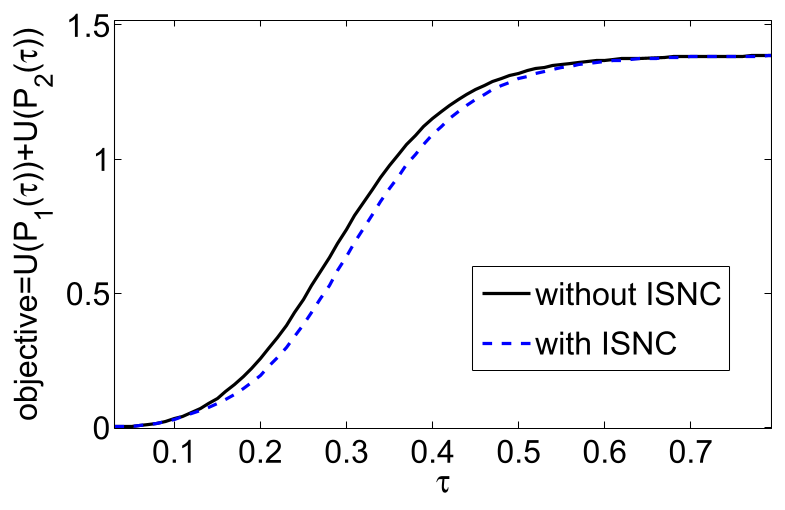
To estimate delays without global knowledge, the paper adopts three criteria based on Graph Conductance ().
- Criterion 1: Estimates one-hop community delays.
- Criterion 2: Integrates node "utility" (social rank) into the propagation speed.
- Criterion 3: Extends the search to two-hop community paths.
The goal is simple: only code at node if the estimated delay for the "remedy" packet to reach the destination is shorter than the time it takes for the coded packet to arrive.
Experimental Results: Real-World Validation
The protocol was stress-tested against the MIT Reality Mining and Intel contact traces.
Key Finding 1: Higher Delivery under Load
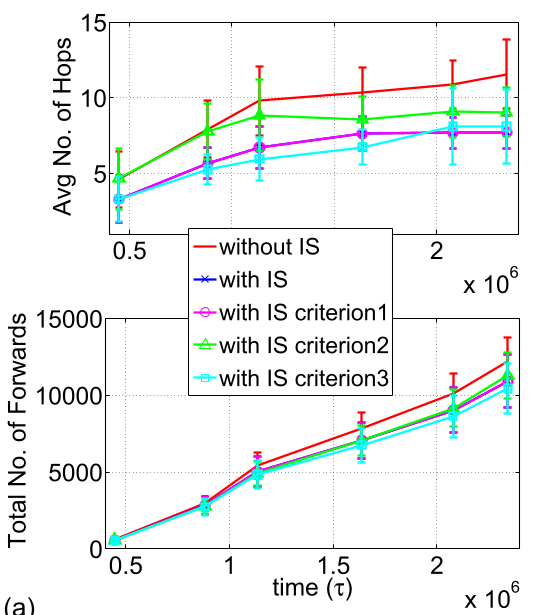
As the number of sessions () increases, the network becomes congested. ISNC acts as a "buffer relief" valve. In the MIT trace, the ISNC criteria consistently outperformed plain SimBet routing.
Key Finding 2: Improving Fairness
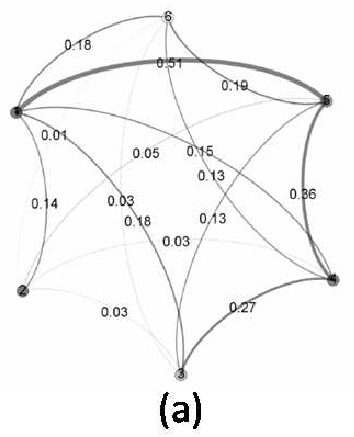
One of the most striking results is the impact on Fairness. In DTNs, "popular" nodes (high centrality) usually get hammered with traffic, draining their battery. ISNC reduces the relative load on these "alpha" nodes by effectively combining traffic streams, redistributing the forwarding burden across the community.
Critical Analysis & Conclusion
Takeaway: This work proves that the "academic" benefits of Network Coding are reachable in "messy" real-world mobile networks if we leverage the underlying social graph.
Limitations:
- Signaling Overhead: Maintaining the community matrices ( and ) adds overhead, which might be heavy for extremely resource-constrained IoT sensors.
- Conservative Nature: The criteria are designed to be "conservative" to avoid performance degradation, meaning they might miss some high-risk/high-reward coding opportunities.
Future Work: The logical next step is integrating these decentralized heuristics into a formal optimization framework that accounts for energy-utility trade-offs, possibly using Reinforcement Learning to tune the coding triggers dynamically.
Published by the Senior Academic Tech Editor.