
I Know Where You All Are: Unmasking the Systematic Fragility of LBSN Privacy
8545_I Know Where You All Are! Exploiting Mobile Social Apps for Large-Scale Location Privacy Probing.
The paper introduces a systematic framework for Location Probing Attacks against Category II Location-Based Social Networks (LBSNs) like WeChat and Momo. By exploiting vulnerabilities in "Nearby" features, the authors propose three distinct methodological approaches—Request Forgery, Encryption Cracking, and Emulator Simulation—to achieve large-scale, automated user tracking with high precision (up to 0.1m in some apps).
TL;DR
Researchers have uncovered that popular Location-Based Social Network (LBSN) apps like WeChat, Weibo, and Momo are highly vulnerable to large-scale Location Probing Attacks. By intercepting network traffic or simulating user actions via emulators, attackers can triangulate the exact physical position of millions of strangers without their consent. The study demonstrates that even when apps appear to show "coarse" distances, the underlying data packets often contain precise GPS coordinates.
Positioning the Threat
In the landscape of cybersecurity, this paper moves beyond simple "proof-of-concept" attacks. It establishes a comprehensive taxonomy of Category II LBSN vulnerabilities—apps designed specifically for discovering strangers nearby. While previous research often required the attacker to be a "friend" of the victim, this methodology allows for the mass-harvesting of location data from any user utilizing the "Nearby" feature.
Problem & Motivation: The Illusion of Obfuscation
The core intuition of the authors is that "obfuscation" in social apps is frequently a UI-only facade. While a user sees "500 meters away," the server might be sending 39.9923481, 116.339193 in the backend JSON response.
The authors identify two fatal flaws:
- Incomplete Obfuscation: Servers providing exact distances or coordinates in hidden fields.
- Deducibility: Even with coarse data, multiple readings from different "fake" locations allow for mathematical trilateration to pinpoint the target.
Methodology: The Three Pillars of Probing
The researchers developed three distinct attack vectors to bypass varying levels of security:
1. Request Forgery (The Low-Hanging Fruit)
For apps using standard HTTP or one-way SSL (like SayHi and Weibo), the authors used Fiddler to intercept requests and inject "fake" coordinates. By automating this, a single PC can "scout" thousands of locations per hour.
2. Encryption Cracking (The Reverse Engineering Approach)
Some apps (like MiTalk) use a checksum or signature (parameter s) to prevent tampering. The authors decompiled the APK, identified the hashing logic (as shown below), and successfully bypassed the integrity checks.
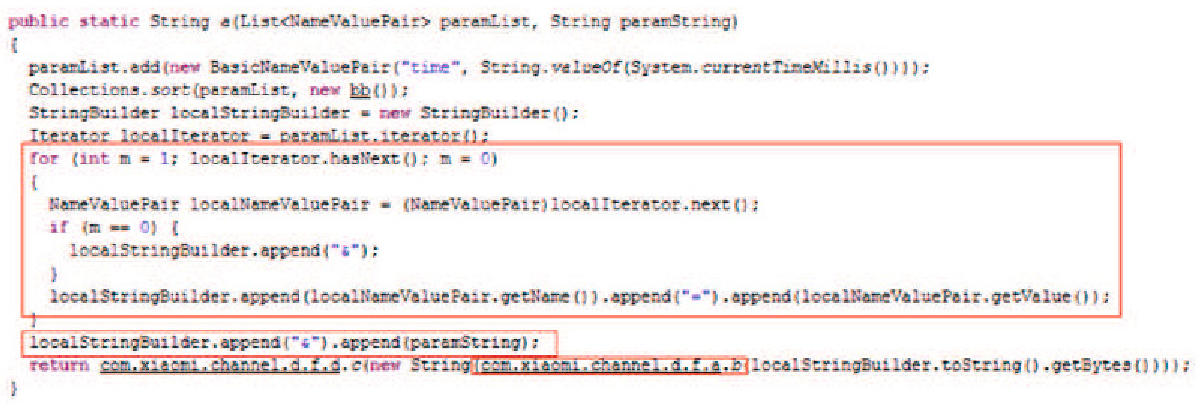 Figure: The decompiled Java logic used to forge valid signatures for MiTalk.
3. Emulator Simulation (Bypassing Hardened Security)
For "hardened" apps like WeChat (using two-way SSL), the authors used uiautomator. Instead of attacking the protocol, they scripted an Android emulator to physically "click" the app and scrape the displayed data from the UI hierarchy.
Experiments: Precision and Scale
The team tested 8 apps with staggering results. The "risk matrix" reveals a grim reality:
| APP | Exploit Ease | Accuracy Leaked |
|---|---|---|
| SayHi / Weibo | Easy | Very High (Exact Coordinates) |
| Momo | Easy | High (1m accuracy) |
| Difficult | Medium |
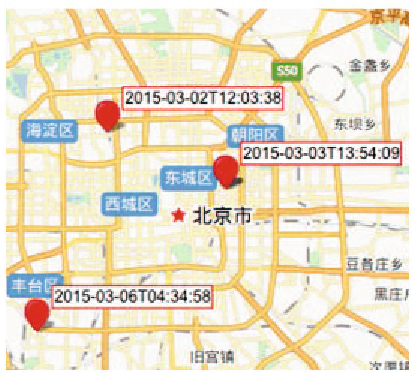 Figure: (a) Exact tracking in Weibo vs (b) Intersection tracking in WeChat.
In the case of WeChat and Momo, the authors proved that by placing "probers" at known points (red dots), the intersection of distance circles (trilateration) resolves a user's position to a remarkably small area.
Critical Insight & Conclusion
The industry value of this research lies in its critique of Client-Server data responsibility. The authors argue that servers should never send more information than the client UI requires. If a user is only meant to see a 100m range, the server should perform that rounding before transmission, not leave it to the app's frontend.
Future Outlook
As tracking becomes more automated, the authors suggest the shift toward Machine Behavior Modeling. Service providers must distinguish between a human checking "Nearby" once every 10 minutes and a bot performing hundreds of "geographic jumps" per second. Without robust anomaly detection and true server-side data obfuscation, the location privacy of millions remains an open book.