
AR Social Continuum: Reimagining Social Relationships in Spatial Computing
863_AR social continuum representing social contacts.
This paper introduces the "AR Social Continuum," a framework for representing social contacts in head-worn Augmented Reality (AR) using proximity and visual fidelity filters. By mapping social intimacy to spatial distance and level of detail (LOD) in virtual avatars, the method enables users to intuitively distinguish between different social groups within a mobile AR environment.
TL;DR
How do we visualize a "Friend" versus a "Stranger" in Augmented Reality? This paper proposes the AR Social Continuum, a system that uses spatial distance and visual complexity to represent the depth of human relationships. By moving away from simple location-based pins to dynamic, proximity-aware avatars, the researchers demonstrate a more intuitive way to manage social networks in head-worn AR.
The Problem: Spatial Clutter and Social Blindness
Traditional social AR applications are "socially blind." They treat all data points the same, usually anchoring them to GPS coordinates. If you are in a crowded space, your HoloLens or AR glasses might show a sea of identical icons, making it impossible to distinguish your best friend from a random passerby.
The core challenge is differentiation. In the real world, we use physical distance and body language to manage social interactions. Current AR interfaces lack this "social logic," leading to high cognitive load and a lack of emotional context.
Methodology: Mapping Intimacy to Pixels and Space
The authors developed a prototype on the Microsoft HoloLens that uses the Social Continuum metaphor. They categorized social contacts into four groups: Intimates, Friends, Acquaintances, and Strangers.
To represent these, they tested two primary variables:
- Proximity (Spatial Cue): Utilizing concentric circles on the ground. The more intimate the contact, the closer they are placed to the user's physical center.
- Visual Fidelity (Graphic Cue): The level of detail follows the social rank.
- Intimates: Full 3D animated avatars.
- Friends: 2D static images.
- Acquaintances: 2D bust images.
- Strangers: Simple emojis or silhouettes.
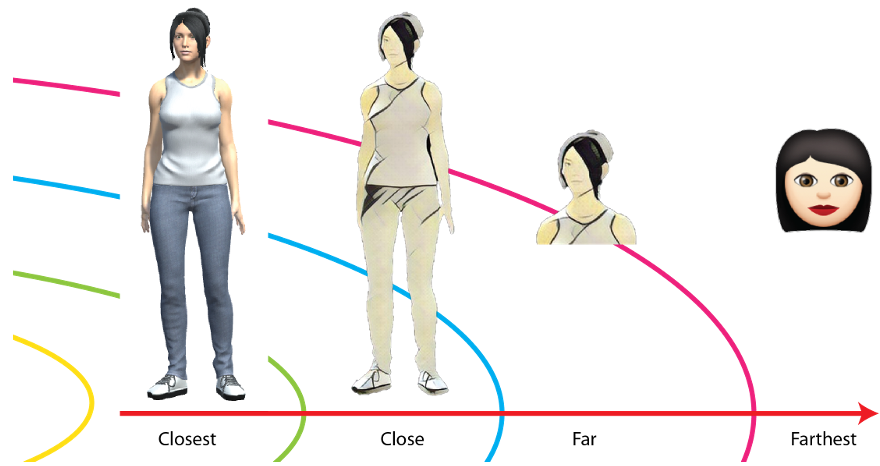
The Four Experimental Conditions
- Baseline (B): Everyone looks the same and stays at the same distance.
- Proximity (P): Distance varies, but everyone is a silhouette.
- Visual Fidelity (F): Distance is constant, but visuals vary (3D avatar vs. emoji).
- Combined (C): Both distance and visuals change based on the relationship.

Why This Works: The Intuition of "Depth"
The research suggests that humans have a natural "inner circle." By mapping this psychological reality to the 3D space of AR, the interface becomes an extension of our natural social instincts. When the researchers allowed users to "tap and drag" an avatar from a distant circle to a near one, the avatar's visual fidelity automatically upgraded (e.g., from an emoji to a 3D character), providing immediate visual feedback on a change in social status.
Experiments & Results
The focus group and user study yielded clear insights:
- Filtering is Essential: Users found it significantly easier to navigate their social network when filtering was applied.
- Combined Method Wins: The combination of proximity and visual fidelity was the most effective. It matches our cognitive expectations: important people "loom larger" and are more "vivid" in our minds.
- Usability: The use of HoloLens Spatial Mapping to ground these circles in the physical environment made the virtual contacts feel like they belonged in the real world.
Critical Analysis & Future Outlook
While this 2017 study laid the groundwork, it has limitations. The representations were relatively static. With today's GenAI and real-time Telepresence (like Apple's Personas), we could see "Visual Fidelity" evolve from static 3D models to high-fidelity "spatial videos" for intimate contacts.
Key Takeaway: The future of Social AR isn't just about where people are, but who they are to us. By using spatial distance as a proxy for social intimacy, we can create Mixed Reality environments that feel human-centric rather than data-centric.
Future Work: The authors suggest exploring "miniature avatars" on nearby surfaces (tabletop AR) and investigating how these representations affect interaction with remote users versus those physically present in the room.