
Beyond Volume: Enhancing Network Centrality via Bi-Criteria Flow Optimization
8761_Modeling centrality measures in social network analysis using bi-criteria network flow optimization problems.
The paper introduces a new family of centrality measures for Social Network Analysis (SNA) by modeling information transmission as a bi-criteria network flow optimization problem. The core method, termed Bi-Objective Integer Network Flow (BOINF), simultaneously maximizes flow capacity and minimizes communication costs to identify structural prominence in directed, valued graphs.
TL;DR
Determining "who is important" in a network usually depends on who can send the most information (Flow). However, this paper argues that volume isn't everything—efficiency (Cost) matters just as much. By leveraging Bi-Objective Integer Network Flow (BOINF), the authors redefine centrality as a balance between maximizing throughput and minimizing communication "costs" (intermediaries), providing a sophisticated lens for analyzing complex social structures like political hierarchies.
The "Missing Dimension" in Network Analysis
In classical Social Network Analysis (SNA), measures like Betweenness and Closeness are often reduced to a single number. While Freeman’s flow-based measures added the ability to handle valued graphs, they remained blind to communication overhead.
The Problem: Imagine two nodes, A and B. Both can send 10 units of info to a target. However, Node A sends it directly, while Node B requires five intermediaries. Classical flow analysis treats them as equal. The authors argue this is a fundamental flaw for real-world applications—from government lobbying to tracking viral outbreaks—where every "hop" increases cost, risk, or delay.
Methodology: Flow vs. Cost
The paper shifts the paradigm from a single-objective search for "max flow" to a multi-objective search for Pareto optimal solutions.
The Bi-Objective Framework
The model evaluates every pair of nodes based on two conflicting goals:
- Maximize Flow (): Total information volume.
- Minimize Cost (): Total distance or sum of unit costs across arcs.
Instead of a single score, each node interaction results in a Set of Non-Dominated (ND) Vectors. To handle these sets, the authors introduced unique mathematical operations:
- Lexicographic Ordering: A way to rank sets of vectors.
- Set Summation (): Combining the influence of a node over multiple targets while preserving the flow-cost trade-off.
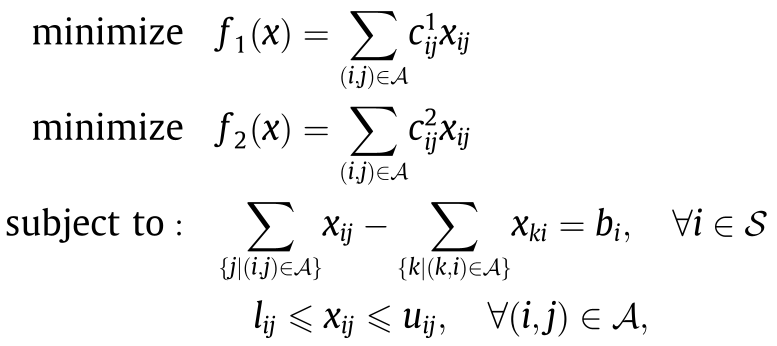 The objective functions for minimizing the two criteria: flow (transformed) and cost.
Case Study: Analyzing the Iranian Government
The authors put their theory to the test by analyzing the influence of senior Iranian leaders over various government bodies (Council of Guardians, Executive Branch, etc.).
The Discovery
Using classical flow analysis, leaders like Mohammad Khatami and Nategh Nouri appeared to have identical influence over the Council of Expediency. However, the bi-criteria model revealed that Khatami required more intermediaries (higher cost) to exert the same volume of influence as his peers.
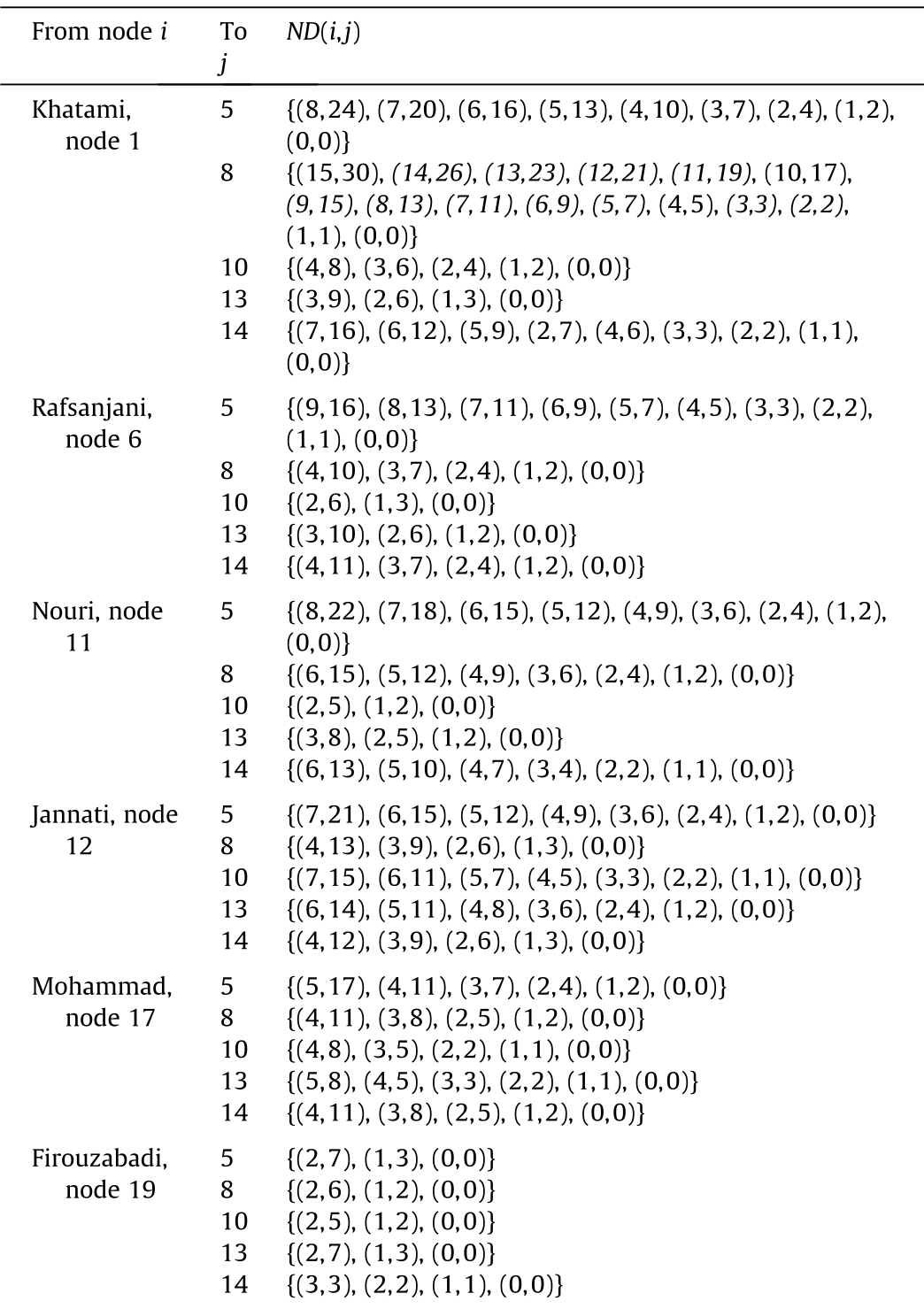 Experimental results showing the ND sets for different Iranian leaders. Note how the sets allow for detailed discrimination beyond a single integer.
Critical Analysis & Professional Insight
The brilliance of this work lies in its Inductive Bias: it assumes that in human systems, efficiency is a form of power. By using Pareto sets, the authors avoid the pitfalls of "Amalgamation" (where different dimensions are squashed into one unit using arbitrary weights).
Limitations
- Computational Complexity: Solving Bi-Objective Integer Network Flow (BOINF) is significantly more taxing than standard Max-Flow, potentially limiting its use in massive graphs like Twitter or Facebook.
- Interpretation: While mathematically rigorous, "sets of vectors" are harder for non-technical policymakers to interpret compared to a simple 0-100 score.
Conclusion
This paper serves as a bridge between Operations Research (OR) and Sociology. It elevates Flow Closeness and Flow Betweenness from academic curiosities to robust tools for strategic analysis. By explicitly modeling the cost of communication, it provides a much-needed reality check for how we define "importance" in an increasingly complex and tiered social world.
Future Work: The next frontier will likely involve applying this bi-criteria framework to Stochastic Networks, where capacities and costs are not fixed but probabilistic.