
Type and Leak Your Ethnicity: The Hidden Privacy Risk in Your Smartphone's Accelerometer
8837_Type and Leak Your Ethnicity on Smartphones.
This paper introduces a novel side-channel attack on Android smartphones that infers user identity and ethnicity by analyzing accelerometer and gyroscope data during soft keyboard typing. Using a Random Forest classifier and specialized signal processing, the study achieves an 86.62% accuracy in identifying Chinese nationality based on specific keystroke patterns.
TL;DR
Researchers have discovered a new side-channel attack that can identify your ethnicity with over 86% accuracy simply by "listening" to the vibrations your fingers make on a smartphone screen. Using an Android app called Sensor-Reader and a Random Forest algorithm, the study proves that motion sensors—which require no special permissions—leak far more than just how much you move; they leak who you are.
The "Zero-Permission" Problem
Most users are cautious about granting apps access to their Camera, Microphone, or GPS. However, motion sensors like the accelerometer and gyroscope are frequently classified as "low-risk" by Android and iOS.
The authors argue this is a major security oversight. When you tap a virtual key, the impact creates a subtle but distinct vibration. Because every individual has a unique hand size, grip strength, and finger length, these vibrations act as a "biometric signature." This paper pushes the boundary further, asking: Do these signatures cluster by nationality?
Methodology: How the Attack Works
The researchers built a pipeline that transforms raw motion data into a classification engine.
1. Data Collection
Using an HTC One A9s, the team collected data from 6 users (3 Chinese nationals, 3 non-Chinese). Users typed a specific set of 114 words while standing and holding the phone with their right hand.
2. Feature Engineering
For every single tap, the system captures 3 points in time (before, during, and after the hit) across three axes (X, Y, Z). They then calculate:
- Statistical Basics: Min, Max, Mean, Median.
- Dispersion & Shape: Standard Deviation and Skewness (to measure the asymmetry of the impact).
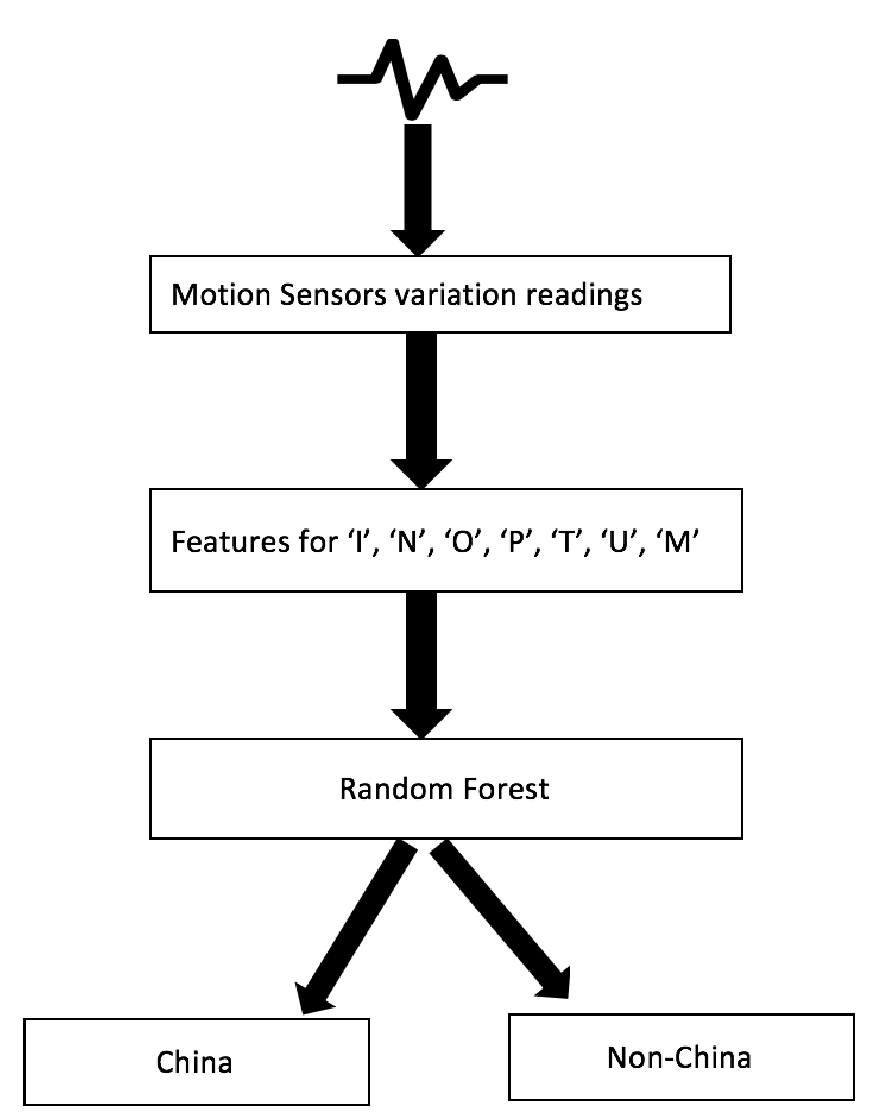 Fig. 1: The system architecture showing the flow from raw sensor data to Random Forest classification.
Key Insight: The "Diagnostic" Characters
One of the paper's most fascinating findings is that not all keys are equal. The researchers discovered that seven specific characters—I, N, O, P, T, U, and M—are the "smoking guns" for ethnicity detection.
By focusing only on these characters, the model's accuracy for identifying Chinese ethnicity jumped significantly. This suggests that the linguistic structure of a user's native tongue or the frequency of certain letter combinations influences the physical mechanics of how they reach for specific areas of the screen.
Results: Fingerprints on the Screen
The performance of the Random Forest model was remarkably high:
- User Identification: 97.67% Accuracy (effectively identifying a specific individual).
- Ethnicity Inference: 86.62% Accuracy (using the filtered character set).
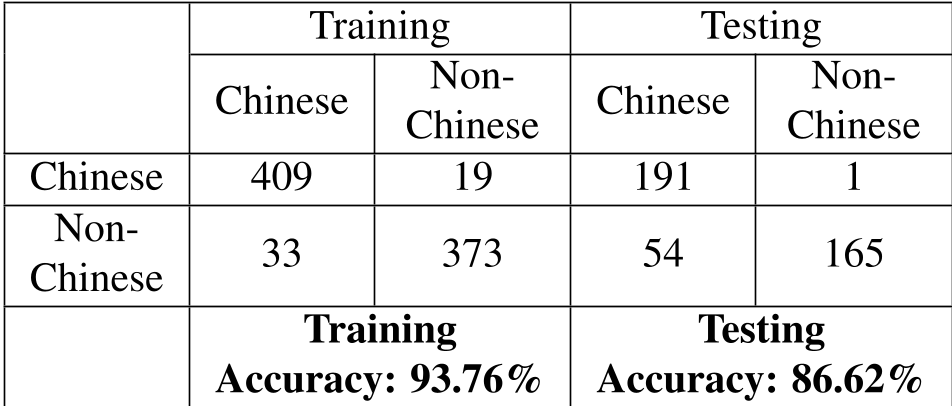 Table 1: Confusion matrix showing the model's performance on Chinese vs. Non-Chinese classification.
Critical Analysis & Future Outlook
Why it Works
The "Why" likely lies in anthropometry. Variations in the average finger length and hand-span across different ethnic populations, combined with learned typing behaviors from different native languages, create a distinct physical "echo" on the device's chassis.
Limitations
- Sample Size: The study was limited to 6 participants. While the results are statistically significant for a preliminary study, a larger, more diverse cohort is needed to generalize the findings across other ethnicities.
- Controlled Environment: The users were standing and using one hand. Real-world typing (while walking or laying down) would introduce significant noise.
Conclusion
This research is a wake-up call for mobile privacy. It proves that seemingly "dumb" sensors can be used by malicious actors or aggressive advertisers to build demographic profiles without the user ever knowing. As we move toward 2026, the industry must reconsider the "open" nature of motion sensors to prevent this type of demographic leakage.