
Precise Digital Twins: Evolution of Pole-Like Object Modeling via 3-D Divergence Analysis
9009_Part-Based Modeling of Pole-Like Objects Using Divergence-Incorporated 3-D Clustering of Mobile Laser Scanning Point Clouds.
This paper introduces a robust framework for the automated extraction and part-based modeling of Pole-Like Objects (PLOs) such as trees, street lamps, and traffic signs from Mobile Laser Scanning (MLS) point clouds. The core methodology leverages a novel Divergence-Incorporated 3-D Clustering for trunk detection and an adaptive growing strategy for canopy extraction, achieving high-precision modeling for 3-D digital cities.
Executive Summary
TL;DR: This research tackles the dual challenge of accurate extraction and efficient rendering of Pole-Like Objects (PLOs) in urban MLS data. By replacing simple density filters with a 3-D statistical divergence check and implementing an "alternate-growth" canopy search, the authors achieve SOTA trunk extraction (98%+) while maintaining high visual fidelity through a voxel-based "part-based" modeling approach.
Positioning: This work moves beyond traditional 2-D projection-based clustering, placing itself as a "Geometric-Statistical" hybrid that bridges raw point cloud processing and high-speed 3-D engine rendering (Unity3D).
Problem & Motivation: The "Cylinder-Lookalike" Trap
In dense urban environments, extracting a "pole" is harder than it looks. Previous methods relied on 2-D density: if you project points onto a flat plane and see a dense cluster, you assume it's a trunk. However, pedestrians, sculptures, and drooping branches often create "phantom poles" in 2-D.
Furthermore, the Inhomogeneity of LiDAR scans (where density drops as the vehicle moves away) often causes standard region-growing algorithms to fail, leaving trees with "shattered" or partial canopies.
Methodology: The Core Innovations
1. Divergence-Incorporated Clustering
Instead of just counting points, the authors treat the trunk as a probability distribution. They use the Kullback–Leibler (K-L) divergence to measure the entropy between the actual point distribution in vertical "buckets" and an ideal cylindrical distribution.
- Physical Intuition: A real trunk has a consistent vertical profile. A pedestrian or a bush is "messy"—its divergence value () will soar, allowing the system to discard it even if its 2-D density is high.
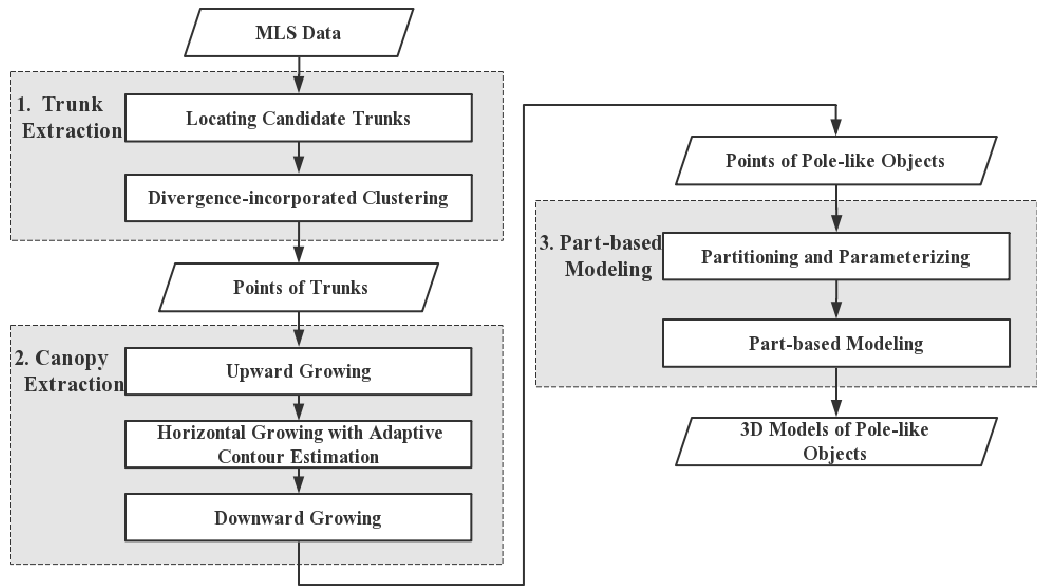
2. Adaptive Growing Strategy
To solve the "missing canopy" problem, the authors propose a three-step dance:
- Upward Growing: Searching the immediate 9-neighbors above the seeds.
- Horizontal Extension: Estimating the "contour" (center and radius ) of a layer and grabbing points within that radius, even if they aren't touching! This "strides" over gaps.
- Downward Growing: Capturing drooping branches that hang below the main canopy junction.
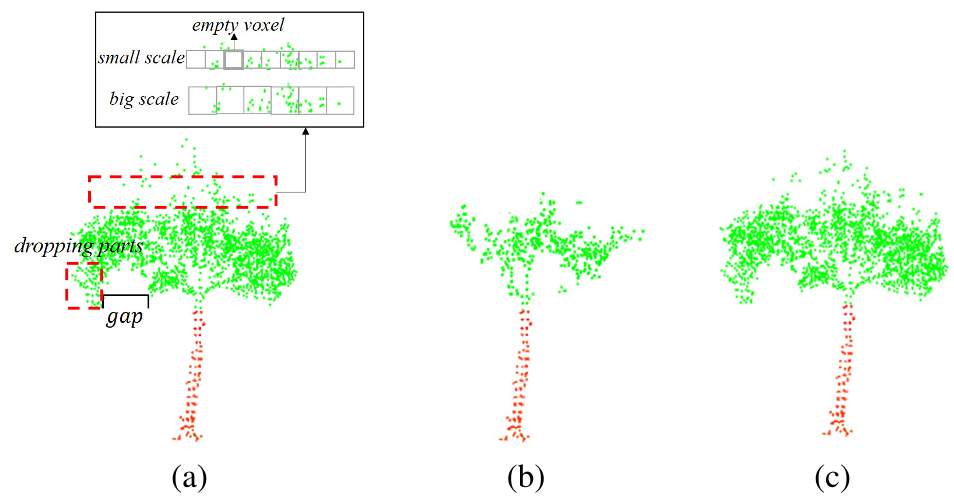
3. Part-Based Modeling
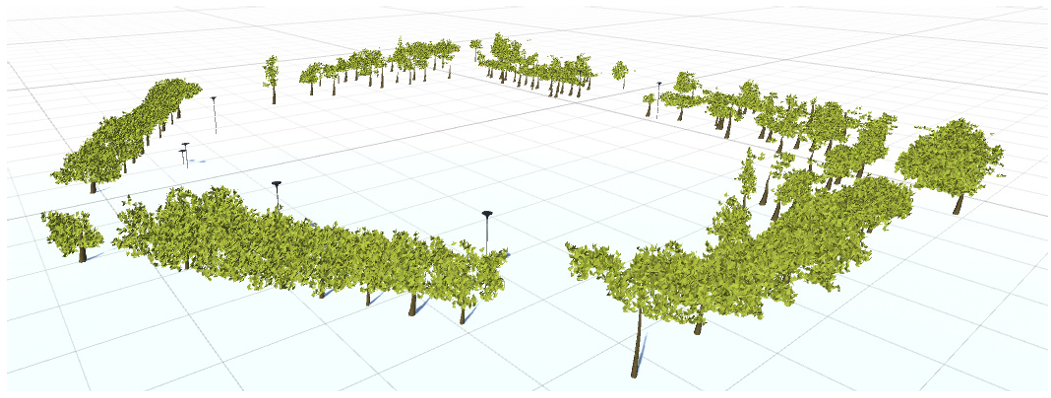
To balance vividness and performance, the model treats the PLO as a modular assembly.
- Trunks are replaced by parameterized primitive cylinders (saving memory).
- Canopies are converted into voxels filled with "miniature leaf models." This allows for a 39x reduction in raw point counts with minimal loss in visual quality.
Experiments: Performance at Scale
The method was stress-tested on three datasets, including the high-complexity IQmulus Paris dataset.
- Trunk Accuracy: The divergence-incorporated approach outperformed 2-D density-based methods by over 20% in precision, successfully filtering out pedestrians and combinational clusters.
- Canopy Completeness: Achieved ~80-90% completeness, whereas previous voxel-neighbor methods often stalled at ~25-40% due to canopy gaps.
| Metric | Dataset A (Low Density) | Dataset B (High Density) | Dataset C (Paris Complex) |
|---|---|---|---|
| Trunk Precision | 98.45% | 98.08% | 92.39% |
| Canopy Completeness | 80.54% | 89.84% | 89.29% |
| Time per PLO | 0.011s | 0.038s | 0.063s |
Critical Analysis & Conclusion
Takeaway
The shift towards statistical geometry (K-L divergence) is the standout contribution. It treats point cloud "noise" not as an error to be filtered, but as a distribution to be measured. The part-based modeling approach provides a pragmatic blueprint for real-time digital twin rendering.
Limitations
- Occlusion: Deeply occluded trunks (hidden by walls or buses) remain undetectable.
- Tilt: The current modeling assumes verticality; "leaning" trees are rendered as vertical, slightly reducing morphological accuracy.
- Intertwined Objects: As noted in Figure 24, when a street lamp is physically touching a lush tree, the algorithm occasionally merges them into a single "meta-tree."
Future Outlook
Integrating Multi-Modal Data (fusing MLS with 2D RGB panoramic images) could resolve the intertwined object issues by providing semantic color cues to separate "green" leaves from "metal" lamp posts.